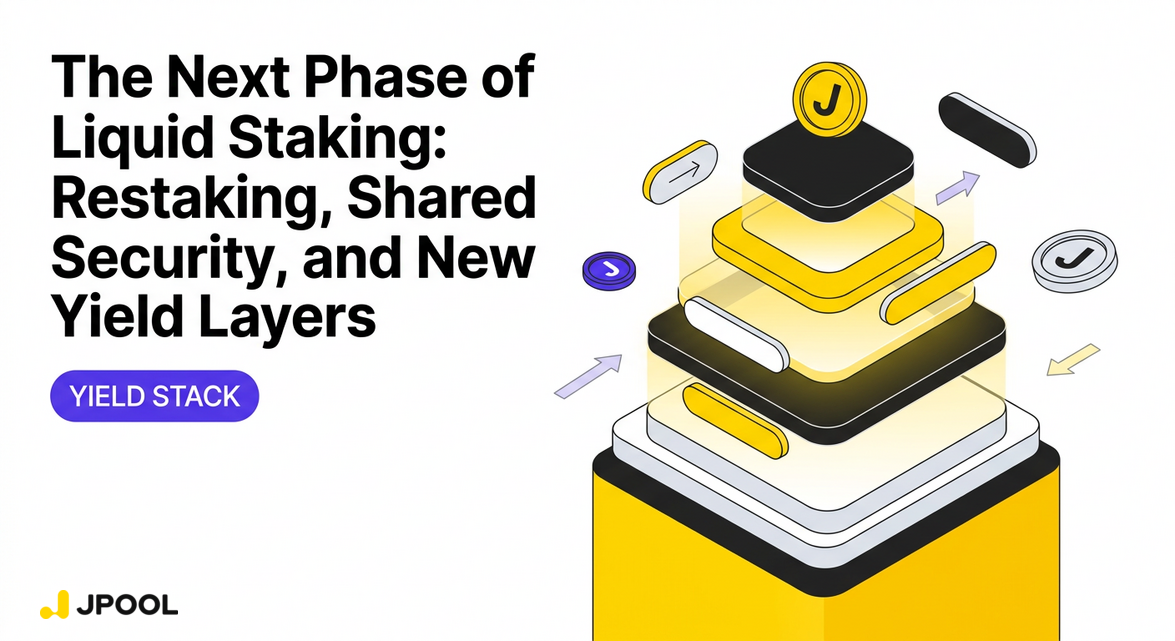
Crypto staking has matured well beyond its original premise. In its earliest form, staking meant locking tokens to earn a single stream of network rewards — a straightforward trade of liquidity for yield. That model is no longer the ceiling. Today, liquid staking tokens have become programmable financial instruments, and the most sophisticated participants in Solana liquid staking are no longer asking “what is my staking APY?” — they are asking “how many yield layers can I stack on a single position?”
Table of Contents
- From Single-Stream to Multi-Layer: Why the Old Mental Model Is Obsolete
- Layer 1: The Base — Validator Performance Yield
- Layer 2: DeFi Composability — Collateral and Liquidity Provision
- Layer 3: Leveraged Staking — Amplifying the Base with Flash Loans
- Layer 4: Ecosystem Rewards — The JPool Holders Club
- The Yield Stack in Practice: A Decision Framework
- Shared Security and Restaking: The Emerging Frontier
- Conclusion: Yield Is No Longer a Single Number
This guide maps the architecture of that stack: what each layer is, how it works on Solana, and how JSOL is specifically designed to participate in each one.
From Single-Stream to Multi-Layer: Why the Old Mental Model Is Obsolete
The foundational assumption of early crypto staking was simple: stake → earn rewards → unstake. Liquidity was the sacrifice you made for yield. Liquid staking tokens broke that constraint — as covered in our guide to redemption liquidity, the ability to redeem or trade an LST at any time fundamentally changed the risk profile of staking.
But the more consequential shift is less discussed: because JSOL is a standard Solana token, it can simultaneously serve as collateral, a liquidity pool asset, a leveraged staking instrument, and an ecosystem reward-earning unit — all while the underlying SOL remains staked and compounding. The yield is no longer a single number. It is a stack.
Understanding that stack — and how to navigate it deliberately — is what separates passive stakers from strategic ones.
Layer 1: The Base — Validator Performance Yield
Every JSOL position begins here. When SOL is staked through JPool, the Smart Delegation Strategy allocates it across a curated set of validators evaluated on performance metrics including current APY, multi-epoch APY averages, stake concentration, and infrastructure diversity scores. The Validators.app score and Smart Validator Toolkit (SVT) adoption are also factored in.
The result is that the SOL-per-JSOL exchange rate increases each epoch, automatically compounding staking rewards into the token’s value. No claiming, no manual action required.
This base layer is the foundation everything else is built on — but it is only Layer 1. The complete mechanics of Solana staking yield, including MEV and priority fees, are covered in detail elsewhere. The strategic question here is: what do you do with JSOL once you hold it?
Layer 2: DeFi Composability — Collateral and Liquidity Provision
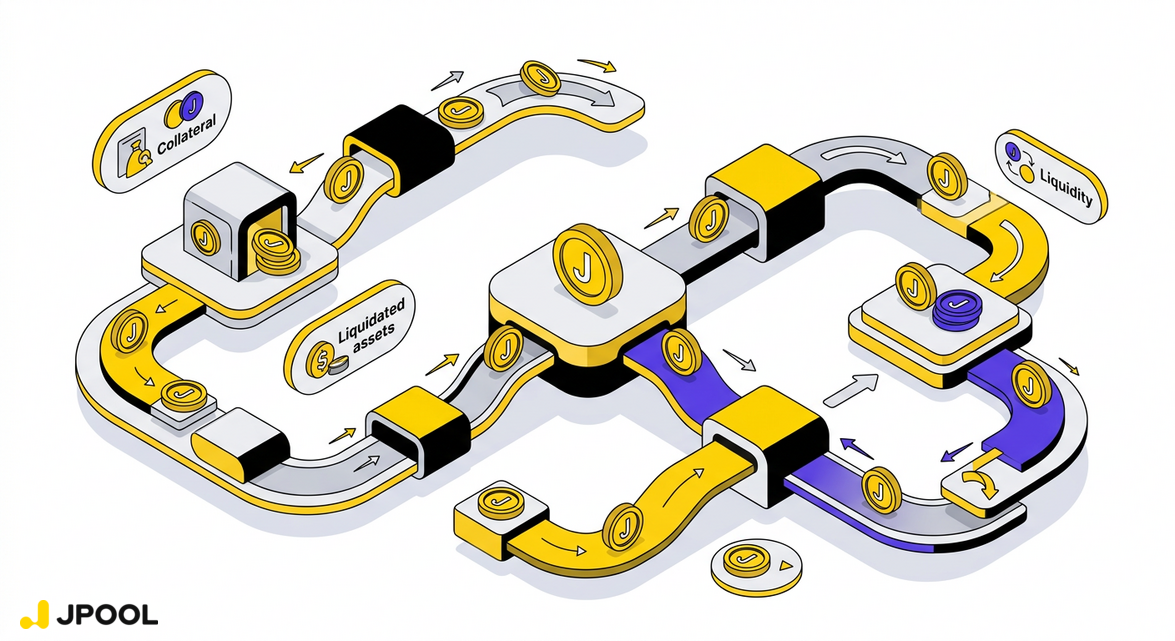
Because JSOL is a standard token, it can be deployed across Solana’s DeFi ecosystem while the underlying stake continues to accrue rewards. JPool’s documentation identifies two primary DeFi use cases:
- Lending platform collateral: JSOL can be deposited to lending platforms as collateral to borrow against, generating additional yield or unlocking capital without exiting the staking position. The underlying SOL keeps compounding; the JSOL collateral earns the lending platform’s supply rate simultaneously.
- Liquidity pool provision: JSOL can be provided as liquidity to liquidity pools, earning trading fees on top of base staking yield. This is a direct second income stream running in parallel to the staking rewards embedded in the token’s exchange rate.
The key insight is simultaneity. Unlike traditional staking where deploying capital in DeFi means unstaking first, JSOL holders never have to choose between staking yield and DeFi yield — both run concurrently. This is the core value proposition of composability in Solana liquid staking, and it is what makes liquid staking tokens structurally different from locked native stake.
The security architecture enabling this — specifically why JSOL can be trusted as collateral — is grounded in JPool’s use of the audited Solana Labs Stake Pool Program, detailed in our SPL vs. proprietary contracts analysis.
Layer 3: Leveraged Staking — Amplifying the Base with Flash Loans
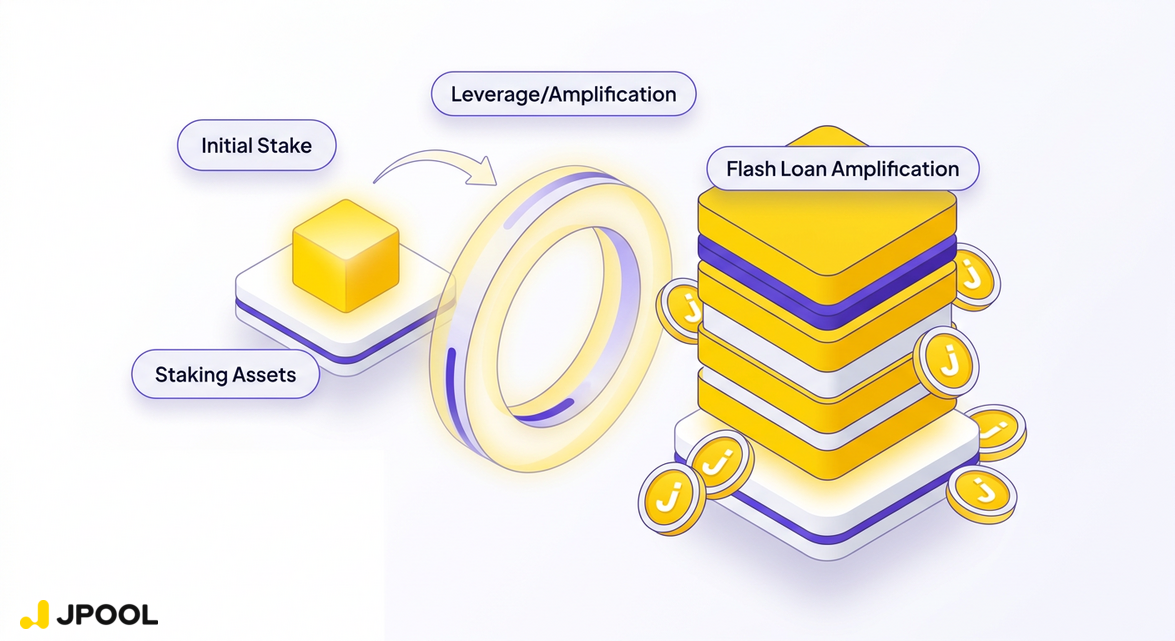
JPool’s Leveraged Staking is the most mechanically sophisticated yield layer currently available on the platform, and it operates in a way that most users do not fully understand.
Here is exactly how it works, step by step:
- Flash loan initiation: When a user selects a leverage multiplier, JPool takes out a flash loan to instantly provide the extra SOL needed for leverage. This is a temporary loan that must be repaid within the same transaction — it is never an open debt position at this stage.
- Combined staking: The user’s original SOL and the flash-loaned SOL are staked together to the chosen validator through JPool’s Direct Staking mechanism. The full combined amount earns staking rewards.
- JSOL minting and collateral deposit: JPool mints JSOL representing the full amplified stake and immediately deposits it as collateral on a lending platform (currently Save or Kamino).
- SOL borrow against collateral: Using the JSOL collateral, JPool borrows fresh SOL from the lending platform up to the allowed Loan-to-Value (LTV) ratio.
- Flash loan repayment: The user’s initial SOL and part of the borrowed SOL are used to repay the flash loan within the same transaction. The entire sequence is atomic — it either completes fully or reverts entirely.
The result: the user holds a leveraged staking position with amplified JSOL collateral and an outstanding SOL loan. The yield differential — staking APY on the amplified stake minus the borrow APR on the loan — is the Leverage APY. For example, with a 2.5× leverage multiplier, a hypothetical staking APY, and a hypothetical borrow APR, a 100 SOL position effectively stakes 250 SOL, earning net yield on the spread between the two rates.
The risk dimension is real and must be understood. The Health Factor (HF) and Loan-to-Value (LTV) indicators govern position safety. If borrow rates exceed staking APY for a sustained period, LTV rises and HF falls. If HF drops below 1.0, the lending platform can liquidate part of the JSOL collateral to cover the loan. JPool provides Telegram-based alerting for LTV thresholds to help users monitor this in real time. In practice, JPool notes that liquidation would require an extreme and prolonged scenario, but the risk is not zero.
This layer is not appropriate for all users. It is a tool for those who have understood the base layer thoroughly and are prepared to actively monitor position health.
Layer 4: Ecosystem Rewards — The JPool Holders Club
The fourth yield layer operates entirely outside the on-chain staking and DeFi mechanics — and is frequently overlooked in yield calculations.
The JPool Holders Club is a tiered membership program that rewards JSOL holders with JPoints, the ecosystem’s reward units. JPoints are earned through:
- Simply holding JSOL — passive accumulation proportional to holdings
- Using JSOL with JPool’s DeFi partners — rewarding the composability behavior described in Layer 2
- Completing social tasks and referrals — ecosystem participation rewards
Membership tier is represented by an NFT-based membership card issued by Albus Protocol, which tracks JPoint balance and tier status. As users advance through tiers, they unlock increasing reward levels. Boosters — multipliers that accelerate JPoints accumulation — can be earned through specific staking activities and DeFi partner engagement.
The strategic implication: a user deploying JSOL in DeFi (Layer 2) is simultaneously earning Holders Club JPoints for that activity. The layers are not independent — they reinforce each other. Deploying JSOL as LP liquidity earns trading fees and JPoints. The ecosystem is designed so that deeper engagement compounds across multiple reward dimensions at once.
The Yield Stack in Practice: A Decision Framework
For users approaching Solana liquid staking strategically, the question is not which single layer to use — it is which combination of layers matches their risk tolerance and time commitment.
| Layer | Mechanism | Risk Level | Active Monitoring Required? |
|---|---|---|---|
| Layer 1: Base Staking | Validator performance via Smart Delegation | Low | No |
| Layer 2: DeFi Composability | LP provision or lending collateral | Low–Medium | Minimal |
| Layer 3: Leveraged Staking | Flash loan amplification via Direct Staking | Medium–High | Yes (LTV/HF) |
| Layer 4: Ecosystem Rewards | JPoints via Holders Club | Low | No |
A conservative user maximizes Layers 1 and 4 with minimal effort. An intermediate user adds Layer 2 by deploying JSOL to a lending platform or LP, earning an additional yield stream without active management. An advanced user activates Layer 3, accepting the LTV monitoring requirement in exchange for amplified staking yield on the spread between staking APY and borrow APR.
The architecture is designed so that each layer is opt-in and additive. No layer requires abandoning another. This is the structural advantage of liquid staking tokens over native locked stake: the position remains productive at every layer simultaneously.
Shared Security and Restaking: The Emerging Frontier
The concept of restaking — using already-staked assets to provide security guarantees to additional protocols — represents the next logical evolution of this yield stack. On other networks, restaking frameworks have demonstrated that validator stake can be committed to secure external services, creating additional yield streams for stakers who opt in.
Solana’s architecture differs from other networks in meaningful ways, and restaking on Solana is still an emerging design space. The core principle, however, is directly relevant to liquid staking token holders: if a staked asset can be used to provide cryptoeconomic security to additional protocols beyond the base layer, the yield potential of that asset expands further.
For JSOL holders, the composability foundation is already in place. JSOL’s status as a standard Solana token — tradable, usable as collateral, deployable in DeFi — means it is structurally positioned to participate in any restaking or shared security framework that emerges on Solana. The token does not need to be redesigned; the composability layer is already live.
The decentralization implications of delegation concentration become especially relevant as restaking models mature: the health of the validator set underpinning any LST directly affects the security guarantees that LST can credibly offer to downstream protocols.
Conclusion: Yield Is No Longer a Single Number
The maturation of Solana liquid staking is not primarily a story about higher APY — it is a story about yield architecture. JSOL is not a passive savings instrument. It is a composable financial primitive that can simultaneously earn base staking rewards, DeFi yields, leveraged staking spreads, and ecosystem incentives — with each layer independently opt-in and additively stackable.
The users who will capture the most value from the next phase of crypto staking are not those chasing the highest headline APY. They are those who understand the full stack, manage the risk dimensions of each layer deliberately, and position themselves in an LST infrastructure designed for composability from the ground up.
Start staking SOL and building your yield stack with JSOL at JPool. https://jpool.one/
Leave a Reply