Category: Finance

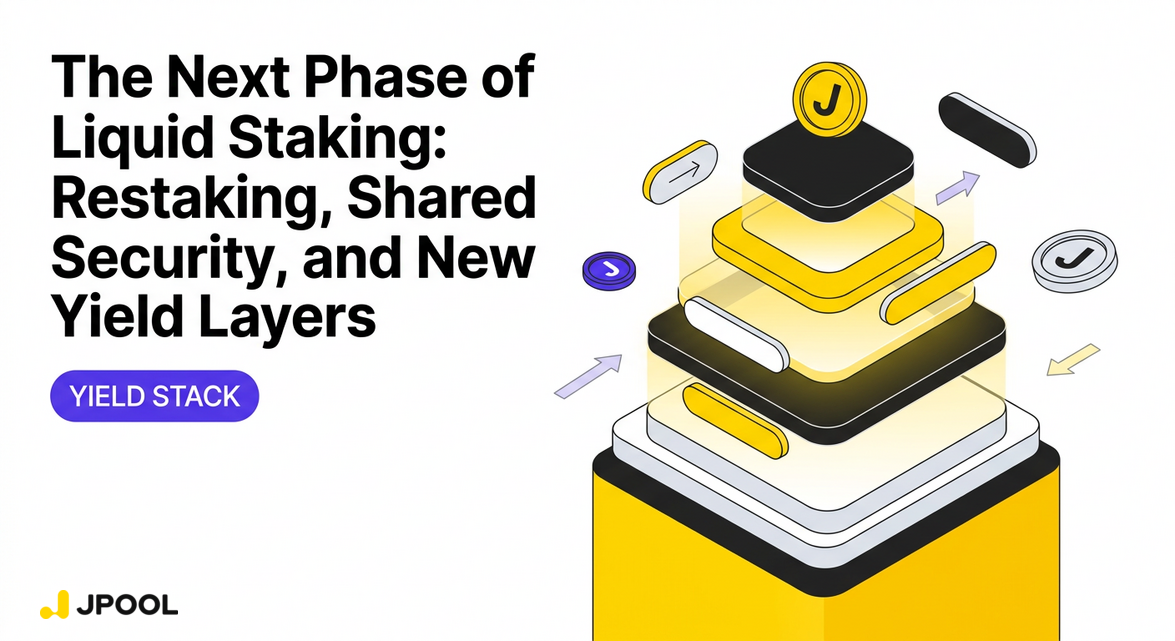
  • The Next Phase of Liquid Staking: Restaking, Shared Security, and New Yield Layers

    The Next Phase of Liquid Staking: Restaking, Shared Security, and New Yield Layers

    Crypto staking has matured well beyond its original premise. In its earliest form, staking meant locking tokens to earn a single stream of network rewards — a straightforward trade of liquidity for yield. That model is no longer the ceiling. Today, liquid staking tokens have become programmable financial instruments, and the most sophisticated participants in Solana liquid staking are no longer asking “what is my staking APY?” — they are asking “how many yield layers can I stack on a single position?”

    This guide maps the architecture of that stack: what each layer is, how it works on Solana, and how JSOL is specifically designed to participate in each one.


    From Single-Stream to Multi-Layer: Why the Old Mental Model Is Obsolete

    The foundational assumption of early crypto staking was simple: stake → earn rewards → unstake. Liquidity was the sacrifice you made for yield. Liquid staking tokens broke that constraint — as covered in our guide to redemption liquidity, the ability to redeem or trade an LST at any time fundamentally changed the risk profile of staking.

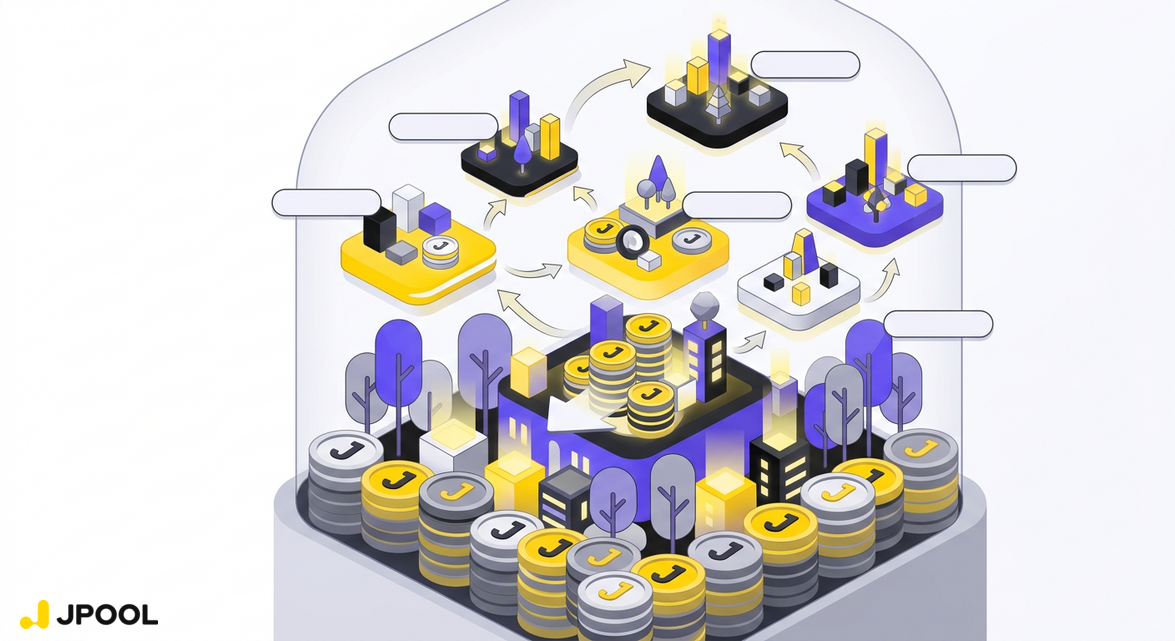
    But the more consequential shift is less discussed: because JSOL is a standard Solana token, it can simultaneously serve as collateral, a liquidity pool asset, a leveraged staking instrument, and an ecosystem reward-earning unit — all while the underlying SOL remains staked and compounding. The yield is no longer a single number. It is a stack.

    Understanding that stack — and how to navigate it deliberately — is what separates passive stakers from strategic ones.


    Layer 1: The Base — Validator Performance Yield

    Every JSOL position begins here. When SOL is staked through JPool, the Smart Delegation Strategy allocates it across a curated set of validators evaluated on performance metrics including current APY, multi-epoch APY averages, stake concentration, and infrastructure diversity scores. The Validators.app score and Smart Validator Toolkit (SVT) adoption are also factored in.

    The result is that the SOL-per-JSOL exchange rate increases each epoch, automatically compounding staking rewards into the token’s value. No claiming, no manual action required.

    This base layer is the foundation everything else is built on — but it is only Layer 1. The complete mechanics of Solana staking yield, including MEV and priority fees, are covered in detail elsewhere. The strategic question here is: what do you do with JSOL once you hold it?


    Layer 2: DeFi Composability — Collateral and Liquidity Provision
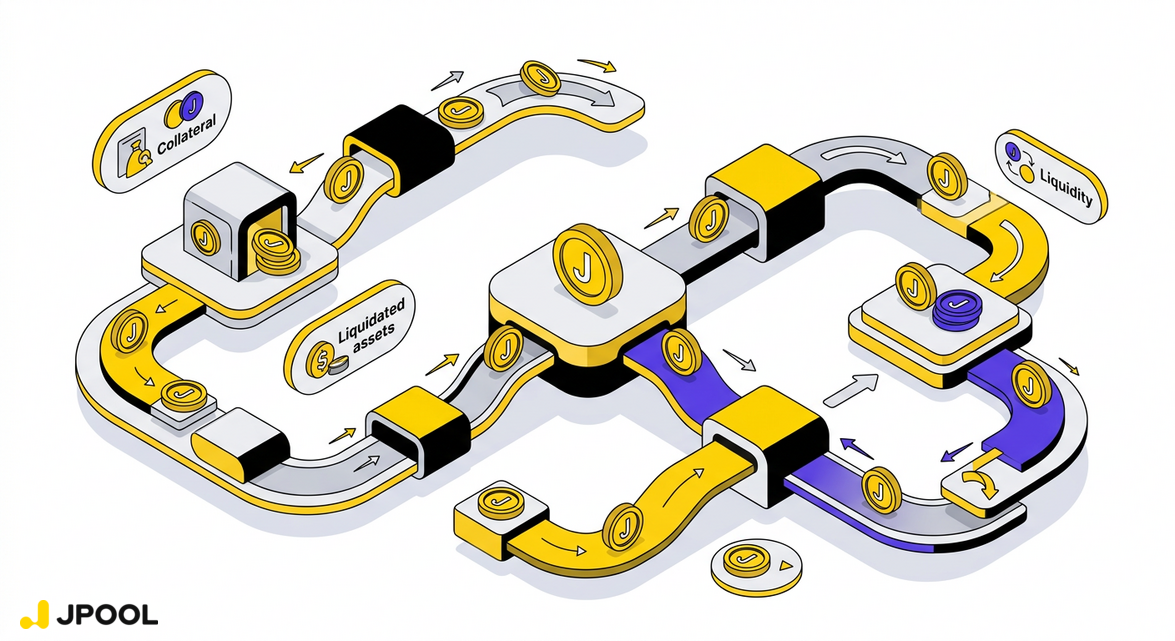
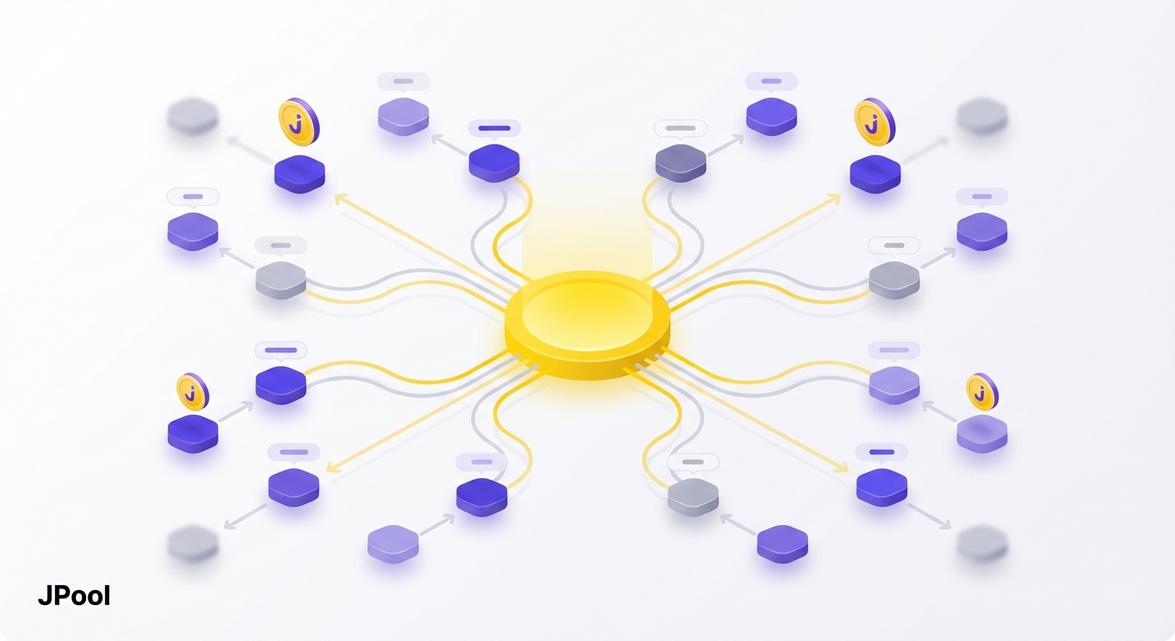
    Visualizing the concept of DeFi composability where a single asset is used in parallel streams.

    Because JSOL is a standard token, it can be deployed across Solana’s DeFi ecosystem while the underlying stake continues to accrue rewards. JPool’s documentation identifies two primary DeFi use cases:

    • Lending platform collateral: JSOL can be deposited to lending platforms as collateral to borrow against, generating additional yield or unlocking capital without exiting the staking position. The underlying SOL keeps compounding; the JSOL collateral earns the lending platform’s supply rate simultaneously.
    • Liquidity pool provision: JSOL can be provided as liquidity to liquidity pools, earning trading fees on top of base staking yield. This is a direct second income stream running in parallel to the staking rewards embedded in the token’s exchange rate.

    The key insight is simultaneity. Unlike traditional staking where deploying capital in DeFi means unstaking first, JSOL holders never have to choose between staking yield and DeFi yield — both run concurrently. This is the core value proposition of composability in Solana liquid staking, and it is what makes liquid staking tokens structurally different from locked native stake.

    The security architecture enabling this — specifically why JSOL can be trusted as collateral — is grounded in JPool’s use of the audited Solana Labs Stake Pool Program, detailed in our SPL vs. proprietary contracts analysis.


    Layer 3: Leveraged Staking — Amplifying the Base with Flash Loans
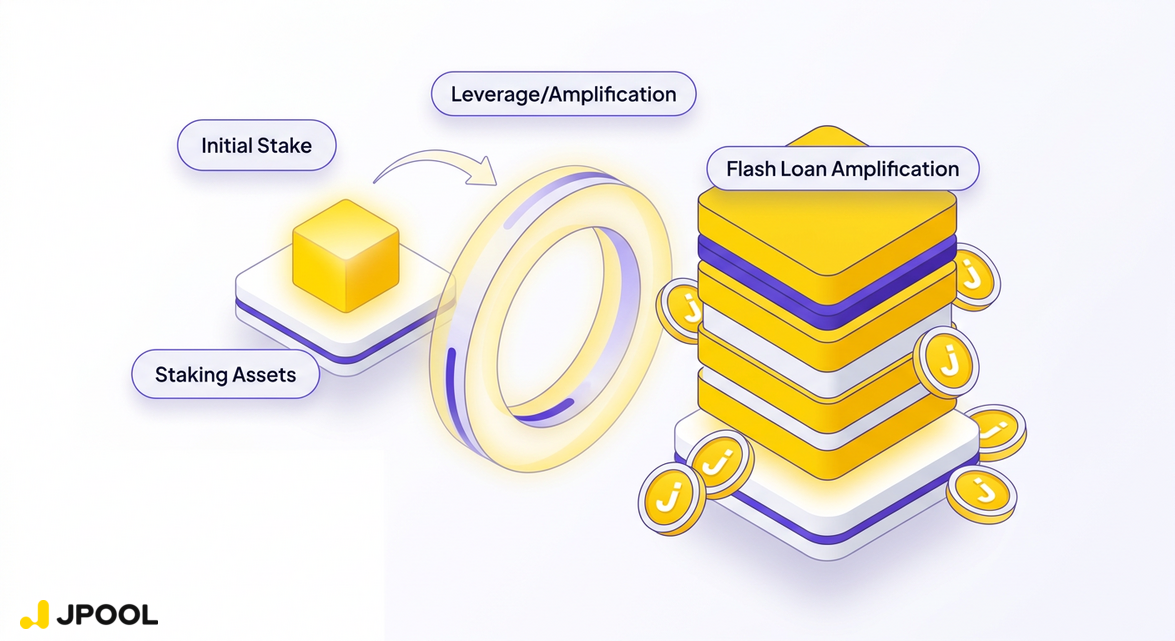
    Illustrating the mechanics of leveraged staking and flash loans amplifying a base position.

    JPool’s Leveraged Staking is the most mechanically sophisticated yield layer currently available on the platform, and it operates in a way that most users do not fully understand.

    Here is exactly how it works, step by step:

    1. Flash loan initiation: When a user selects a leverage multiplier, JPool takes out a flash loan to instantly provide the extra SOL needed for leverage. This is a temporary loan that must be repaid within the same transaction — it is never an open debt position at this stage.
    2. Combined staking: The user’s original SOL and the flash-loaned SOL are staked together to the chosen validator through JPool’s Direct Staking mechanism. The full combined amount earns staking rewards.
    3. JSOL minting and collateral deposit: JPool mints JSOL representing the full amplified stake and immediately deposits it as collateral on a lending platform (currently Save or Kamino).
    4. SOL borrow against collateral: Using the JSOL collateral, JPool borrows fresh SOL from the lending platform up to the allowed Loan-to-Value (LTV) ratio.
    5. Flash loan repayment: The user’s initial SOL and part of the borrowed SOL are used to repay the flash loan within the same transaction. The entire sequence is atomic — it either completes fully or reverts entirely.

    The result: the user holds a leveraged staking position with amplified JSOL collateral and an outstanding SOL loan. The yield differential — staking APY on the amplified stake minus the borrow APR on the loan — is the Leverage APY. For example, with a 2.5× leverage multiplier, a hypothetical staking APY, and a hypothetical borrow APR, a 100 SOL position effectively stakes 250 SOL, earning net yield on the spread between the two rates.

    The risk dimension is real and must be understood. The Health Factor (HF) and Loan-to-Value (LTV) indicators govern position safety. If borrow rates exceed staking APY for a sustained period, LTV rises and HF falls. If HF drops below 1.0, the lending platform can liquidate part of the JSOL collateral to cover the loan. JPool provides Telegram-based alerting for LTV thresholds to help users monitor this in real time. In practice, JPool notes that liquidation would require an extreme and prolonged scenario, but the risk is not zero.

    This layer is not appropriate for all users. It is a tool for those who have understood the base layer thoroughly and are prepared to actively monitor position health.


    Layer 4: Ecosystem Rewards — The JPool Holders Club

    The fourth yield layer operates entirely outside the on-chain staking and DeFi mechanics — and is frequently overlooked in yield calculations.

    The JPool Holders Club is a tiered membership program that rewards JSOL holders with JPoints, the ecosystem’s reward units. JPoints are earned through:

    • Simply holding JSOL — passive accumulation proportional to holdings
    • Using JSOL with JPool’s DeFi partners — rewarding the composability behavior described in Layer 2
    • Completing social tasks and referrals — ecosystem participation rewards

    Membership tier is represented by an NFT-based membership card issued by Albus Protocol, which tracks JPoint balance and tier status. As users advance through tiers, they unlock increasing reward levels. Boosters — multipliers that accelerate JPoints accumulation — can be earned through specific staking activities and DeFi partner engagement.

    The strategic implication: a user deploying JSOL in DeFi (Layer 2) is simultaneously earning Holders Club JPoints for that activity. The layers are not independent — they reinforce each other. Deploying JSOL as LP liquidity earns trading fees and JPoints. The ecosystem is designed so that deeper engagement compounds across multiple reward dimensions at once.


    The Yield Stack in Practice: A Decision Framework

    For users approaching Solana liquid staking strategically, the question is not which single layer to use — it is which combination of layers matches their risk tolerance and time commitment.

    Layer Mechanism Risk Level Active Monitoring Required?
    Layer 1: Base Staking Validator performance via Smart Delegation Low No
    Layer 2: DeFi Composability LP provision or lending collateral Low–Medium Minimal
    Layer 3: Leveraged Staking Flash loan amplification via Direct Staking Medium–High Yes (LTV/HF)
    Layer 4: Ecosystem Rewards JPoints via Holders Club Low No

    A conservative user maximizes Layers 1 and 4 with minimal effort. An intermediate user adds Layer 2 by deploying JSOL to a lending platform or LP, earning an additional yield stream without active management. An advanced user activates Layer 3, accepting the LTV monitoring requirement in exchange for amplified staking yield on the spread between staking APY and borrow APR.

    The architecture is designed so that each layer is opt-in and additive. No layer requires abandoning another. This is the structural advantage of liquid staking tokens over native locked stake: the position remains productive at every layer simultaneously.


    Shared Security and Restaking: The Emerging Frontier

    The concept of restaking — using already-staked assets to provide security guarantees to additional protocols — represents the next logical evolution of this yield stack. On other networks, restaking frameworks have demonstrated that validator stake can be committed to secure external services, creating additional yield streams for stakers who opt in.

    Solana’s architecture differs from other networks in meaningful ways, and restaking on Solana is still an emerging design space. The core principle, however, is directly relevant to liquid staking token holders: if a staked asset can be used to provide cryptoeconomic security to additional protocols beyond the base layer, the yield potential of that asset expands further.

    For JSOL holders, the composability foundation is already in place. JSOL’s status as a standard Solana token — tradable, usable as collateral, deployable in DeFi — means it is structurally positioned to participate in any restaking or shared security framework that emerges on Solana. The token does not need to be redesigned; the composability layer is already live.

    The decentralization implications of delegation concentration become especially relevant as restaking models mature: the health of the validator set underpinning any LST directly affects the security guarantees that LST can credibly offer to downstream protocols.


    Conclusion: Yield Is No Longer a Single Number

    The maturation of Solana liquid staking is not primarily a story about higher APY — it is a story about yield architecture. JSOL is not a passive savings instrument. It is a composable financial primitive that can simultaneously earn base staking rewards, DeFi yields, leveraged staking spreads, and ecosystem incentives — with each layer independently opt-in and additively stackable.

    The users who will capture the most value from the next phase of crypto staking are not those chasing the highest headline APY. They are those who understand the full stack, manage the risk dimensions of each layer deliberately, and position themselves in an LST infrastructure designed for composability from the ground up.

    Start staking SOL and building your yield stack with JSOL at JPool. https://jpool.one/
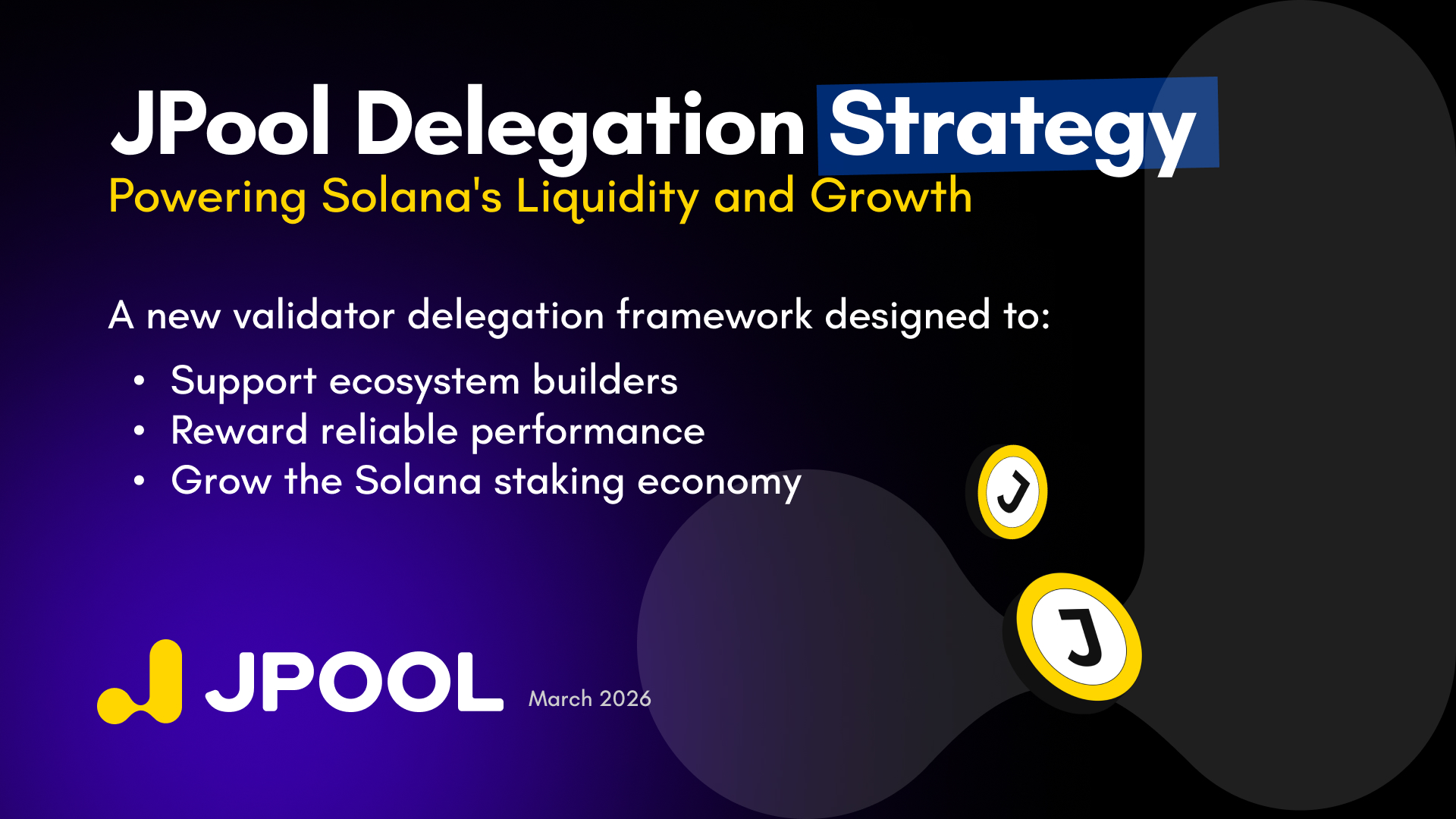
  • JPool Delegation Strategy, Powering Solana’s Liquidity and Growth

    JPool Delegation Strategy, Powering Solana’s Liquidity and Growth

    JPool Delegation Strategy

    Distributing Power, Driving Growth

    Why JPool Exists

    JPool prioritizes the long-term resilience and true decentralization of the Solana network by distributing more voting power to validators outside of the super-minority as well as directly incentivizing operators to attract more independent stake.

    While many protocols focus exclusively on maximizing APY by delegating to a limited number of nodes, we believe that true decentralization is impossible without independent
    builders and community leaders that are financially motivated to push the ecosystem forward. JPool not only supports mid range validators, but rewards them for launching new ecosystem projects and bringing more delegation to liquid staking market.

    Five Pillars

    • Fund the builders. Up to 40% of our pool allocation goes to Community Good validators – teams shipping open-source tools, DeFi protocols, developer infrastructure, and community resources that make the Solana ecosystem better for everyone.
    • Reward performers. Validators with consistently strong APY earn larger allocations through our Performance bucket. Performance is not all, but performance matters.
    • Grow liquid stake. JPool dedicates 45% of pool stake to direct delegations matching. Validators who attract external delegators and convert native stakers into liquid stakers will receive
      proportional matching. This is the single largest allocation in the pool.
    • Protect delegators. Every validator posts a JSOL bond that covers both possible security risks as well as APY shortfalls. Delegators shouldn’t pay for validators underperforming the bond system will guarantee the target APY.
    • Optimizing for Distribution. JPool maintains a strict 750K SOL stake limit per validator to keep the network balanced. Instead of over-funding a few dominant players, we distribute stake among high-performing, independent operators, ensuring a healthy and diverse validator set.

    Ecosystem growth engine

    These five pillars create a self-reinforcing cycle:

    More validators attract direct stake → more SOL flows into JSOL → deeper DeFi liquidity → JSOL becomes more useful → more stakers choose JPool → more TVL → more validator slots → broader decentralization → stronger network

    More validators attract direct stake → more SOL flows into JPool → more JSOL DeFi utility → more SOL flows into JPool

    We believe that JPool is more than simply a liquid staking pool – it has become an ecosystem growth engine that allows all players – delegators, validators, and builders, benefit from the others’ success.

    Scaling with Solana

    JPool grows its validator set linearly with TVL — 10 validators per 100K SOL. This keeps delegation meaningful (~10K SOL average per validator) while scaling decentralization as the pool grows. With the current TVL of 1.3M SOL, JPool will support 125 validators.

    No matter how large JPool gets, every validator will receive a meaningful portion of the stake.

    Who We Support

    Ecosystem Builders — validators who actively contribute to Solana’s growth by developing core infrastructure, launching innovative products, or expanding DeFi liquidity. We reward those who bring tangible value to the network – whether through technical tooling, community onboarding, or ecosystem support – with a dedicated stake allocation proportional to their impact.

    Growth-Oriented Operators – We prioritize validators who actively expand the ecosystem by attracting direct stake and facilitating the shift from native to liquid staking. JPool supports this growth by providing matching stake to those who successfully bring new liquidity and trust to the network.

    Reliable Infrastructure – Technical stability is essential for a healthy network. We allocate stake to validators who demonstrate consistent excellence through high uptime and low commission. By meeting the network’s performance benchmarks, these operators ensure that stakers receive steady, competitive rewards without compromising on decentralization.

    The Path to Growth

    Our tiers are dynamic, not static. We reward active contribution over historical status. Any validator can move into a higher-priority allocation by launching a project, increasing direct stake, or optimizing performance.

    Even if a validator doesn’t currently fit into the three main buckets, holding direct stake is enough to qualify for support. JPool provides additional “matching” stake on top of your existing direct delegations to amplify your growth and impact.

    Eligibility

    Every validator in JPool must meet baseline requirements:

    • Not on any blacklist (Solana Foundation, Jito Foundation, or internal)
    • Not in the superminority
    • Total stake under 750,000 SOL
    • Commission ≤ 10% on inflation and MEV rewards
    • Published name and avatar
    • No suspicious or poor performer flags
    • Active JSOL bond posted – minimum 1 SOL* (* soon will be replaced to JSOL)

    The Cascade: How Slots Are Allocated

    Slot Calculation: To maintain an optimal delegation balance, the total number of available slots in JPool is calculated by dividing our Total Value Locked (in SOL) by 10,000.
    We open one new validator slot for every 10,000 SOL in our Total Value Locked (TVL).

    Validator slots are allocated through a cascading priority system. Unused slots from higher-priority tiers flow down to the next:

    Priority Category Allocation, slots Who Qualifies
    1 Community Good (GS) 40% Validators with approved CG status
    2 Direct Stake (DS) 40% + CG overflow Validators with direct stake delegations
    3 Performance 20% minimum + DS overflow Top-30 APY validators (past 10-epoch average)
    • CG overflow: If there’s less CG validators than slots available, unused slots go to Direct Stake.
    • DS overflow: If there’s less DS validators than available slots, unused slots go toPerformance.
    • Performance floor: Performance always gets at least 20% of total slots — high-APY operators are never fully crowded out.

    Within each tier, validators compete on merit:

    • CG: Ranked by ecosystem impact score, then direct stake, then APY
    • DS: Ranked by direct stake size, then APY
    • Performance: Ranked by APY-30, then APY-10, then APY-3, then APY, then validator age

    How Stake Is Distributed

    Once validators earn their slots, pool stake is split into three buckets. Any unallocated remainder overflows into DS Matching, further rewarding validators who bring external stake.

    Bucket Share of Pool Stake Distribution
    Direct stake Matching 45% Proportional to direct stake
    Community Good 30% Proportional to CG impact score
    Performance 25% Proportional to performance weight

    DS Matching: Attract Stake, Get Matched

    The DS Matching bucket is the largest allocation in JPool — 45% of pool stake. Every SOL of direct stake you attract earns proportional matching from JPool.

    • In a DS slot: Full matching
    • Out of DS slot, with bond: Up to 50% matching
    • Out of DS slot, no bond: No matching

    Why this matters: JPool is the most powerful growth accelerator for Growth-Oriented Operators validators on Solana. Every delegator you attract is worth 1.5–2× more through matching — and we incentivize converting native stake to liquid stake, which deepens DeFi liquidity for the entire ecosystem.

    Community Good: Funding the Builders

    30% of pool stake flows to validators who are actively building for Solana, distributed proportionally by CG score.

    Area What We Look For
    Business model Non-commercial or free/freemium projects score highest
    Ecosystem impact Attracting developers, projects, liquidity, or users to Solana
    Open source Public code with permissive license (MIT, Apache, GPL)
    Reach Monthly active users, on-chain metrics, community size
    Visibility Media coverage, partnerships, ecosystem recognition

    CG scores (1–9) are assigned by the JPool review committee based on the validator’s ecosystem contribution. Higher score = proportionally more stake from the CG bucket. The committee evaluates:

    Criteria Points
    Basic point (monetisation)
    Non-commercial (no paid services) 3
    Free or freemium (≥50% free users) 2
    Commercial (fee / subscription) 0
    Bonus points (tracks)
    DEV +1
    PROJECTS +1
    LIQUIDITY +1
    USERS +1
    Open-source +1
    Free (MIT, Apache, GPL) +1
    1K+ MAU +1
    10K+ MAU +2
    Media coverage (Tier 1-2 level) +2

    Example: With 40 CG validators and a total score pool of 120, a validator with score 8 receives roughly 3× more CG stake than a validator with score 3.

    Performance: Rewarding Excellence

    25% of pool stake goes to validators in Performance slots, distributed by performance weight — a combination of APY strength.

    Global Cap

    No single validator receives more than 5% of pool stake as pool delegation. Excess is redistributed to validators with direct stake. This prevents concentration and ensures broad distribution.

    Examples

    Base on Epoch 935 data

    • JPool TVL = 1.5M SOL
    • Direct stake = 0.2M SOL

    Typical delegation outcomes at =1.3M SOL TVL with ~130 validators:

    Validator slot Delegation Bond Needed
    Performance slot (no direct stake; no community good; APY in top 30) 9,700 SOL 4.85 SOL
    Community good — score 4, 3,300 direct stake; APY (-0.1 lower from target APY) 19,700 SOL
    (9,400 SOL – Community Good;
    7,000 SOL – Direct stake matching;
    3,300 SOL – Direct stake)
    8.95 SOL
    Direct stake — 20,000; APY near target 63,000 SOL
    (43,000 SOL – Direct stake matching;
    20,000 SOL – Direct stake)
    31.5 SOL
    Out of slots – Direct stake 1,000 SOL APY near target 1,500 SOL
    (500 SOL – matching;
    1,000 SOL – Direct stake)
    1 SOL

    Every validator has a clear growth path: start with a Performance slot, then either build a project (→ CG) or attract delegators (→ DS) to multiply your allocation.

    Target APY & The Bond System

    How Target APY Works

    JPool calculates a Target APY – the benchmark yield guaranteed to stakers through the bond system.

    1. Take all Solana validators with total stake ≤ 750K SOL
    2. Exclude blacklisted, superminority, and low-quality validators
    3. Sort validators by past 10-epoch average APY
    4. Target APY = mean of the top 30 validators

    Recalculated every epoch (~2 days). The target reflects what the best mid-size validators on Solana are actually delivering.

    For delegators: You always earn the target APY. The bond covers any shortfall.

    For validators: Charging a commission does not disqualify you from receiving a delegation. You don’t need to match the target APY strictly through raw performance. If your actual yield falls short – whether due to your commission rate or slight technical variance – your bond simply covers the difference between the factual and target APY. This lets builders and community operators maintain their revenue models without being penalized.

    One Bond, Dual Purpose

    JPool simplifies collateral by using a single, unified bond that serves two critical functions: securing the network and guaranteeing delegation yields.

    1. Security (The Baseline)

    Purpose: Protects delegators against validator misbehavior, extended downtime, or exit risk.
    Requirement: 0.5 SOL per 1,000 SOL of your total validator JPool stake (both JPool delegation and direct delegations).
    Why total stake? By covering your full stake rather than just the pool’s allocation, this bond ensures stakers are fully protected against the total risk profile of your node.

    2. Performance (The Equalizer)

    Purpose: Covers any deficit between your factual (native) APY and the network target APY.
    Requirement: Dynamically calculated based on the size of the APY gap, your JPool delegation amount.
    The Advantage: If your native performance matches or exceeds the target APY, your performance bond requirement is strictly zero.

    Bond Health

    Your bond balance is split security-first: security bond is fully funded before any remainder goes to performance coverage.

    Health Level What Happens
    ≥ 100% Full delegation, no action needed
    80–99% Grace period starts — time to top up
    50–79% Stake cut 50%
    < 50% Suspension — delegation zeroed until replenished

    The security floor: As long as your security bond is fully funded, performance exhaustion alone can only push you down to 80% (Warning). Your delegation is safe from cuts until the security portion is actually impacted.


    Getting Into JPool

    New Validators

    • Meet baseline requirements – stake < 750K, commission ≤ 10%, published identity, no blacklist flags
    • Fund a bond – minimum 1 SOL
    • Compete for a slot – CG, DS, or Performance based on your strengths

    Community Good Applicants

    • Submit project details, metrics, and impact evidence via the CG application form
    • Review committee evaluates on a regular cycle
    • Score assigned based on the CG scoring criteria
    • Activated in the next rebalance cycle

    Direct Stake Validators

    Minimum 10 SOL direct stake to validator to qualify for a DS slot. Validators below 10 SOL still receive direct stake only and no matching. Ranking is purely by direct stake size.


    JSOL & DeFi

    JSOL is JPool’s liquid staking token – a first-class DeFi asset across Solana.

    For delegators: JSOL is listed on every major Solana DeFi platform: Jupiter, Raydium, Kamino, Orca, and many others. Your staked SOL stays liquid – use it as collateral, provide liquidity, or trade, all while earning staking yield.

    For validators: We’re building a DeFi incentive layer that rewards validators contributing to JSOL liquidity across protocols.

    For the ecosystem: More JPool TVL = more JSOL in circulation = deeper DeFi liquidity across Solana. Every SOL staked through JPool strengthens not just the validator network, but the entire DeFi ecosystem built on top of it.


    Operations

    Rebalancing

    Stake changes are gradual – no sudden large shifts:

    • Maximum 2.5% total pool change per epoch
    • Full rebalance every 2 epochs (migration period) then 5 epochs
    • Up to 10 new validators per epoch
    • Direct Stake delegation available instantly

    Hot Standby

    10 standby validators are always ready to fill any slot that opens from removal or suspension, ranked by 10-epoch APY and promoted automatically.

    Suspension & Recovery

    Bond health below 50% triggers suspension (delegation zeroed). Standard validators have 5 epochs to recover; DS-protected validators get 10 epochs. Failure to recover means permanent removal.

    Instant removal

    Instant removal triggers:

    • Commission > 10%
    • Total stake > 750K SOL
    • Blacklist
    • Superminority
    • Missing name/avatar

    Why Validators Choose JPool

    Benefit Details
    Meaningful delegation ~10,000 SOL average — significant enough to impact your economics
    DS Matching Largest matching program in Solana liquid staking — 45% of TVL
    Builder support 30% of stake reserved for Community Good projects
    Transparent Every parameter public, every decision has clear criteria
    No surprises Grace periods, warnings

    Why Delegators Choose JPool

    Benefit Details
    Guaranteed target APY Bond system covers any underperformance — you always earn the target
    Real decentralization 750K cap + broad distribution = genuine network security
    Ecosystem impact Your stake funds builders, community projects, and independent operators
    Full protection Security bond covers total validator stake — pool + direct
    Liquid & composable JSOL works across Solana DeFi – Jupiter, Raydium, Kamino, and more
    Always liquid Reserve fund ensures you can unstake when you need to

    Reserve Fund

    0.5% of TVL is reserved for unstake requests. Stakers can always withdraw.


    Resources

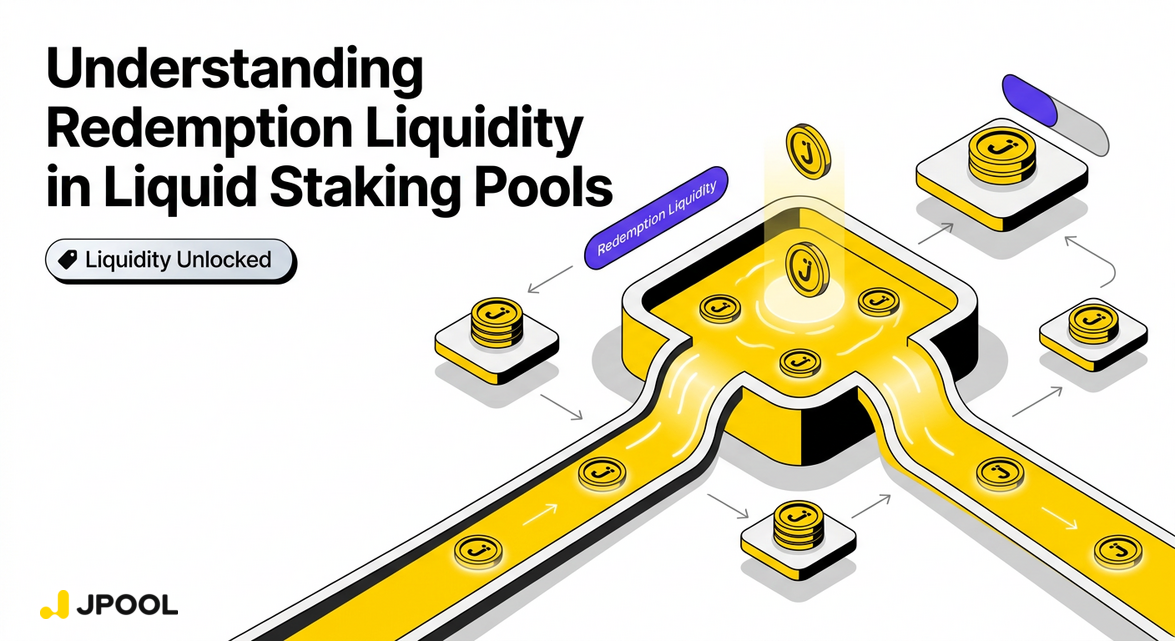
  • Understanding Redemption Liquidity in Liquid Staking Pools

    Understanding Redemption Liquidity in Liquid Staking Pools

    Most guides about Solana liquid staking focus on entry: how to stake, which validators are selected, and what APY to expect. Far fewer address the mechanics that matter most when you actually need your SOL back. Redemption liquidity — the ability to exit a staked position efficiently, at the right cost, and without surprises — is where the structural maturity of a liquid staking platform is truly tested.

    This guide maps every JSOL exit route in precise detail, surfaces the tradeoffs most users never consider until it’s too late, and gives you a decision framework to choose the right path for your situation.


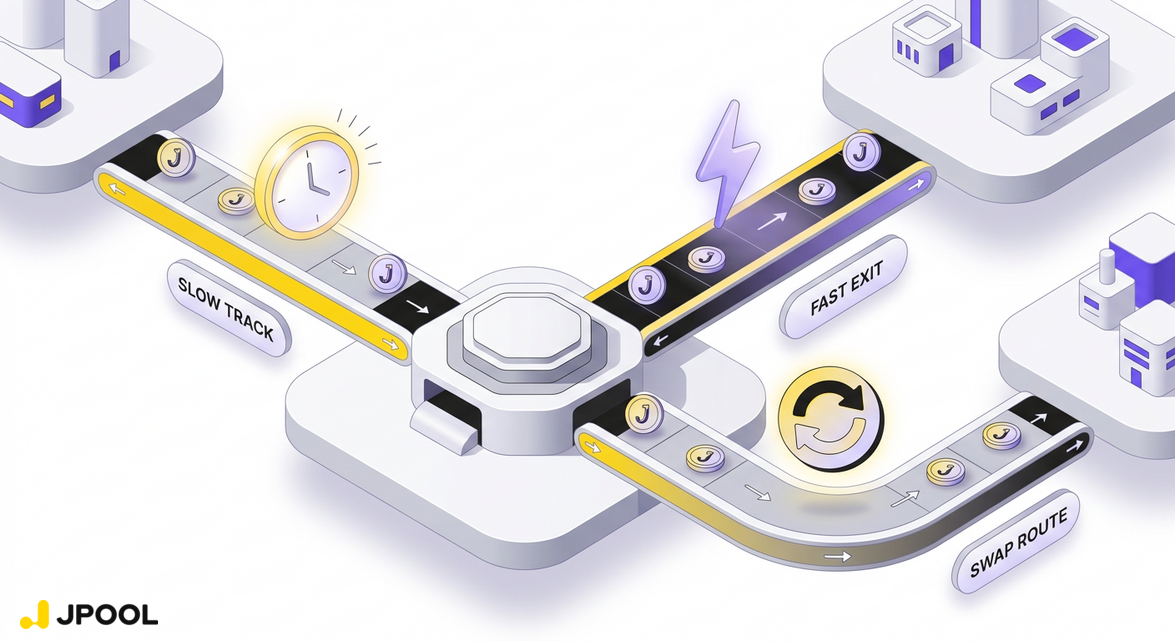
    The Three Exit Routes: Not All Redemptions Are Equal

    Visual representation of the three different exit routes for liquid staking.

    When you hold JSOL and want to convert back to SOL, JPool offers three structurally distinct paths. Understanding the mechanics of each is the foundation of any solana liquid staking redemption liquidity strategy.

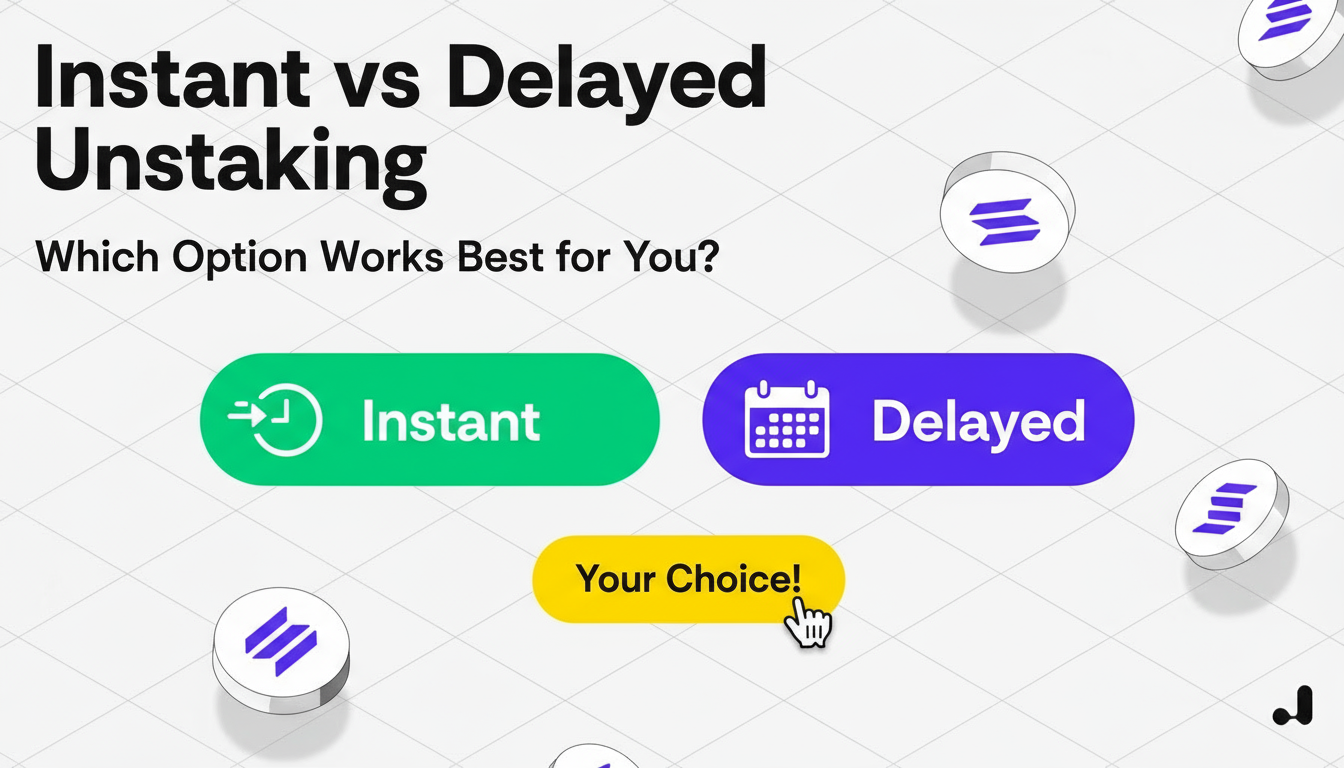
    Route 1: Delayed Unstake (Protocol-Native, Lower Fee)

    The delayed unstake route redeems JSOL directly through the JPool stake pool at the end of the current Solana epoch. The SOL you receive equals your JSOL balance multiplied by the current exchange rate, minus applicable fees. Because the pool processes this redemption at epoch boundary — when validator stake accounts are settled — no liquidity premium is charged beyond a standard, lower fee.

    The tradeoff is timing. Your wait depends entirely on where you are in the current epoch cycle: submit near the end of an epoch and SOL arrives quickly; submit at the start and you wait through the remainder of that epoch.

    Best for: Users who are not time-sensitive and want to minimize exit costs.

    Route 2: Instant Unstake (Protocol-Native, Higher Fee)

    Instant unstake allows you to receive SOL immediately by paying a higher fee. Critically, the JPool documentation explicitly states that availability “depends on pool liquidity and may involve price impact/slippage.” This is the detail most users overlook: instant unstake is not unconditionally available. It draws from the pool’s liquid reserves, and under high redemption pressure, the price impact can be meaningful.

    The SOL received still equals your JSOL balance multiplied by the current exchange rate — minus the higher fee and any applicable price impact. This route is not a free shortcut; it is a liquidity premium you pay to bypass the epoch wait.

    Best for: Users with urgent liquidity needs who accept a higher cost and understand availability is conditional.

    Route 3: DEX Swap (Secondary Market, Immediate)

    JSOL is a standard SPL token, which means it can be swapped directly on Solana DEXes for SOL without interacting with the JPool protocol at all. This route is genuinely immediate and does not depend on pool liquidity reserves. However, it introduces a different cost variable: DEX slippage, which is determined by the depth of JSOL/SOL liquidity pools on secondary markets rather than by JPool’s protocol mechanics.

    Best for: Users who need the fastest possible exit and are willing to accept market-determined slippage rather than protocol-determined fees.


    The Reserve Buffer: JPool’s Structural Liquidity Backstop

    A detail that receives almost no attention in liquid staking discussions is how a pool manages large, sudden withdrawal requests without destabilizing validator delegations.

    JPool maintains a reserve account holding 1% of total staked SOL. This reserve exists specifically to fulfill large withdrawal requests without requiring immediate unstaking from validators. If a withdrawal reduces the reserve below the 1% threshold, JPool replenishes it by proportionally reducing the stake of all participating validators. Conversely, large incoming deposits are distributed among eligible validators during the current epoch.

    This mechanism has a direct implication for redemption liquidity: the reserve acts as a first-line buffer that absorbs redemption pressure before it cascades into validator-level stake changes. For users making large redemptions, this means the pool’s structural design — not just its fee schedule — determines how smoothly your exit executes.


    The DeFi-Lock Blind Spot: When Your JSOL Isn’t Fully Redeemable

    Illustration explaining the concept of tokens being locked in DeFi protocols.

    Here is the hidden cost that catches the most users off guard.

    JSOL’s composability — the ability to use it as collateral in lending protocols, provide it to liquidity pools, or deploy it in other DeFi applications — is one of its core strengths. But composability creates a liquidity split that is invisible unless you know where to look.

    When you check your unstakable amount in JPool’s Direct Staking interface, the platform explicitly shows how many JSOL you can currently exchange back for SOL. If this amount is lower than your total stake balance, it means part of your JSOL tokens are locked in DeFi protocol(s). Those tokens are not redeemable through the protocol until they are withdrawn from the external application holding them.

    This is not a flaw — it is the expected behavior of a composable token. But it means that a user who has deployed JSOL as collateral in a lending protocol and simultaneously wants to unstake faces a two-step process: first, withdraw or deleverage from the DeFi position; second, proceed with the standard unstake flow. Treating these as a single step is the most common redemption planning error in liquid staking.


    Leveraged Positions: The Most Complex Exit Sequence

    For users in a leveraged staking position, the redemption path is structurally different from standard unstaking and deserves its own analysis. Understanding yield mechanics like MEV and validator revenue is foundational context — covered in depth in The Complete Guide to Solana Staking Yield Mechanics — but the exit sequence for leveraged positions introduces an entirely separate layer of complexity.

    When you deleverage, JPool executes an atomic flash-loan sequence within a single transaction:

    1. JPool takes a flash loan of SOL equal to your current debt on the lending platform.
    2. The flash-loan SOL fully repays your outstanding borrowed amount, freeing the locked JSOL collateral.
    3. JPool unstakes just enough JSOL to obtain the SOL required to repay the flash loan — only the portion needed.
    4. Any remaining JSOL is returned to your wallet in its de-multiplied form.

    You can deleverage completely or partially. In a partial deleverage, the same sequence executes proportionally, improving your Loan-to-Value (LTV) ratio and Health Factor without fully closing the position.

    The redemption liquidity implication here is significant: a leveraged position cannot be exited through a simple “unstake” click. The JSOL is locked as collateral on a third-party lending platform. Your effective redemption liquidity is gated by the deleverage transaction, which itself depends on flash loan availability and the lending platform’s conditions. Users who build leveraged positions should factor this multi-step exit cost into their position planning from the outset.


    Choosing Your Exit Route: A Decision Framework

    Understanding how redemption liquidity works in Solana liquid staking pools is only half the equation — knowing which path to take for your specific situation is the other half. Given the three exit routes and the two structural constraints (reserve buffer availability, DeFi-lock status), here is a practical decision framework for JSOL redemption:

    1. Step 1 — Check your unstakable amount: Before initiating any exit, confirm how much JSOL is freely redeemable versus locked in DeFi protocols. If a portion is locked, address that position first.
    2. Step 2 — Assess your time horizon: If you can wait until the end of the current epoch, the delayed unstake route delivers the lowest exit cost with full protocol-native settlement. If timing is critical, move to Step 3.
    3. Step 3 — Evaluate instant unstake availability and cost: Instant unstake is available subject to pool liquidity. Check the current fee and any indicated price impact before confirming. If the cost is prohibitive or availability is constrained, consider the DEX route.
    4. Step 4 — Compare DEX slippage against instant unstake cost: For smaller positions, DEX slippage on a well-capitalized JSOL/SOL pool may be lower than the instant unstake fee. For larger positions, the inverse may be true. The optimal route depends on position size and current market depth — neither is universally superior.
    5. Step 5 — For leveraged positions, deleverage first: Execute the deleverage transaction to release JSOL collateral before attempting any standard unstake. Partial deleverage is available if you only need to free a portion of your position.

    Why Redemption Liquidity Is the Real Measure of Platform Maturity

    Entry into a liquid staking position is trivially easy on any platform. The structural test is exit: how many routes exist, how transparent are the costs, and what happens when redemption pressure is high?

    When evaluating the best Solana liquid staking platform for liquidity, the answer lies not in headline APY but in architectural depth. JPool’s architecture addresses this through three complementary mechanisms: a dual-path protocol redemption system (instant and delayed), a 1% reserve buffer that absorbs large withdrawal requests before they impact validator delegations, and secondary market liquidity through JSOL’s DEX composability. For users in leveraged positions, an atomic flash-loan deleverage sequence provides a structured exit path that does not require manual debt management.

    Understanding these mechanics before you need them is not optional — it is the difference between an efficient exit and an expensive one.

    Explore JPool’s liquid staking strategies at jpool.one.

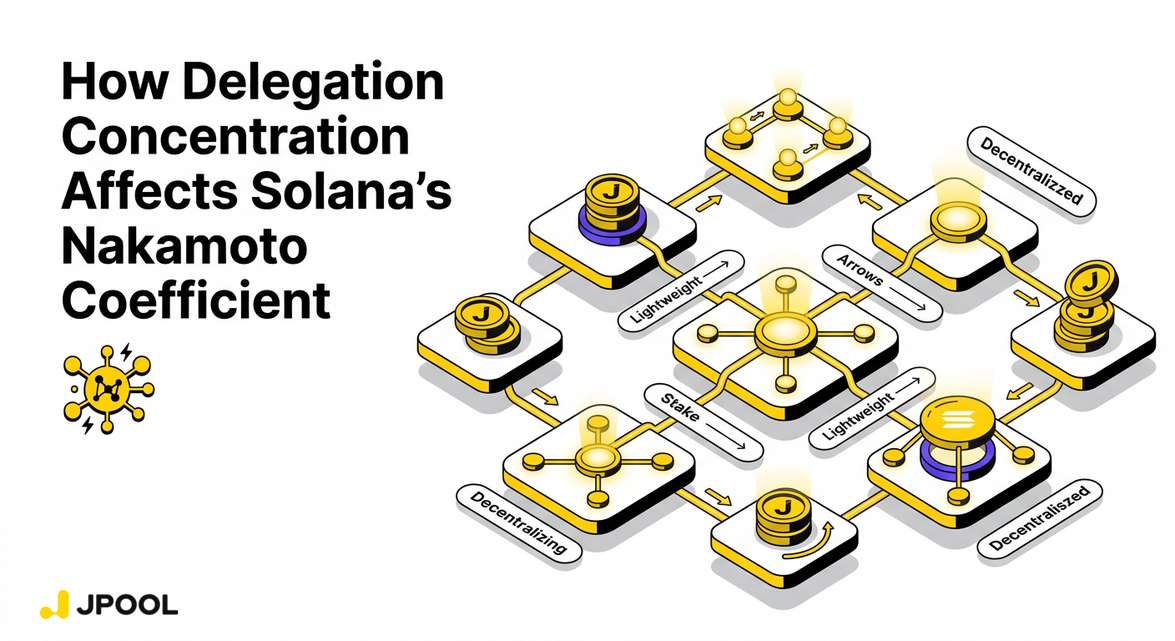
  • How Delegation Concentration Affects Solana’s Nakamoto Coefficient

    How Delegation Concentration Affects Solana’s Nakamoto Coefficient

    The Nakamoto Coefficient is the minimum number of independent validators that would need to collude to halt or corrupt a blockchain network. On Solana, where Proof-of-Stake means voting power is proportional to delegated stake, this number is directly shaped by how stake is distributed—not just across validators, but across the infrastructure they run on. When stake clusters, the Nakamoto Coefficient compresses. When it disperses, the network becomes structurally harder to attack or censor.

    Most conversations about Solana validator decentralization stop at the validator count. This analysis goes deeper into the specific scoring mechanics that determine whether liquid staking delegation actively improves or silently erodes the Nakamoto Coefficient over time.


    The Structural Problem: Why Stake Gravitates Toward Concentration

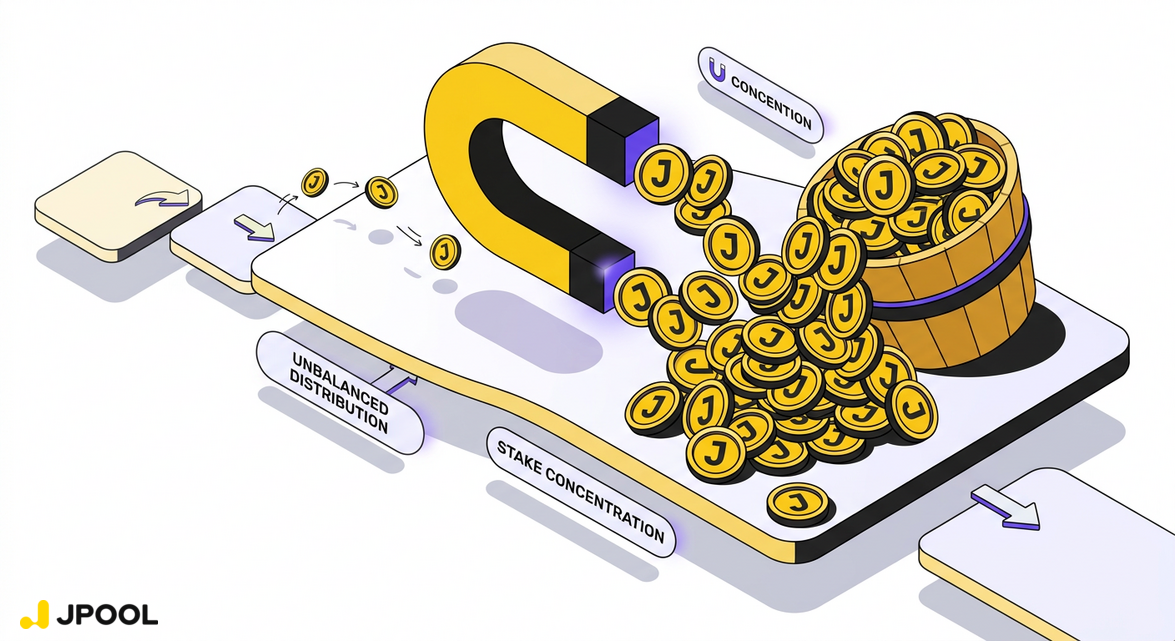
    Visualizing the structural problem of stake concentration where yield-chasing behavior leads to a superminority.

    Stake concentration is not the result of malicious intent—it is the predictable output of rational delegation behavior. Delegators optimizing purely for yield will naturally flow toward the highest-performing validators. High-performing validators, in turn, attract more stake, which can compound their influence over consensus. Left unchecked, this feedback loop produces a superminority: a small group of validators controlling enough stake to influence network outcomes.

    JPool’s inclusion criteria explicitly exclude any validator that is a member of the Superminority group. This is a hard gate, not a soft preference; a validator cannot participate in JPool’s delegation program at all if it already holds disproportionate consensus power. JPool also enforces a maximum stake cap of 750,000 SOL per validator, ensuring that even high-performing nodes cannot accumulate stake beyond a threshold that would dangerously concentrate voting weight.

    These are structural constraints. However, the more revealing mechanism is what happens inside the scoring system—where decentralization pressure is embedded directly into yield-weighted delegation.


    How Concentration Scores Function as a Decentralization Forcing Function

    JPool’s validator scoring system evaluates each validator across nine metrics, producing a total adjusted score between 3 and 39. Four of those nine metrics are dedicated exclusively to infrastructure diversity, measuring stake concentration across independent dimensions of the validator’s hosting environment.

    Each of these four concentration metrics is scored on a scale of 1 to 10, with a weight of 0.25 each. Critically, the scoring is relative: all possible concentration values across all validators are aggregated into 10 equal bands, and each validator is placed within that distribution. This means the score is not a static threshold; it is a continuously recalibrated ranking that responds to the actual state of stake distribution across the network at any given moment.

    The practical implication is significant. A validator hosted in an environment where cumulative stake has grown—even if that validator’s own stake has not changed—will receive a lower concentration score. The scoring system treats ecosystem-level concentration as the relevant variable, not just the individual node’s footprint. As JPool’s documentation states: “The more stake a group of validators in a single [hosting environment] attracts from delegators, the higher the concentration of stake… High rates of stake concentration are bad for Solana’s health because they bring down the network’s decentralization, which can create a point of failure.”

    This is a fundamentally different design philosophy from yield-only delegation. It means that two validators with identical APY performance can receive meaningfully different delegation weights based solely on where their infrastructure sits in the broader stake distribution.


    The Scoring Weight Asymmetry: What the Numbers Reveal

    Examining the full scoring table reveals a deliberate architectural choice. The four infrastructure diversity metrics together contribute a maximum of 10 adjusted-weight points (4 × 0.25 × 10). The three APY metrics together contribute a maximum of approximately 9.9 adjusted-weight points (3 × 0.33 × 10). In other words, infrastructure diversity and yield performance carry near-equal total weight in determining a validator’s score-based delegation.

    This parity is not accidental. It encodes a specific institutional stance: a validator’s contribution to network decentralization is as valuable as its contribution to staker yield. For delegators who assume liquid staking protocols simply chase the highest APY, this scoring architecture reveals a more complex reality.

    The Validators.app score (weight: 1, max: 11) and the Smart Validator Toolkit (SVT) bonus (weight: 4, max: 2 points) round out the system. SVT—JPool’s free validator management tool—rewards operators who adopt standardized, auditable node management practices:

    • A validator running SVT receives 2 points.
    • A validator running sv-manager receives 1 point.
    • Unmanaged nodes receive 0 points.

    This creates an incentive layer that correlates operational professionalism with delegation access, further filtering for validators that are less likely to become points of failure.


    Liquid Staking’s Dual Role: Amplifier or Corrective?

    Liquid staking protocols occupy a structurally powerful position in the Solana validator ecosystem. Because they aggregate retail delegation at scale, their internal allocation logic has outsized influence on where stake flows across the network. A protocol that delegates purely based on yield will amplify existing concentration. Conversely, a protocol that weights infrastructure diversity will act as a corrective force.

    JPool’s liquid staking delegation strategy is designed to function as the latter through several key mechanisms:

    • The Superminority exclusion removes already-concentrated validators from consideration entirely.
    • The 750,000 SOL cap prevents any single validator from accumulating excessive stake through the pool.
    • The concentration scoring system continuously redirects score-based delegation away from infrastructure environments where stake is already clustering—even as the pool grows.

    This architecture means that as JPool’s total staked SOL increases, the decentralization pressure it exerts on the network scales proportionally. More pooled SOL distributed through a concentration-aware scoring system means more stake actively flowing toward underrepresented infrastructure environments. The Nakamoto Coefficient, in this framing, is not just a network-level metric; it is a direct output of how delegation protocols are designed.

    For a deeper look at how validator selection and delegation mechanics interact with staking yield, see The Complete Guide to Solana Staking Yield Mechanics: MEV, Priority Fees, and Validator Revenue.


    The Compounding Effect: Community Good and the Ecosystem Multiplier

    Visualizing the compounding effect of community good and ecosystem growth through decentralized delegation.

    One dimension of JPool’s liquid staking delegation strategy that receives little attention in standard decentralization discussions is the Community Good framework. Validators whose earnings fund projects that introduce new functionality to the Solana ecosystem—across tracks including developer tooling, liquidity, and user acquisition—receive additional bonus stake.

    The Community Good score ranges from 1 to 14, and the resulting bonus stake is calculated by multiplying that score by 3,000 SOL. This means a maximum-scoring validator can receive up to 42,000 SOL in additional delegation. This is not a trivial amount for an independent validator. It creates a material economic incentive for smaller, ecosystem-contributing operators to remain viable—precisely the category of validator most at risk of being crowded out by stake concentration dynamics.

    The mechanism matters for the Nakamoto Coefficient because it actively subsidizes the long-tail of the validator set. Validators that contribute to ecosystem growth but may not yet command top-tier APY performance can remain economically sustainable through Community Good delegation. This expands the effective validator set that holds meaningful stake, which is the foundational requirement for a higher Nakamoto Coefficient.


    Conclusion: Delegation Design Is Network Design

    The Solana Nakamoto Coefficient is not a fixed property of the network; it is a dynamic output of how stake is allocated, epoch by epoch, across thousands of validators. Liquid staking protocols that manage significant pooled stake are, whether they acknowledge it or not, making active choices about network topology with every delegation cycle.

    JPool’s Smart Delegation Strategy encodes decentralization as a first-class objective—not through marketing language, but through concrete scoring mechanics. It implements this by:

    • Placing infrastructure diversity on equal footing with yield performance.
    • Hard-excluding Superminority validators.
    • Capping individual validator stake at 750,000 SOL.
    • Creating economic incentives for ecosystem-contributing operators to remain viable.

    Each of these mechanisms applies pressure against the concentration dynamics that compress the Nakamoto Coefficient.

    For delegators, the implication is clear: choosing a liquid staking delegation strategy is not just a yield decision. It is a vote on what kind of network Solana becomes.

  • The Complete Guide to Solana Staking Yield Mechanics: MEV, Priority Fees, and Validator Revenue

    The Complete Guide to Solana Staking Yield Mechanics: MEV, Priority Fees, and Validator Revenue

    Understanding where Solana staking yield actually comes from is essential for making informed delegation decisions in 2026. Unlike traditional narratives that focus solely on inflation-based APY, the reality of Solana validator economics involves multiple revenue streams—including network transaction fees and validator performance dynamics—that directly impact your staking returns.

    This guide breaks down the transparent, network-cash-flow model behind Solana staking yield and explains how platforms like JPool optimize these mechanics to deliver competitive returns.

    Where Does Solana Staking Yield Come From?

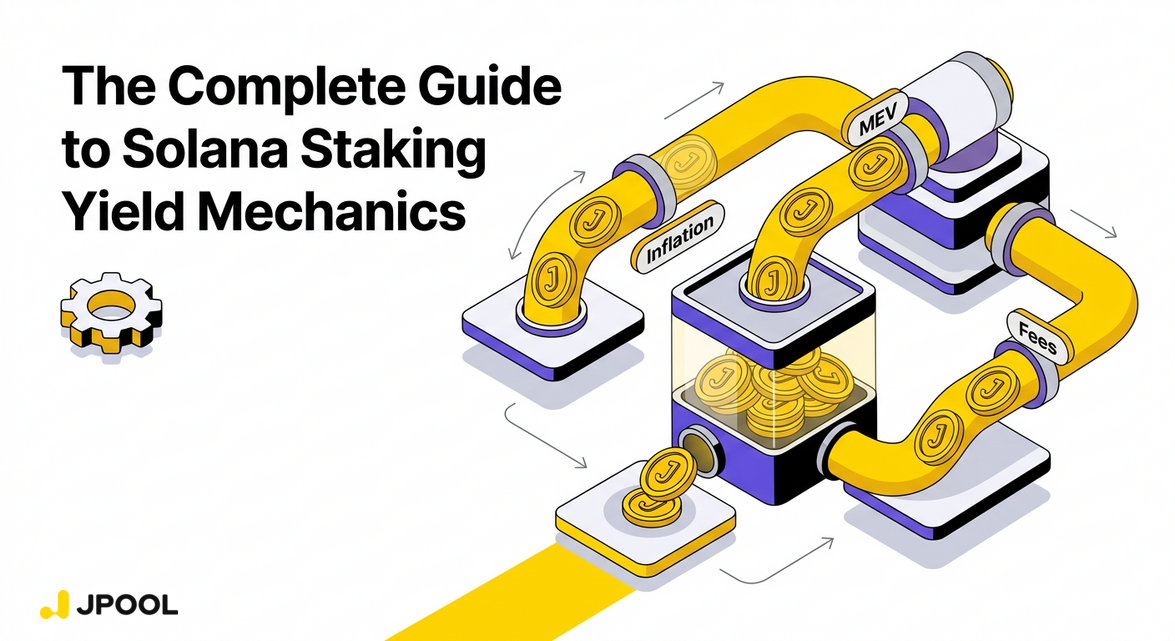
    Visualizing the three distinct sources of yield (Inflation, Priority Fees, MEV) merging into one.

    Solana staking rewards are generated through a combination of protocol-level inflation and network activity. When you stake SOL, you delegate your tokens to validators who process transactions and secure the network. In return, validators earn rewards that are distributed to delegators after deducting validator commissions.

    The core components of validator revenue include:

    • Inflation Rewards: Protocol emissions distributed to validators based on their stake weight and vote participation.
    • Priority Fees: Transaction fees paid by users to prioritize their transactions during periods of network congestion.
    • MEV (Maximal Extractable Value): Additional revenue opportunities that can provide incremental yield during periods of elevated network activity.

    JPool’s delegation criteria strictly cap commissions at 10% to protect user yield, ensuring that validators in the JPool Delegation Program maximize the portion of rewards flowing to stakers.

    How Validator Performance Impacts Your APY

    Not all validators deliver the same returns. Validator performance directly determines the APY you earn, which is why JPool requires validators to maintain top-tier performance metrics.

    JPool’s Performance Standards:

    • Validators must rank in the top 400 by APY over the previous 10 epochs and achieve a resulting JPool Rank above Top 200 to qualify for the JPool Delegation Program.
    • To remain in the program, validators must maintain a JPool Rank above the top 350.
    • Commission on inflation and MEV rewards must remain under 10%.

    These rigorous standards ensure that delegated stake flows only to high-performing validators who consistently deliver competitive yields.

    The Security Bond Mechanism

    JPool has implemented a unique accountability system for validator performance. If a validator’s APY falls below the requirement, operators can deposit SOL as a security bond to cover the shortfall. At the end of each epoch, JPool compares the validator’s APY with the APY of the validator in 10th place in the Top-10 list (validators ranked by APY over the last 10 epochs).

    If a validator underperforms, the bond is used to compensate delegators for the yield gap. This mechanism protects staker returns even when individual validators experience temporary performance issues.

    The Role of Smart Delegation in Optimizing Yield

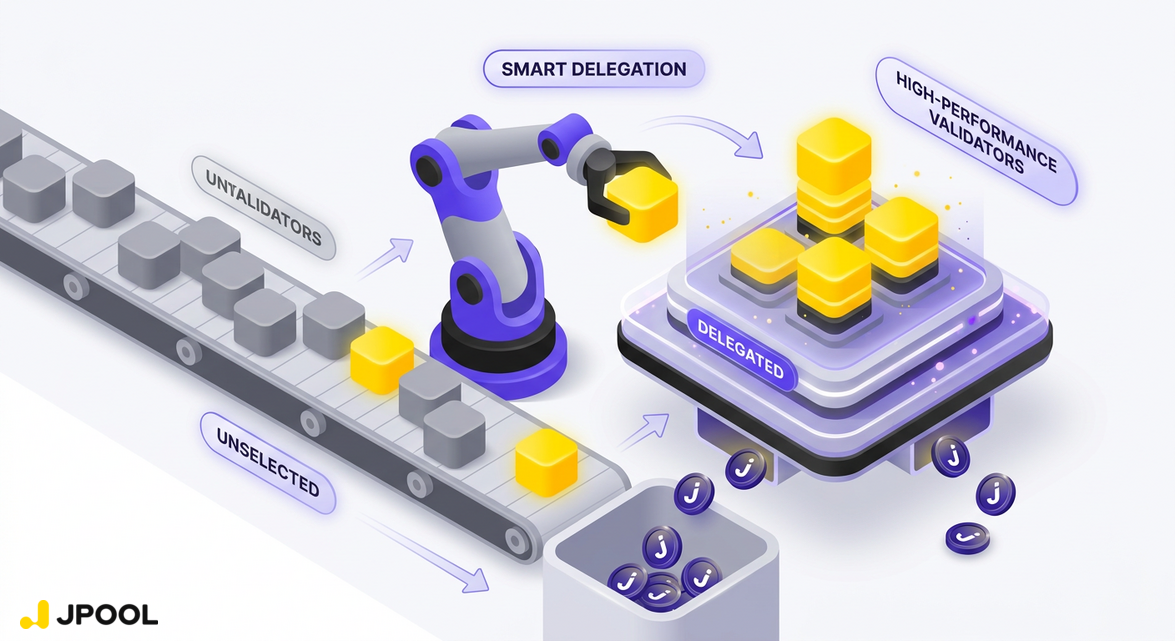
    Visualizing the Smart Delegation algorithm filtering and selecting the best validators.

    Manual validator selection requires constant monitoring and technical expertise. JPool’s Smart Delegation Strategy automates this process by continuously evaluating validators across multiple performance dimensions and reallocating stake to optimize returns.

    How JPool’s Smart Delegation Strategy Works:

    JPool utilizes a dynamic, multi-factor delegation strategy that optimizes for performance, decentralization, and ecosystem growth. The strategy evaluates validators using a comprehensive scoring system that weighs:

    • Current APY, 3-epoch average APY, and 10-epoch average APY (weighted at 0.33 each).
    • Infrastructure diversity to minimize risk by penalizing excessive stake concentration.
    • Validators.app score (weighted at 1.0) for independent performance validation.
    • Smart Validator Toolkit (SVT) adoption (weighted at 4.0), rewarding validators using JPool’s free management tools.

    Every five epochs, JPool recalculates validator rankings, adds newly eligible validators, and redistributes stake across all active participants. Every epoch, validators that no longer meet the criteria are removed, ensuring continuous optimization.

    MEV and Priority Fees: The Variable Yield Component

    While inflation rewards provide a baseline APY, network activity generates additional revenue through priority fees and MEV opportunities. These components are variable and depend on network congestion and transaction demand.

    Priority Fees Explained:

    During periods of high network activity, users pay priority fees to ensure their transactions are processed quickly. Validators earn these fees in addition to inflation rewards, creating yield variability based on real-time network conditions.

    MEV Considerations:

    MEV can provide incremental yield during periods of elevated network activity. However, MEV revenue is opportunistic and market-condition dependent—not a guaranteed structural premium. JPool’s delegation criteria ensure that validators handling MEV opportunities maintain the same 10% commission cap, protecting delegator returns.

    How JSOL Captures and Compounds Staking Yield

    When you stake SOL through JPool, you receive JSOL—a liquid staking token that represents your claim on a growing pool of staked SOL plus accrued rewards.

    JSOL Yield Mechanics:

    • Exchange Rate Growth: JSOL accrues rewards automatically as the JSOL↔SOL exchange rate increases each epoch.
    • Auto-Compounding: Your number of JSOL tokens stays constant; each JSOL simply becomes redeemable for more SOL over time.
    • No Manual Claiming: Rewards compound continuously without requiring any action on your part.

    The rate of exchange rate growth approximates JPool’s net APY after validator performance and protocol fees. APY varies with network conditions and validator performance and is not guaranteed.

    Validator Revenue Transparency: Beyond Headline APY

    Understanding the full economics of validator operations provides context for evaluating staking platforms. JPool offers a Validator Profit Calculator that breaks down validator economics across multiple time horizons, showing how revenues and costs translate into profit.

    Key Validator Economic Factors:

    • Inflation rewards based on stake weight and vote participation.
    • Commission rates that determine the split between validators and delegators.
    • Operational costs including infrastructure, bandwidth, and vote transaction fees.
    • Performance consistency measured across current, 3-epoch, and 10-epoch averages.

    JPool’s requirement that validators publish their name and logo creates additional accountability, enabling delegators to track performance and make informed decisions.

    Direct Staking with Amplified Returns

    For users who want to support specific validators while maximizing returns, JPool offers Direct Staking with a unique matching program.

    Direct Stake Matching:

    For every SOL staked directly to a validator in the JPool Delegation Program, JPool supplies an equal 1-for-1 delegation, based on available liquidity and capped at 20,000 SOL per validator. This matching applies to both standard direct stakes and leveraged positions.

    If the validator also participates in the Solana Foundation Delegation Program, the Foundation provides a second boost, potentially multiplying the effective stake significantly.

    Leveraged Staking: Amplifying Yield Through Network Economics

    JPool’s Leveraged Staking option allows users to amplify their direct stake by borrowing additional SOL from lending platforms. This strategy increases the effective stake amount, boosting APY while introducing additional risk considerations.

    How Leverage Amplifies Yield:

    When you stake with leverage, JPool borrows extra SOL from a lending platform and adds it to your stake. Since rewards are calculated on the larger combined balance, your APY rises. The additional yield comes from earning rewards on the amplified stake at JPool’s APY while paying the borrow APR on the outstanding debt.

    The positive difference between staking APY and borrow APR is reflected in the Leverage APY. This mechanism allows users to capture more of the network’s cash flow without adding new capital, though it requires active monitoring of loan-to-value ratios and health factors.

    Evaluating Staking Platforms: A Framework for 2026

    When evaluating liquid staking platforms, focus on transparent, verifiable metrics rather than marketing-driven headline rates:

    • Validator Selection Criteria: Does the platform enforce rigorous performance standards?
    • Commission Caps: Are validator commissions capped to protect delegator yield?
    • Performance Accountability: Are there mechanisms to compensate delegators when validators underperform?
    • Infrastructure Diversity: Does the delegation strategy minimize concentration risk?
    • Yield Transparency: Can you verify where APY comes from and how it’s calculated?

    How to Evaluate the Best Solana Liquid Staking Token in 2026: A Security & Yield Framework provides an institutional-style framework for assessing architecture, diversification, transparency, and DeFi utility across Solana LST options.

    Conclusion: Moving Beyond Inflation-Only Narratives

    Solana staking yield in 2026 is driven by a combination of inflation rewards, priority fees, validator performance, and network activity. Platforms that optimize across all these dimensions—through smart delegation, rigorous validator selection, and performance accountability mechanisms—deliver more consistent and competitive returns.

    JPool’s approach combines automated validator monitoring, strict performance criteria (top 400 APY requirement with a resulting Top 200 JPool Rank, 10% commission cap, 750,000 SOL maximum stake), and unique features like security bonds and direct stake matching to maximize delegator yield while supporting network decentralization.

    Understanding these mechanics allows you to make informed staking decisions based on transparent, verifiable network economics rather than headline APY figures alone.

  • SPL Stake Pool vs. Proprietary Contracts: Mitigating Liquid Staking Risks on Solana

    SPL Stake Pool vs. Proprietary Contracts: Mitigating Liquid Staking Risks on Solana

    As Solana’s liquid staking ecosystem matures in 2026, institutional evaluators and retail investors alike face a critical architectural choice: platforms built on Solana Labs’ audited SPL Stake Pool Program versus those relying on proprietary smart contracts. This decision fundamentally shapes your risk exposure, capital security, and long-term confidence in liquid staking infrastructure.

    Understanding the distinction between these two approaches is essential for anyone asking, “Can I lose my staked Solana?” The answer depends heavily on which technical foundation your liquid staking platform employs.

    The SPL Stake Pool Architecture: Battle-Tested Security by Design

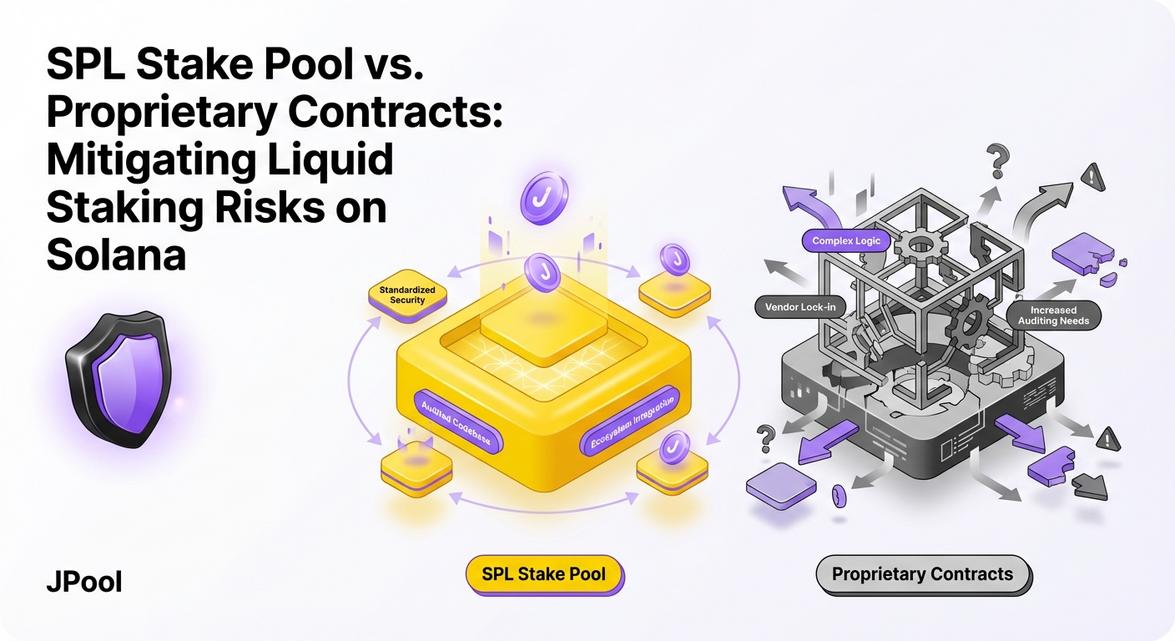
    Visualizing the security and robustness of the SPL Stake Pool architecture.

    Solana Labs’ SPL Stake Pool Program represents the gold standard for liquid staking infrastructure on Solana. This on-chain program has undergone multiple independent security audits and operates as a non-custodial framework where the platform itself has no direct access to user funds.

    JPool operates exclusively on this audited SPL Stake Pool Program. According to the platform’s documentation, “JPool has no access to your SOL whatsoever. Solana Foundation’s Program has undergone several audits and is considered as secure as humanly possible.”

    The SPL architecture functions through a transparent mechanism: users deposit SOL in exchange for liquid staking tokens (in JPool’s case, JSOL) that represent proportional ownership in the stake pool. As validators earn rewards, the pool and pool tokens grow proportionally in value through an increasing exchange rate. This design eliminates the need for users to trust the platform operator with custody of their assets.

    Proprietary Smart Contracts: Elevated Code Risk and Trust Assumptions

    Proprietary liquid staking contracts introduce a fundamentally different risk profile. These custom-built systems require users to trust that the platform’s developers have:

    • Implemented secure code without exploitable vulnerabilities
    • Conducted thorough independent audits (which may or may not be publicly verifiable)
    • Designed fail-safe mechanisms for edge cases and network disruptions
    • Maintained ongoing security monitoring as the codebase evolves

    Standard risk disclosures in liquid staking acknowledge that smart contract code may contain exploitable vulnerabilities introduced by developers or third parties. When evaluating proprietary systems, consider that successful attacks or even the perception of technological weakness can adversely affect functionality, convertibility, or transferability of your liquid staking tokens.

    Can You Actually Lose Your Staked SOL? Understanding Real vs. Perceived Risks

    One of the most common concerns among prospective liquid stakers is the fear of principal loss. On Solana, it’s critical to understand that validator underperformance affects yield, not your staked principal.

    When using the SPL Stake Pool architecture through platforms like JPool, your SOL remains staked across a diversified set of validators monitored through continuous performance tracking. JPool’s Smart Delegation Strategy removes validators that no longer meet eligibility criteria every epoch and redistributes stake every five epochs to maintain optimal performance and decentralization.

    If a validator underperforms, the impact is reflected in reduced APY—not a loss of your original stake. The platform maintains a 1% reserve account specifically to fulfill large withdrawal requests, ensuring liquidity even during periods of high redemption demand.

    The real risks to monitor in liquid staking are:

    • Smart contract vulnerabilities (mitigated by using audited SPL infrastructure)
    • Validator concentration risk (addressed through diversification strategies that minimize excessive stake concentration)
    • Transaction irreversibility (inherent to blockchain; always verify wallet addresses)
    • Delayed execution during network congestion (temporary, not permanent loss)

    Withdrawal Mechanisms: Testing Platform Liquidity and Architecture Resilience

    A platform’s withdrawal system reveals critical insights into its architectural soundness. JPool offers two unstaking options that demonstrate the SPL Stake Pool’s flexibility:

    • Delayed Unstake: SOL withdrawn after the current epoch completes at a lower fee, based on the current exchange rate when redemption settles
    • Instant Unstake: Immediate SOL withdrawal at a higher fee, subject to pool liquidity availability

    The ability to offer instant withdrawals depends on the platform maintaining adequate reserves—a feature enabled by the SPL Stake Pool’s reserve account mechanism. This 1% reserve is replenished by proportionally reducing stake across all participating validators when depleted, ensuring systemic stability.

    Proprietary systems may lack these built-in liquidity safeguards, potentially exposing users to extended lock-up periods during market stress.

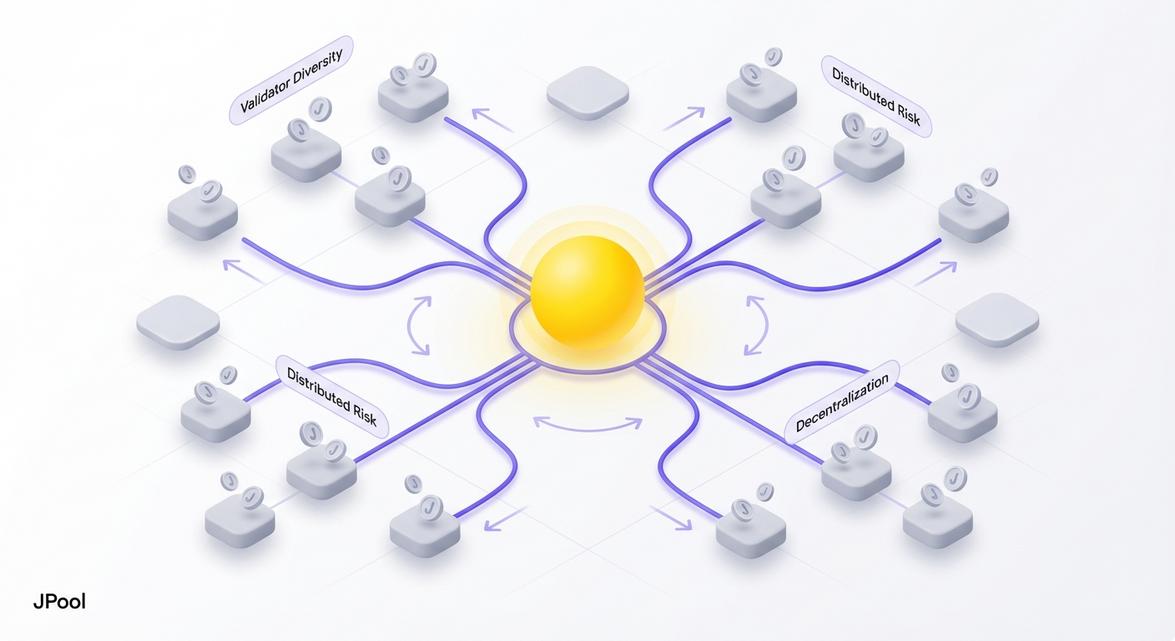
    Decentralization as a Security Layer: Multi-Validator Risk Distribution

    Illustrating the concept of decentralization and multi-validator risk distribution.

    Beyond architectural security, effective liquid staking platforms must distribute stake across a diversified validator set to minimize single points of failure. JPool’s approach continuously monitors validators using performance and reliability metrics, automatically including eligible validators and removing those that fail to meet criteria.

    The platform’s delegation strategy evaluates validators based on APY performance across multiple epochs, ensures validators are not blacklisted by the Solana Foundation or Jito Foundation, and caps maximum stake per validator at 750,000 SOL to prevent excessive concentration.

    This multi-validator approach means that even if individual validators experience downtime or performance issues, your overall staking position remains protected through diversification—a critical risk mitigation layer regardless of whether you’re using SPL or proprietary infrastructure.

    The Leverage Risk Exception: Third-Party Integration Considerations

    While SPL Stake Pool architecture provides robust security for standard liquid staking, users should understand that additional risks emerge when integrating with third-party DeFi protocols. JPool’s Leveraged Staking option, which uses flash loans from lending platforms to amplify yield, introduces liquidation risk if borrow interest exceeds staking rewards for extended periods.

    These risks stem from the lending platform integration, not the underlying SPL Stake Pool architecture. Users must evaluate third-party protocol risks independently when utilizing leveraged strategies.

    This distinction is crucial: the SPL foundation remains secure, but composability with external protocols requires additional due diligence.

    Due Diligence Framework: Questions to Ask Before Staking

    When evaluating any Solana liquid staking platform, institutional-grade due diligence should include:

    1. Architecture verification: Does the platform use audited SPL Stake Pool Program or proprietary contracts?
    2. Audit transparency: Are security audit reports publicly accessible and independently verifiable?
    3. Custody model: Does the platform operator have any access to user funds?
    4. Validator diversification: How many validators receive delegations, and what are concentration limits?
    5. Withdrawal mechanisms: Are instant and delayed unstaking both available? What are the fee structures?
    6. Reserve management: Does the platform maintain liquidity reserves for redemptions?
    7. Performance monitoring: How frequently are validators evaluated and rebalanced?

    For a comprehensive framework on evaluating liquid staking tokens across security, yield, and decentralization dimensions, see our institutional evaluation guide.

    Conclusion: Architecture Determines Risk Ceiling

    The choice between SPL Stake Pool and proprietary contract architectures is not merely technical—it defines the upper boundary of your risk exposure in Solana liquid staking. Audited, non-custodial SPL infrastructure provides a security foundation that proprietary systems must work to replicate through independent audits, transparent operations, and proven resilience over time.

    For users asking “Can I lose my staked Solana?”, the answer depends on understanding that principal loss risk on Solana stems primarily from smart contract vulnerabilities and custodial exposure—not from validator performance. Platforms built on audited SPL Stake Pool architecture with non-custodial designs minimize these structural risks, allowing you to focus on optimizing yield and decentralization rather than worrying about fundamental security.

    As the Solana liquid staking landscape evolves through 2026, the platforms that prioritize battle-tested infrastructure over proprietary innovation will likely emerge as the trusted choice for institutional and retail capital alike.

  • How to Evaluate the Best Solana Liquid Staking Token in 2026: A Security & Yield Framework

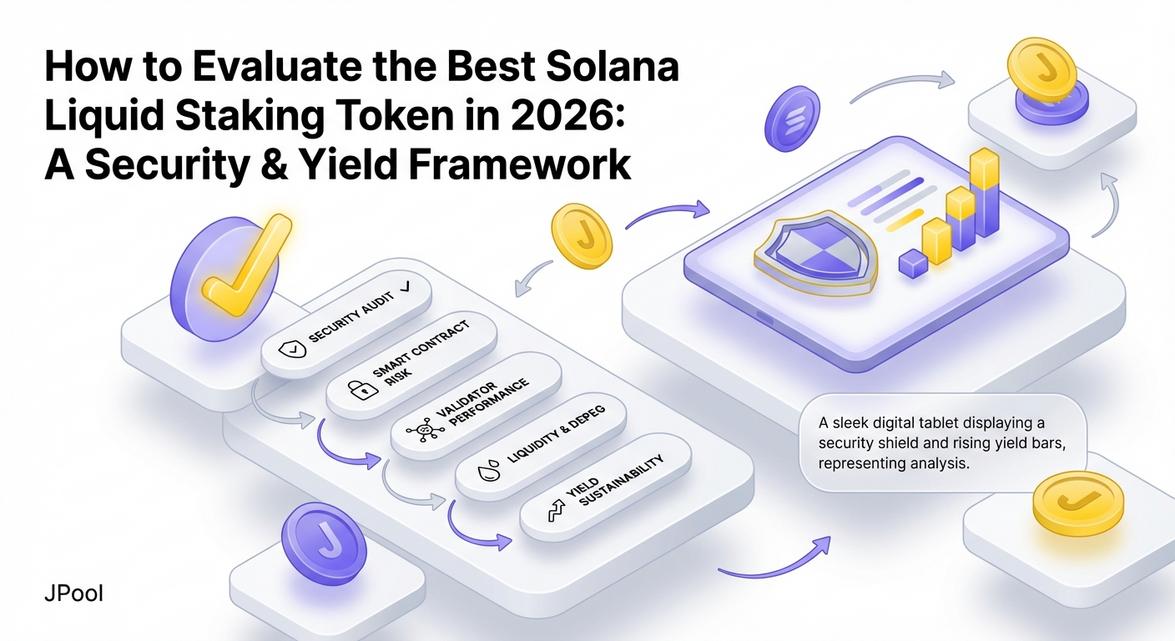
    How to Evaluate the Best Solana Liquid Staking Token in 2026: A Security & Yield Framework

    By 2026, the Solana ecosystem has evolved from a high-speed experimental network into a cornerstone of institutional finance. With this maturity comes a crowded marketplace of staking solutions. For investors holding SOL, the question is no longer if they should stake, but how to maximize capital efficiency while minimizing risk.

    Finding the best Solana liquid staking token 2026 has to offer requires looking beyond flashy marketing and high headline numbers. It demands a rigorous evaluation of the underlying technology, the delegation strategy, and the legal framework supporting the protocol.

    This guide provides a neutral, criteria-based framework to help you navigate the landscape and identify safe liquid staking Solana options that align with institutional-grade standards.

    1. The Architectural Foundation: Custom vs. Standardized

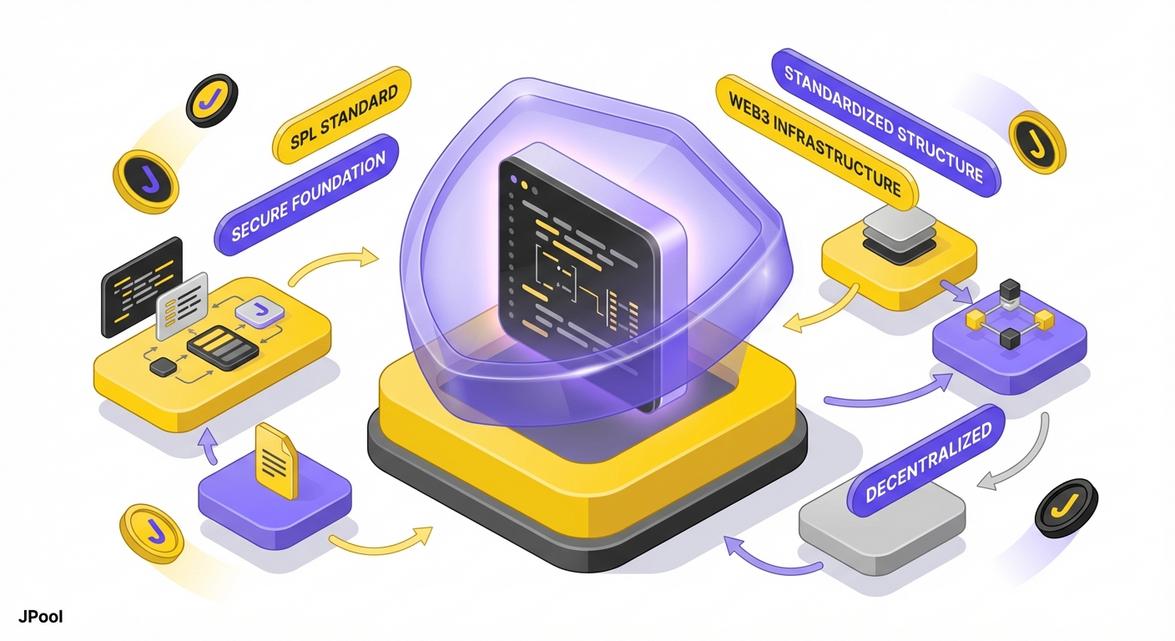
    Visualizing the technical architecture and security foundation of the SPL Stake Pool standard.

    The first and most critical filter in your evaluation framework should be the technical architecture of the protocol. In the world of DeFi, code is law, and the complexity of that code directly correlates with risk.

    The SPL Stake Pool Standard Benefits

    When evaluating a liquid staking token (LST), check if the protocol uses custom, proprietary smart contracts or the official SPL Stake Pool standard.

    • Proprietary Contracts: These are custom-built by the project team. While they allow for unique features, they introduce a larger attack surface. If the team makes a coding error, user funds could be vulnerable.
    • SPL Standard: This is the official reference implementation developed and audited by Solana Labs. Protocols built on this standard—like JPool—inherit the security of the core Solana codebase.

    Choosing a protocol built on the SPL standard offers significant peace of mind. It ensures the protocol is non-custodial by design; the protocol managers can direct stake to validators but never have the technical ability to withdraw or freeze user funds. This “security inheritance” is a massive advantage for risk-averse investors.

    2. Yield Mechanics: Analyzing the Source of Returns

    Not all Annual Percentage Yields (APYs) are created equal. When you see a high return, you must ask: How is this being generated? A sustainable yield comes from optimizing network rewards, not from subsidizing users with inflationary governance tokens.

    Smart Delegation & MEV Capture

    The best protocols utilize an algorithmic Smart Delegation Strategy. Instead of manually picking validators, they use off-chain bots to rebalance the pool every epoch. Look for a protocol that:

    1. Targets High Performance: Automatically routes capital to validators with high uptime and APY performance (e.g., top 500 ranked nodes).
    2. Captures MEV: Maximal Extractable Value (MEV) consists of “tips” paid to validators for processing transactions. Superior LSTs ensure that validators charge a specific commission on MEV (often around 10%) to subsidize their operations, allowing them to offer 0% commission on the staking pool itself. This mathematically favors the LST holder.
    3. Prunes Underperformers: The system should actively monitor the “health score” of validators and instantly withdraw stake from those that underperform or maliciously raise fees.

    3. Assessing Safety: Mitigating Liquid Staking Risks

    Visualizing the concept of validator diversity and risk distribution across a network.

    While liquid staking unlocks liquidity, it introduces specific liquid staking risks, primarily smart contract risk (addressed above) and centralization risk.

    Validator Diversity & Decentralization

    A protocol is only as safe as the validators securing it. If an LST concentrates all its SOL into 5 or 10 large validators, a failure in one of those nodes could lead to slashing (loss of funds).

    To find a safe liquid staking Solana option, look for “massive diversification.” A robust protocol should spread its stake across hundreds of validators (JPool, for example, utilizes 204 distinct validators). This dilution ensures that even if one node is penalized, the impact on the overall pool is negligible (often <0.5%).

    Censorship Resistance & Infrastructure

    Deep diligence involves asking where the validators are physically located. Does the delegation algorithm penalize concentration in single data centers (like AWS) or specific jurisdictions? A “boutique” protocol focused on decentralization will actively avoid clustering to protect against infrastructure outages or regulatory attacks.

    Jurisdictional Clarity

    In 2026, anonymity is a liability. Institutional-grade safety requires regulatory clarity. Protocols headquartered in recognized “crypto valley” jurisdictions, such as Switzerland, offer a layer of legal recourse and operational standards often missing in anonymous DeFi projects. This transparency signals a long-term commitment to compliance and user protection.

    4. Capital Efficiency & DeFi Utility

    The primary purpose of a liquid staking token is usability. A high yield is useless if the token cannot be used elsewhere in the ecosystem.

    Tax Efficiency

    Evaluate the nature of the token. Is it a “rebasing” token (where your balance increases daily) or a “value-accruing” token (where the price of the token rises relative to SOL)?

    Value-accruing tokens (like JSOL) are generally preferred for tax efficiency. In many jurisdictions, the yield is treated as capital gains realized only upon sale, rather than daily taxable income.

    Composability

    Finally, the token must be integrated into the wider DeFi economy. Can you use it as collateral to borrow USDC? Can you pair it in a liquidity pool?

    The true power of liquid staking is unlocked when you stack yields. For a deep dive on how to leverage these strategies effectively, read our guide on the Best Ways to Use JSOL in DeFi: Lending, Liquidity Provision, Collateral & Yield Stacking.

    Summary: The 2026 Evaluation Checklist

    When searching for the best Solana liquid staking token 2026, use this checklist to cut through the noise:

    • Architecture: Is it built on the secure, audited SPL Stake Pool standard?
    • Yield: Does it use algorithmic delegation and MEV capture to maximize returns (~6% APY)?
    • Safety: Is stake diversified across 200+ validators to minimize slashing risk?
    • Transparency: Is the team public, and is the project domiciled in a reputable jurisdiction like Switzerland?
    • Utility: Is the token value-accruing and widely accepted in Solana DeFi?

    By adhering to this framework, you move beyond simple APY chasing and toward a strategy that balances high performance with institutional-grade security.

  • Best Ways to Use JSOL in DeFi: Lending, Liquidity Provision, Collateral & Yield Stacking

    Best Ways to Use JSOL in DeFi: Lending, Liquidity Provision, Collateral & Yield Stacking

    If you’re holding JSOL, you’re already earning staking rewards. But the moment you start using it across DeFi, you unlock something far more powerful — staking rewards + extra yield on top. That’s the core idea behind it: letting your staked SOL work in multiple places at once.

    This guide breaks down the main DeFi opportunities on JPool’s Explore DeFi page, and explains when each one makes sense. Whether you’re still learning DeFi or already yield-hunting, you’ll find a path that fits your risk and experience level.


    Why Use JSOL in DeFi Instead of Keeping It Idle?

    JSOL represents staked SOL, whichcompounds staking rewards by default. But once you plug JSOL into DeFi, your tokens can:

    • Earn layered yield (staking APY + DeFi APY).
    • Serve as collateral for loans.
    • Be provided as liquidity to earn fees.
    • Help you build diversified yield strategies.

    Think of JSOL as staked capital with mobility. You don’t have to “choose” between staking and DeFi. JSOL lets you do both.


    1. Liquidity Pools: Earn Trading Fees with JSOL

    For users who prefer steady, predictable yield, liquidity pools are usually the first stop. By supplying JSOL together with another asset, you earn a share of trading fees and sometimes additional rewards.

    JSOL / SOL Pools (Multiple Platforms)

    Available on: Meteora, Raydium, Orca.

    A JSOL/SOL pool is one of the simplest ways to provide liquidity. Because JSOL is JPool’s liquid staking token backed by SOL and is designed to closely track SOL’s price with yield on top, JSOL/SOL pools typically experience much lower impermanent loss (IL) than uncorrelated or highly volatile pairs.

    Who it fits:

    • You want to keep exposure to SOL.
    • You want a low-maintenance DeFi yield.
    • You’re comfortable with minor IL in exchange for fees.

    JSOL / USDC Pools: For Yield + Stability

    If you want yield but prefer a more stable pairing, JSOL/USDC pools offer a balance. Because roughly half of your position sits in USDC, your overall exposure to SOL’s price swings is reduced compared with a pure JSOL/SOL position. You’re taking partial SOL risk and partial stablecoin stability.

    Who it fits:

    • You want to earn fees but reduce SOL volatility.
    • You’re stacking yield without going full-risk.
    • You want a “middle-ground” LP position.

    2. Lending: Use JSOL as Interest-Earning Collateral

    The moment JSOL becomes accepted as collateral, stakers unlock a new play: borrow other assets while keeping your staking yield and exposure.

    JSOL Lending via Sanctum

    Users can deposit JSOL and borrow against it. This suits people who want liquidity without unstaking or selling.

    Why it’s useful:

    • Access liquidity without losing SOL exposure.
    • Borrow to farm, trade, or hedge.
    • Keep earning staking yield while using capital elsewhere.

    Best for intermediate users who understand borrowing risks and want to unlock capital efficiency.


    3. Yield Stacking: Combining Multiple JSOL Utilities

    This is where JSOL becomes interesting. Yield stacking means earning multiple streams from the same underlying tokens. A simple example:

    1. Stake SOL → Receive JSOL.
    2. Deposit JSOL into a lending platform.
    3. Borrow SOL or USDC.
    4. Provide it as liquidity for extra yield.

    It’s the same money working 2–3 layers deep.

    Stacked yield sources:

    • JSOL staking yield.
    • Lending deposit APY.
    • Liquidity provision fees.

    This strategy isn’t for newcomers, but it’s a powerful tool once you understand risks.


    4. When to Choose Each JSOL DeFi Strategy

    StrategyBest ForRisk LevelKey Benefit
    JSOL/SOL poolLong-term SOL believersLow–MediumEarn fees without losing SOL exposure
    JSOL/USDC poolBalanced approachMediumPartial volatility hedge + fees
    Lending (collateral)Capital efficiency seekersMedium–HighBorrow without unstaking
    Yield StackingExperienced DeFi usersHighMultiple yield layers

    How to Think About Risk Before You Jump In

    Even “safe” DeFi isn’t risk-free. Before allocating JSOL anywhere, check these:

    • Impermanent loss: relevant for liquidity pools.
    • Smart contract risk: depends on platform maturity.
    • Token volatility: especially in JSOL/USDC pools.
    • Borrowing liquidation risk: if using JSOL as collateral.
    • APY fluctuation: DeFi yields change based on liquidity & volume.

    Why JSOL Is Naturally Suited for DeFi

    Some staked assets aren’t widely used in DeFi. JSOL is becoming a “DeFi-native” liquid staking token on Solana for a simple reason:

    • It behaves like SOL
    • It earns staking yield
    • It moves freely across DeFi
    • It avoids long unstaking periods

    It’s designed for users who want a productive version of staked SOL, not a locked one.


    Final Thoughts: Start Simple, Then Expand

    If you’ve never taken JSOL into DeFi before:

    Start with one pool → see how it performs → then scale into more complex strategies.

    A possible progression path:

    1. JSOL/SOL LP (beginner-friendly).
    2. JSOL/USDC LP (balance volatility).
    3. Lending for collateral (unlock liquidity).
    4. Yield stacking (advanced).

    JSOL gives you flexibility. Whether your goal is conservative fee-earning or stacked yield strategies, the DeFi side of Solana offers plenty of ways to compound.

    If you already hold JSOL, you’re not starting from zero — your base yield is working. Everything else you do in DeFi is an optional “boost.”

  • Instant vs. Delayed Unstaking — Which Option Works Best for You?

    Instant vs. Delayed Unstaking — Which Option Works Best for You?

    If you’ve held SOL long enough, you’ve probably gone through the moment every staker eventually faces: you need your funds back, but they’re stuck in the unstaking queue. On Solana, unstaking isn’t complicated, but the choice between instant and delayed unstaking can affect how much you keep, how fast you get it, and whether the timing works in your favor.

    Unstaking used to be simple because there was only one path — wait. Now, with liquid staking and new withdrawal methods, you actually have to pick the approach that fits your situation. And like most things in crypto, the “best” choice depends on your priorities.

    This article breaks down both options in plain language, compares when each one makes sense, and shows how users think about them in real scenarios.


    Why Unstaking Exists in the First Place

    Staking secures the Solana network. When you stake, your SOL helps validators process blocks and keep the chain decentralized. In return, you earn rewards.

    But because staked SOL is actively participating in consensus, it can’t just vanish instantly. Unstaking has a cool-down period (typically around one epoch) before your funds become liquid again.

    This is where the two paths come into play:

    • Delayed Unstaking: standard path with a waiting period.
    • Instant Unstaking: get SOL back right away, usually with a small cost attached.

    Both exist because different users value different things: speed or efficiency.


    Delayed Unstaking: The “No Rush, Keep My Full Value” Option

    Delayed unstaking is the traditional method. You request to unstake and then wait for the unlock period to pass. Once it’s done, your SOL becomes available again.

    Who usually prefers this option:

    People who want to pay smaller unstaking fee and don’t mind waiting.

    Why choose delayed unstaking:

    • You pay less in fees.
    • Best if you’re managing long-term holdings.
    • Suitable when markets are calm and you’re not chasing immediate opportunities.

    Think of it as withdrawing money from a term deposit — it’s not instant, but you’re not losing much by letting the process finish.

    When it makes sense:

    • You’re exiting staking gradually, not in a hurry.
    • You expect SOL price to stay stable in the short term.
    • You simply want your funds back with little impact on your balance.

    Some users treat delayed unstaking the same way they treat staking: set it, forget it, and pick it up when it’s ready.


    Instant Unstaking: The “I Need It Right Now” Exit

    Instant unstaking wasn’t always a thing. It became popular once liquid staking arrived and users started prioritizing flexibility.

    With instant unstaking, you convert your position back to SOL immediately. The trade-off is that you usually give up a greater slice of value to access your funds instantly.

    Who usually uses instant unstaking:

    People who value time, speed, or opportunity over maximizing every token.

    Why? Because markets move fast. Sometimes the cost of waiting is greater than the cost of exiting now.

    Why choose instant unstake:

    • You want to react to a market move today, not two epochs later.
    • There’s a new farm, a token launch, or an airdrop you don’t want to miss.
    • You simply don’t like waiting for your capital to unlock.

    This is the crypto equivalent of selling an asset immediately instead of waiting for a buyer — you get convenience in exchange for a fee.


    Which Unstaking Option Is “Better”?

    Here’s the truth: neither is universally better. It depends entirely on the situation you’re in. A long-term holder sees things differently than someone hopping across DeFi pools every week.

    A simple breakdown:

    If your priority is…Better Option
    Maximum value backDelayed unstake
    Fast access to liquidityInstant unstake
    Taking advantage of a new opportunity ASAPInstant unstake
    You don’t know?Start with delayed unless you feel the urgency

    A good rule of thumb:

    If you’re calm and not rushing — delayed makes sense. If you’re looking at your screen thinking “I need this SOL now” — instant unstake is your friend.


    A Quick Scenario to Make It Real

    Let’s use two fictional stakers to illustrate both sides.

    Bob: has 180 SOL staked. He decides to exit because he wants to rebalance his portfolio into BTC, but he isn’t in a rush. Waiting doesn’t hurt him. He chooses delayed unstaking, receives almost the full value when the period ends, and moves his capital with a slight loss.

    Alice: stakes 120 SOL through a liquid staking platform. A new yield farm launches with a 3-day window for boosted APYs. If she waits through the standard unstaking period, she’ll miss the promo entirely. She chooses instant unstake, accepts a higher fee, moves into the farm on day one, and ends up earning more than she would’ve saved by waiting.

    Different goals, different options — and both walked away satisfied with their choice.


    What Liquid Staking Changed About Unstaking Options

    Before liquid staking existed, unstaking was mostly standard and slow. Now, some users don’t unstake at all. They simply swap their liquid staking token back into SOL with one click.

    This adds a third informal “option”: sell the token instead of unstaking it. It’s similar to instant unstaking, but sometimes with better or worse pricing depending on market liquidity.

    The positive side is clear: users have more control. Your staked assets are no longer locked behind one exit path.


    Why Many Solana Users Lean Toward Flexibility

    The Solana ecosystem moves quickly. New launches, mints, DeFi pools, and airdrops appear often without warning. Because of this, more users value the ability to move capital.

    Instant unstaking isn’t always the cheapest choice, but missing a great opportunity often costs more.

    This is why platforms that provide flexible withdrawal options (including liquid staking providers) are becoming the norm for SOL holders who prefer active participation to passive staking.

    If you’re the type who keeps your SOL staked but likes having a clean exit route, picking a liquid staking platform that offers smooth unstake paths can make your strategy more adaptable.


    A Simple Guideline to Help You Decide

    Ask yourself one honest question before choosing your route:

    “Is speed worth more to me right now than squeezing the maximum value?”

    If your answer is yes, instant unstake fits your current priority.

    If your answer is no, delayed unstake protects the full value you earned.

    The best part is that you don’t have to commit to one forever. Many experienced stakers mix both based on circumstances.


    The Bottom Line

    Unstaking options on Solana evolved for a reason, not everyone stakes the same way. Some want maximum returns with patience. Others want control and agility.

    • If you’re exiting calmly or rebalancing long-term holdings → delayed unstake works best.
    • If you need capital now to act on a new opportunity or market shift → instant unstake gives you the speed you want.

    Both exist because both types of users exist.

    The key is simple: match the exit method to your situation, not the other way around.