Category: Solana

  • Best Ways to Use JSOL in DeFi: Lending, Liquidity Provision, Collateral & Yield Stacking

    Best Ways to Use JSOL in DeFi: Lending, Liquidity Provision, Collateral & Yield Stacking

    If you’re holding JSOL, you’re already earning staking rewards. But the moment you start using it across DeFi, you unlock something far more powerful — staking rewards + extra yield on top. That’s the core idea behind it: letting your staked SOL work in multiple places at once.

    This guide breaks down the main DeFi opportunities on JPool’s Explore DeFi page, and explains when each one makes sense. Whether you’re still learning DeFi or already yield-hunting, you’ll find a path that fits your risk and experience level.


    Why Use JSOL in DeFi Instead of Keeping It Idle?

    JSOL represents staked SOL, whichcompounds staking rewards by default. But once you plug JSOL into DeFi, your tokens can:

    • Earn layered yield (staking APY + DeFi APY).
    • Serve as collateral for loans.
    • Be provided as liquidity to earn fees.
    • Help you build diversified yield strategies.

    Think of JSOL as staked capital with mobility. You don’t have to “choose” between staking and DeFi. JSOL lets you do both.


    1. Liquidity Pools: Earn Trading Fees with JSOL

    For users who prefer steady, predictable yield, liquidity pools are usually the first stop. By supplying JSOL together with another asset, you earn a share of trading fees and sometimes additional rewards.

    JSOL / SOL Pools (Multiple Platforms)

    Available on: Meteora, Raydium, Orca.

    A JSOL/SOL pool is one of the simplest ways to provide liquidity. Because JSOL is JPool’s liquid staking token backed by SOL and is designed to closely track SOL’s price with yield on top, JSOL/SOL pools typically experience much lower impermanent loss (IL) than uncorrelated or highly volatile pairs.

    Who it fits:

    • You want to keep exposure to SOL.
    • You want a low-maintenance DeFi yield.
    • You’re comfortable with minor IL in exchange for fees.

    JSOL / USDC Pools: For Yield + Stability

    If you want yield but prefer a more stable pairing, JSOL/USDC pools offer a balance. Because roughly half of your position sits in USDC, your overall exposure to SOL’s price swings is reduced compared with a pure JSOL/SOL position. You’re taking partial SOL risk and partial stablecoin stability.

    Who it fits:

    • You want to earn fees but reduce SOL volatility.
    • You’re stacking yield without going full-risk.
    • You want a “middle-ground” LP position.

    2. Lending: Use JSOL as Interest-Earning Collateral

    The moment JSOL becomes accepted as collateral, stakers unlock a new play: borrow other assets while keeping your staking yield and exposure.

    JSOL Lending via Sanctum

    Users can deposit JSOL and borrow against it. This suits people who want liquidity without unstaking or selling.

    Why it’s useful:

    • Access liquidity without losing SOL exposure.
    • Borrow to farm, trade, or hedge.
    • Keep earning staking yield while using capital elsewhere.

    Best for intermediate users who understand borrowing risks and want to unlock capital efficiency.


    3. Yield Stacking: Combining Multiple JSOL Utilities

    This is where JSOL becomes interesting. Yield stacking means earning multiple streams from the same underlying tokens. A simple example:

    1. Stake SOL → Receive JSOL.
    2. Deposit JSOL into a lending platform.
    3. Borrow SOL or USDC.
    4. Provide it as liquidity for extra yield.

    It’s the same money working 2–3 layers deep.

    Stacked yield sources:

    • JSOL staking yield.
    • Lending deposit APY.
    • Liquidity provision fees.

    This strategy isn’t for newcomers, but it’s a powerful tool once you understand risks.


    4. When to Choose Each JSOL DeFi Strategy

    StrategyBest ForRisk LevelKey Benefit
    JSOL/SOL poolLong-term SOL believersLow–MediumEarn fees without losing SOL exposure
    JSOL/USDC poolBalanced approachMediumPartial volatility hedge + fees
    Lending (collateral)Capital efficiency seekersMedium–HighBorrow without unstaking
    Yield StackingExperienced DeFi usersHighMultiple yield layers

    How to Think About Risk Before You Jump In

    Even “safe” DeFi isn’t risk-free. Before allocating JSOL anywhere, check these:

    • Impermanent loss: relevant for liquidity pools.
    • Smart contract risk: depends on platform maturity.
    • Token volatility: especially in JSOL/USDC pools.
    • Borrowing liquidation risk: if using JSOL as collateral.
    • APY fluctuation: DeFi yields change based on liquidity & volume.

    Why JSOL Is Naturally Suited for DeFi

    Some staked assets aren’t widely used in DeFi. JSOL is becoming a “DeFi-native” liquid staking token on Solana for a simple reason:

    • It behaves like SOL
    • It earns staking yield
    • It moves freely across DeFi
    • It avoids long unstaking periods

    It’s designed for users who want a productive version of staked SOL, not a locked one.


    Final Thoughts: Start Simple, Then Expand

    If you’ve never taken JSOL into DeFi before:

    Start with one pool → see how it performs → then scale into more complex strategies.

    A possible progression path:

    1. JSOL/SOL LP (beginner-friendly).
    2. JSOL/USDC LP (balance volatility).
    3. Lending for collateral (unlock liquidity).
    4. Yield stacking (advanced).

    JSOL gives you flexibility. Whether your goal is conservative fee-earning or stacked yield strategies, the DeFi side of Solana offers plenty of ways to compound.

    If you already hold JSOL, you’re not starting from zero — your base yield is working. Everything else you do in DeFi is an optional “boost.”
  • Top Mistakes to Avoid When Staking SOL (Security & APY Pitfalls)

    Top Mistakes to Avoid When Staking SOL (Security & APY Pitfalls)

    Staking SOL looks simple from the outside: delegate tokens, earn rewards, and help secure the network. But in practice, beginners repeat the same staking mistakes that reduce earnings, trap funds, or expose them to unnecessary risk. Most of these errors are avoidable once you understand how staking actually behaves on-chain, what affects rewards, and where the hidden pitfalls are.

    This guide breaks down the common staking mistakes Solana ****users make, why they happen, and what to do differently if you want to earn consistently without blocking yourself from opportunities.


    Mistake 1 — Staking Without Understanding the Lock-Up

    A lot of first-time delegators press “delegate” and only later discover that their SOL are locked and cannot be moved immediately. Native staking requires an unstaking period before your tokens are liquid again. If you need capital during that time, you simply can’t access it. This one misunderstanding is the reason many people get stuck during market moves.

    How to avoid staking losses from this:

    Before staking, decide whether you will need liquidity. If you may want flexibility, consider liquid staking solutions that allow you to exit or rotate positions without waiting through the unlock period.


    Mistake 2 — Picking a Validator Blindly

    Many users choose a validator by name, by random selection, or by the highest APY. This approach ignores reliability, commission, and history. Validators with poor uptime or bad configuration reduce your rewards and sometimes even slash your earnings indirectly.

    Safe staking practices Solana users should follow:

    Research validator track record, commission rates, and uptime before delegating. Spread stake across reliable validators rather than placing everything into an unknown node.


    Mistake 3 — Ignoring the Value of Liquidity Entirely

    Some users treat staking like a bank deposit and forget that crypto is a dynamic environment. Markets move, new DeFi opportunities launch, and capital sometimes needs to be reallocated. Locking all SOL with no liquid layer leaves you unable to react.

    How to choose staking strategy wisely:

    If you are an inactive holder, locking may be fine. If you are an active user, leave at least a portion liquid or use solutions that maintain liquidity underneath.


    Mistake 4 — Staking on Impulse After Reading a Guide Once

    People often search “how to stake SOL for rewards,” find a two-step wallet tutorial, and execute immediately. They never examine validator decentralization, yield structure, unstake timelines, or liquidity alternatives. That shortcut mindset causes slow losses and missed upside.

    Staking security tips Solana users overlook:

    Don’t delegate before you understand what you are committing to. Read beyond the button, not just the interface instructions.


    Mistake 5 — Treating Staking as Risk-Free

    Many assume staking SOL is guaranteed income with no downside. That belief hides multiple categories of exposure: validator failures, price divergence when using derivative tokens, and market-timing risk during unlock periods.

    Beginner staking errors to avoid:

    Recognize that staking is not a shield against volatility. A staking position can lose value if price moves against you while you remain locked.


    Mistake 7 — Not Diversifying Across Staking Paths

    Some users put 100% of SOL into one validator or a single staking mechanism. This concentrates exposure unnecessarily.

    Practical correction:

    Split between direct staking and liquid staking if you are unsure. This reduces operational and timing risk while allowing you to compare both approaches in real conditions.


    Mistake 8 — Delegating and Then Never Monitoring Again

    Staking is not “set and vanish forever.” Validators can degrade, DeFi integrations can change, and rewards can drift. Leaving a position unmonitored for months is how people discover slow performance leaks far too late.

    Safe staking practices Solana holders should follow:

    Check validator performance periodically or, if you’re using liquid staking through JPool platform, use its built-in validator dashboard to monitor delegation health and track token behavior on DEXs.


    Mistake 9 — Unstaking Reactively Instead of Deliberately

    Unstaking on Solana isn’t instant. Deactivation completes only at epoch boundaries (roughly every ~2 days) and sometimes can take multiple epochs. If you wait until you urgently need funds, that delay can leave you unable to redeploy capital when you want.

    Better policy:

    Split stake accounts so you can deactivate only what you need. Keep some liquidity — either as unstaked SOL or via a stake-pool/liquid-staking token ****— while recognizing the trade-offs (derivatives can diverge from SOL’s price and introduce additional program risk).


    Mistake 10 — Assuming All Liquid Staking Is the Same

    Not all liquidity solutions behave alike. They differ in validator strategy, integration depth, exit mechanics, and economic design. Treating them as interchangeable is another silent leak in returns.

    How to avoid staking losses caused by wrong assumptions:

    Evaluate how a liquid staking token is integrated in the Solana ecosystem before committing to it. The utility of the derivative is part of the real yield.


    What All These Errors Have in Common

    Almost every mistake in this list comes from treating staking as a button instead of a system. The gap between theory and real results is created by timing, liquidity, validator selection, and user behavior — not just reward rate.

    People lose more from structure decisions than from APY differences.


    Platform to choose

    Some users prefer direct delegation, some choose liquid staking, and many use a hybrid. Platforms such as JPool exist in that middle space — offering both direct and liquid approaches in one place for those who want flexibility without leaving the Solana environment. Mentioning it here is not a recommendation but a practical illustration that different mechanisms exist under one roof for different risk profiles.


    Final Takeaway

    The biggest staking mistakes are not technical — they are behavioral: locking without thinking, chasing numbers, ignoring liquidity, picking validators blindly, assuming safety, and treating staking as if it needs no oversight. Correcting those mistakes has more effect on long-term outcomes than increasing APY by a single percent.

    If you avoid the mistakes above, you will already outperform the average Solana delegator — not by luck, but by structure and awareness.

  • What Is Liquid Staking? A Beginner’s Guide to Earning Rewards and Staying Flexible

    What Is Liquid Staking? A Beginner’s Guide to Earning Rewards and Staying Flexible

    The Limitations of Traditional Staking

    If you’ve ever staked SOL, you know the feeling. You hit Stake, feel accomplished for a second — and then realize your funds are frozen. Days go by, sometimes longer. You can’t move or sell, even if the market turns around.

    That’s the classic trade-off: earn staking rewards or keep your tokens liquid. For years, you had to pick one side. Not anymore.

    This problem led to the rise of liquid staking, an alternative that lets you keep earning while your tokens stay usable.


    What Is Liquid Staking in Crypto (and Why It Matters)

    So, what is liquid staking? In simple terms, it’s staking without the handcuffs. You still delegate your SOL to validators, but instead of locking it away, you get another token in return — JSOL.

    JSOL represents your staked SOL. Behind the scenes, it earns validator rewards just like before. The difference is, you can actually do something with it. Swap it, lend it, hold it, or use it in DeFi — all while your original SOL keeps generating yield.

    In short, liquid staking turns staking from a waiting game into an active strategy. That’s why more people searching what is liquid staking crypto end up finding JPool — it’s the simplest way to combine yield and flexibility.


    Why Solana Is Perfect for Liquid Staking

    Let’s be honest: not every blockchain makes this idea practical. On networks with high gas fees, small moves can eat into profits. Solana’s different.

    It’s fast, lightweight, and cheap. That means you can experiment with JSOL in DeFi without worrying about losing half your gains to fees. Swaps cost cents, sometimes less. And because Solana’s ecosystem keeps expanding — Raydium, Kamino, MarginFi, Orca, and more — JSOL isn’t just “proof” of staking. It’s an asset you can actually use.

    That’s the real power of liquid staking on Solana: it isn’t theoretical. It’s live, integrated, and growing fast.


    Why So Many Choose JPool

    There are several liquid staking providers out there, but JPool consistently earns trust among Solana users. Here’s why:

    • Balanced validator network. JPool spreads your stake across reliable validators, supporting decentralization and reducing performance risk.

    • Transparency first. All validator stats, total value locked, and APYs are public — no guessing games.

    • Instant liquidity. You stake, confirm, and get JSOL in seconds. That’s it.

    • DeFi integrations everywhere. JSOL works with Solana’s top apps, meaning your staked tokens are never idle.

    • Community rewards. Through the Holders Club, users can earn JPoints, level up, and unlock perks.

    It’s a mix of reliability, simplicity, and community — three things most staking platforms rarely combine.


    The Key Advantages of Liquid Staking with JPool

    Here’s what sets it apart once you start using it day-to-day:

    • You’re never locked. Your SOL keeps earning while staying available.

    • Your returns can stack. You get validator rewards plus whatever extra yield JSOL earns in DeFi.

    • You don’t waste time managing validators — JPool does it for you.

    • Transactions are smooth and low-cost, even if you’re testing multiple DeFi apps.

    • And honestly? It’s beginner-friendly. The interface is clear, and you see your results immediately.

    All of that turns staking from a passive habit into a small, consistent source of motion in your portfolio.


    How It Works (Real Example)

    Here’s a quick story.

    Alex and Dana both have 50 SOL.
    Alex stakes directly with a validator. He earns around 7–8% a year but can’t touch the funds until the cooldown ends.

    Dana stakes with JPool instead. She gets 50 JSOL instantly and earns the same validator rewards. Then she pairs part of it in a Raydium pool. Now she’s earning staking yield and liquidity rewards.

    A year later, both earned from staking — but Dana’s SOL worked twice as hard.


    The Risks: Real, But Manageable

    No crypto product is risk-free. Here’s what’s worth knowing:

    • Smart contract bugs — every DeFi protocol faces this risk. JPool’s code is audited, but users should stay aware.

    • Price deviation — JSOL may temporarily trade a bit below SOL depending on market liquidity.

    • Validator uptime — JPool’s multi-validator setup limits issues, but performance still affects yields slightly.

    Nothing dramatic, but it’s worth understanding before diving in. Transparency is part of what keeps the ecosystem healthy.


    How to Stake SOL with JPool (Step-by-Step)

    1. Set up a Solana wallet. Phantom, Backpack, or Solflare — any trusted one works.

    2. Add SOL. Transfer or buy directly in the wallet.

    3. Open app.jpool.one. Connect your wallet.

    4. Enter amount. Choose how much to stake.

    5. Confirm. You’ll see JSOL appear in seconds.

    From there, it’s up to you. Hold JSOL, trade it, or use it in DeFi. You can even stake-and-forget, and still stay flexible if something new catches your eye.

    To exit, swap JSOL for SOL on a DEX or use JPool’s native unstake option.


    Inside the Holders Club

    The JPool Holders Club adds a layer most staking platforms miss — fun. You earn JPoints for holding JSOL, doing community quests, or completing learning missions.

    Those points push you up through tiers that unlock boosters, bonuses, and special campaigns. It turns staking from something passive into a kind of progression system.

    It’s simple, but it keeps users connected — which is exactly what Web3 projects need more of.


    Quick FAQ

    Is liquid staking safe?
    Safer than most DeFi experiments, but still not risk-free. JPool’s contracts are audited and public.

    What happens if I sell JSOL?
    Whoever buys it gets the staking rewards from that point onward. It’s how you exit instantly.

    How much can I earn?
    Validator rewards average 7–8% APY, plus whatever DeFi income you create with JSOL.

    Can I choose validators myself?
    No need. JPool’s algorithm balances them automatically for better decentralization.


    Final Thoughts

    For years, staking on Solana meant patience and limited control. You either locked your tokens or left them idle.

    Liquid staking changed that.

    With JPool, you stake SOL, receive JSOL instantly, and keep your options open. You earn rewards, join a growing ecosystem, and stay in full control of your funds. It’s staking that finally fits how crypto actually moves — fast and flexible.

    If you’ve been wondering what is liquid staking crypto, this is where the answer turns practical.

    Head to jpool.one, stake your SOL, and see it in action.

    What Is Liquid Staking? A Beginner's Guide to Earning Rewards and Staying Flexible
    What Is Liquid Staking? A Beginner’s Guide to Earning Rewards and Staying Flexible

  • Explore JPool’s Brand New and Revamped Features

    Explore JPool’s Brand New and Revamped Features

    At JPool, our mission is to make staking on Solana transparent, decentralized, and rewarding for everyone — from first-time delegators to power users. With our latest redesign, we’ve transformed the Direct Staking experience, revamped the Validator Dashboard for unprecedented visibility, and highlighted a Validator Profit Calculator for instant, crystal-clear projections of potential validator returns.

    Whether you’re choosing a validator or analyzing your own node’s performance, everything you need is now at your fingertips.

    What’s New in Direct Staking?

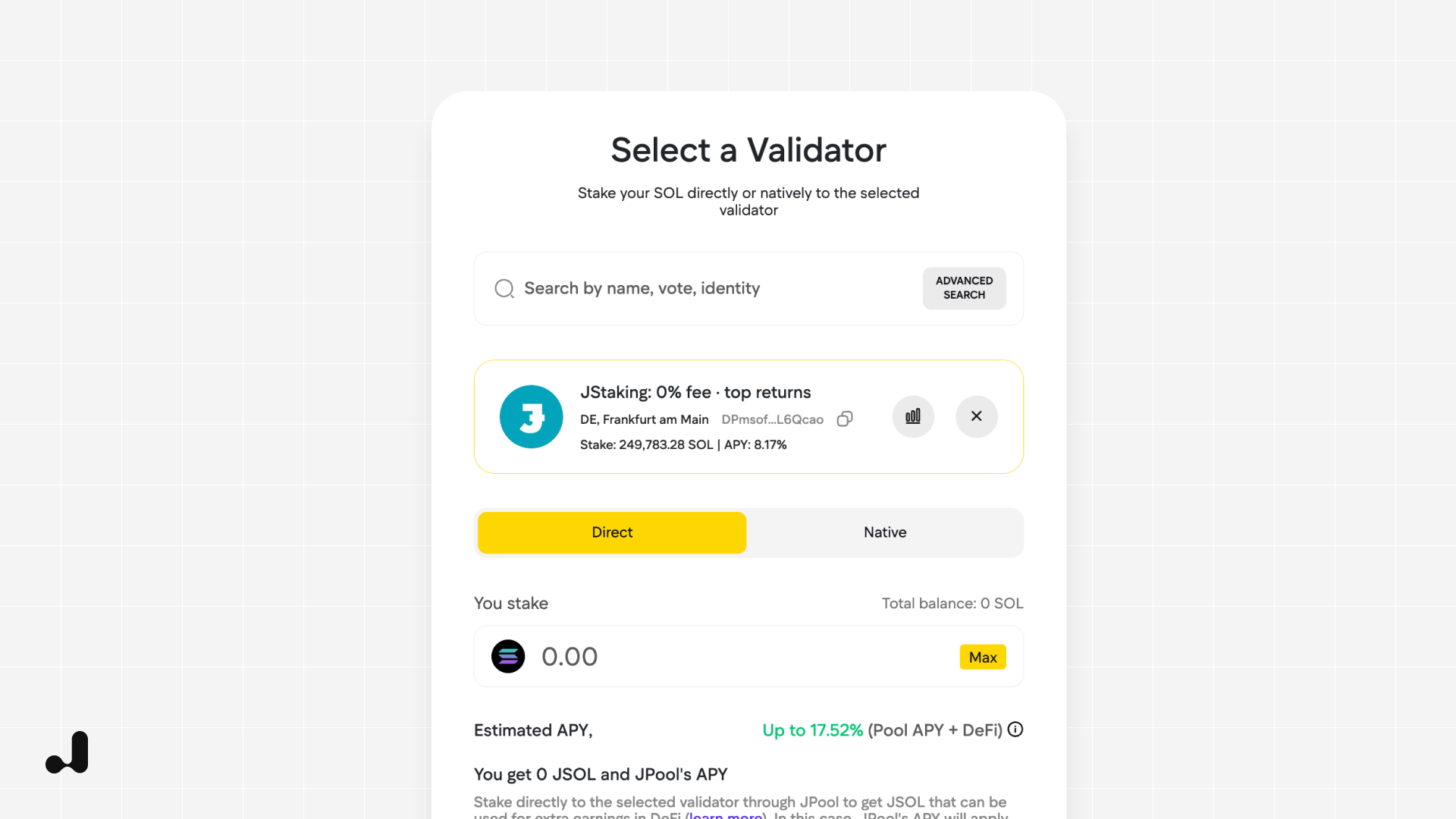
    We’ve completely reimagined the Direct Staking interface to be smarter, more intuitive, and packed with features that matter. The new design makes it easier than ever to find the best validator for your purposes — whether you’re optimizing returns, supporting decentralization, or implementing a diversified staking strategy.

    Choose Direct to delegate SOL through JPool and instantly receive JSOL in return. Your SOL still sits with the validator of your choice, but JSOL gives you far more firepower:

    • Always liquid: trade or deploy JSOL across DeFi without waiting for an unlock period.
    • Auto-compounded rewards: JPool pools earnings and reallocates them using its Smart Strategy, so your yield grows on autopilot.
    • Zero maintenance: no need to manage stake accounts or manually restake; JPool handles everything.

    Prefer the old-school route? The Native option delegates SOL straight to a validator and forgoes JPool. You’ll pick up that validator’s raw APY—but:

    • Your SOL are locked until you unstake.
    • Rewards are not auto-compounded; you will need to manage restaking yourself.
    • No liquid token means no DeFi opportunities such as lending or liquidity mining.

    The Native alternative suits purists who are willing to manage their stake on their own. For almost everyone else, the liquidity, smart delegation management, and auto-compounding benefits of the Direct option make it the perfect choice.

    Deep Dive: Inside the Validator Dashboard

    Each validator on JPool has its own dedicated dashboard designed for both delegators and validators. It’s your control center for monitoring, comparing, and optimizing financial and operational performance. Let’s break down the dashboard’s useful features below!

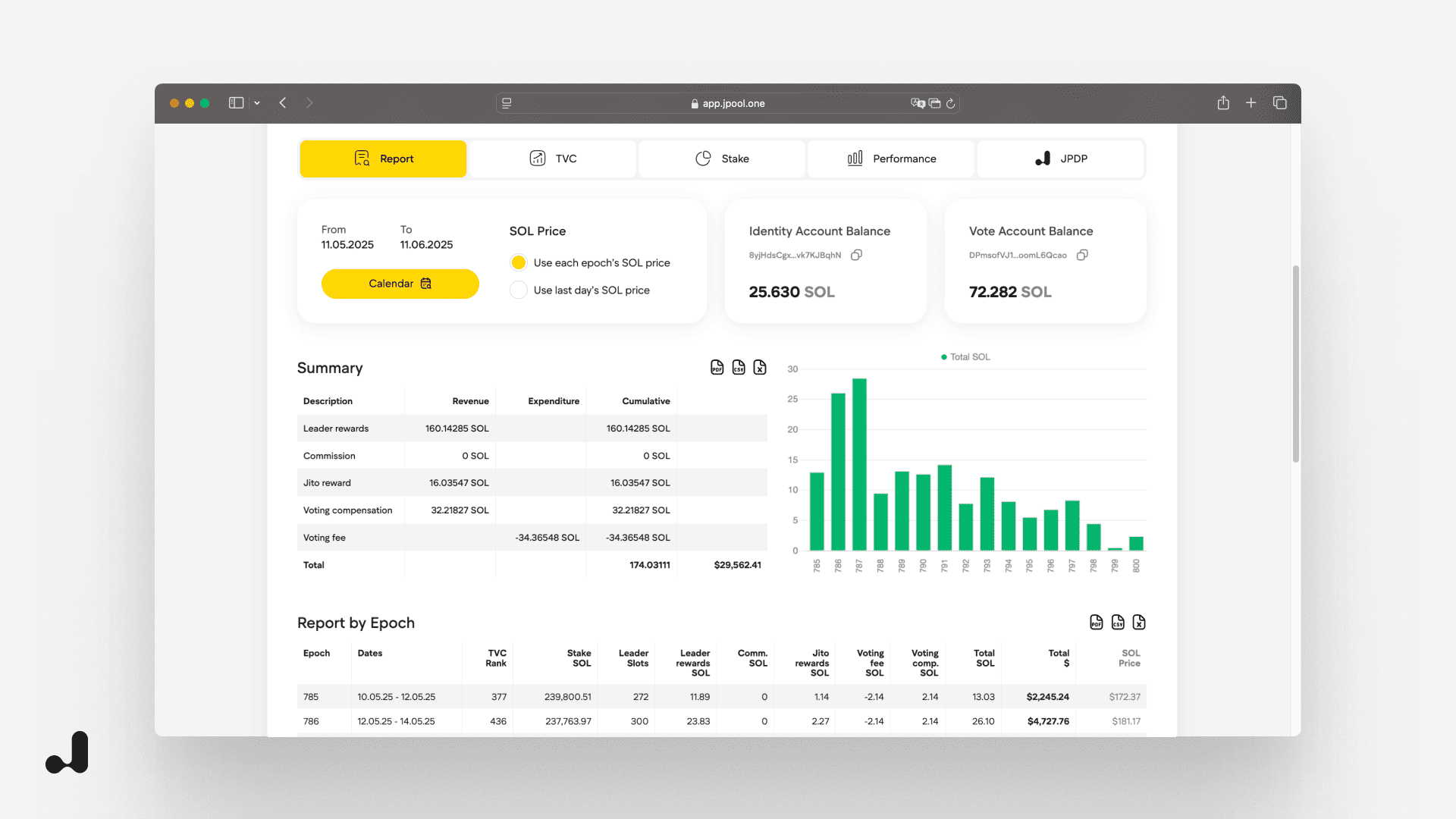
    1. Report – Know Your Numbers at a Glance

    The Report tab turns raw on-chain data into a crystal-clear earnings statement.

    • Custom date range: Pick any period you care about—whether that’s a single epoch or an entire quarter.
    • Instant financial snapshot: A summary rolls up every revenue and expense stream—Leader rewards, Jito MEV, voting compensation, fees, and more—so you can see net SOL earned (and their value in USD) in one clean row.
    • Epoch-by-epoch breakdown: Dive deeper with a line-item table that logs every epoch’s stake size, rewards, fees, and TVC (timely vote credits) rank. Perfect for spotting trends or pinpointing anomalies.
    • Visual earnings graph: A bar chart plots total SOL earned per epoch, making growth spurts and slow patches pop at a glance.
    • One-click export: Need to share or archive the data? Download the full report in PDF, CSV, or XLS with a single click.

    💡 Why it matters: From big-picture profitability to granular epoch analytics, the Report tab gives validators—and the delegators who back them—complete financial transparency.

    2. TVC – Drill Down Into Timely Vote Credits

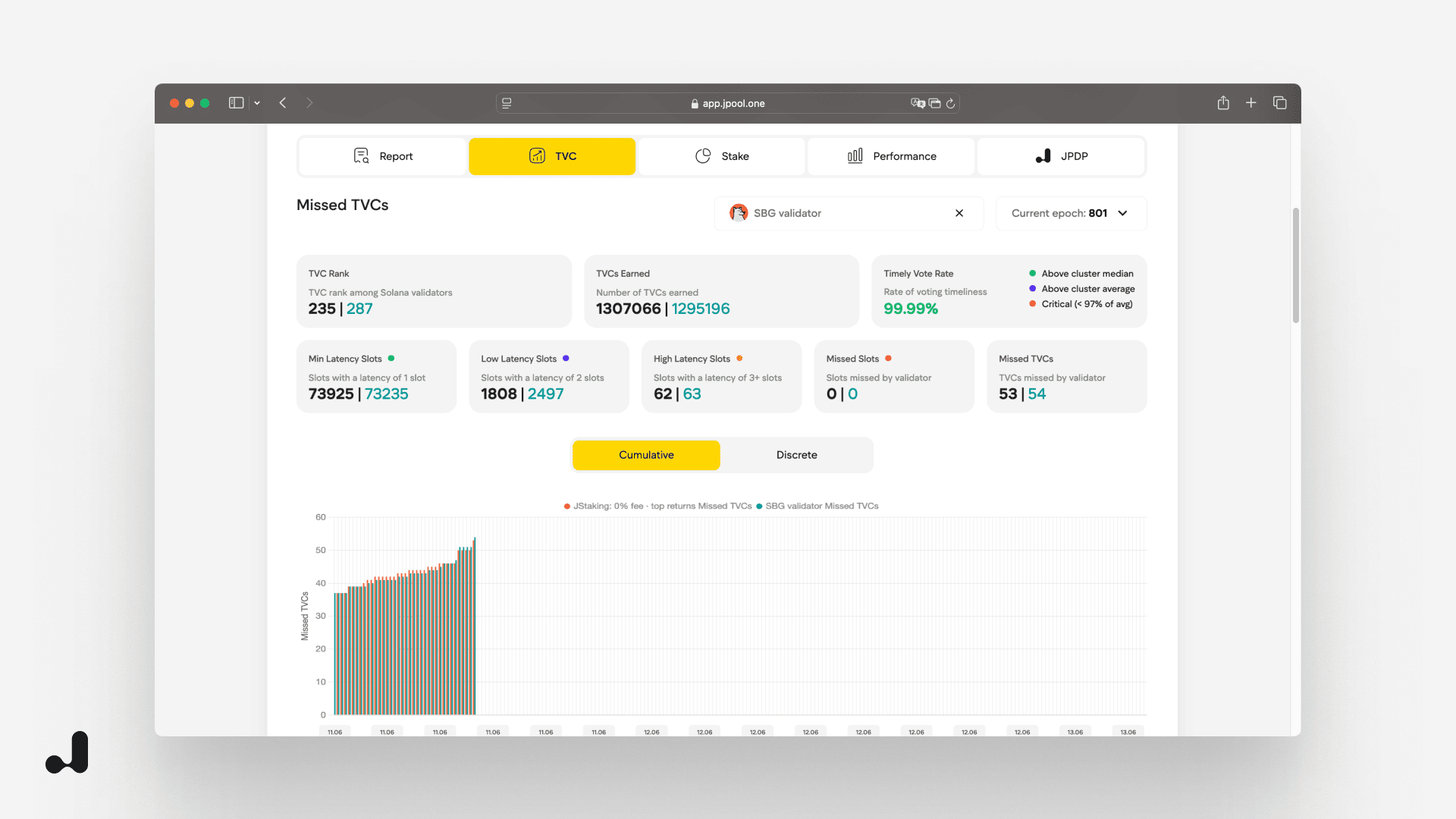
    Timely Vote Credits metric measures how quickly and consistently a validator submits its votes. The TVC tab visualizes this raw performance data so you can reliably assess the quality of the node’s infrastructure without guesswork.

    • Performance snapshot: Instantly see headline figures such as TVC Rank among all Solana validators, a color-coded Timely Vote Rate, and counts of min-, low-, and high-latency vote slots—plus any missed slots or TVCs.
    • Validator comparison: Pull in a second validator and watch every metric update side by side to benchmark uptime and latency in real time.
    • Missed TVC timeline: Toggle between cumulative and discrete charts that plot each missed credit by timestamp, revealing exactly when issues emerge or escalate.
    • Granular vote analytics: Dive into the Vote Details table to inspect every batch—start time, slot range, average latency, and any credits or slots missed—for pinpoint debugging and performance tuning.

    💡 Why it matters: The lower your missed TVCs, the better your performance score — and higher your chances of earning delegated stake.

    3. Stake – See Specifically Who Holds the Tokens, and How They Move

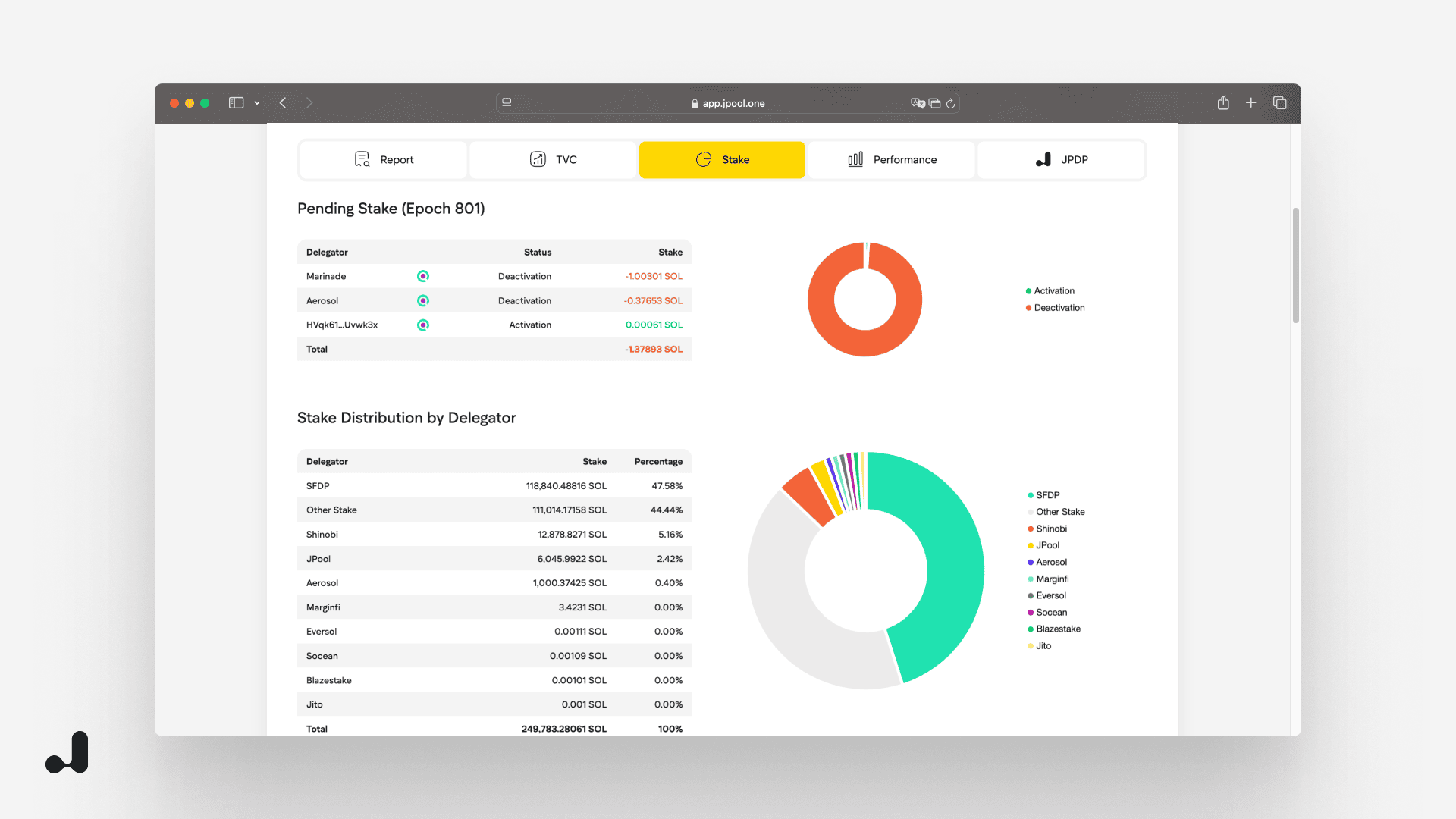
    The Stake tab turns stake movement into an open book, revealing who’s funding a validator, where that SOL is going next, and how the picture shifts epoch after epoch.

    • Stake change over time: A bar chart plots total stake each epoch, making growth spurts, churn events, or long-term plateaus impossible to miss.
    • Pending activations & deactivations: A live donut plus table surfaces stake scheduled to enter or exit, so you can gauge short-term inflows and outflows before they hit the ledger.
    • Delegator distribution: A breakdown by delegator—liquid staking pools, DAOs, whales, or retail wallets—shows exactly who holds what percentage today, paired with a color-matched donut for instant context.

    💡 Why it matters: Understanding stake dynamics lets you spot concentration risk, anticipate liquidity shocks, and market your validator more effectively to the delegator segments that matter most.

    4. Performance – Measure the Metrics That Drive Rewards

    The Performance tab pulls a validator’s operational stats into one dashboard, so you can gauge efficiency, reliability, and profitability in a single glance.

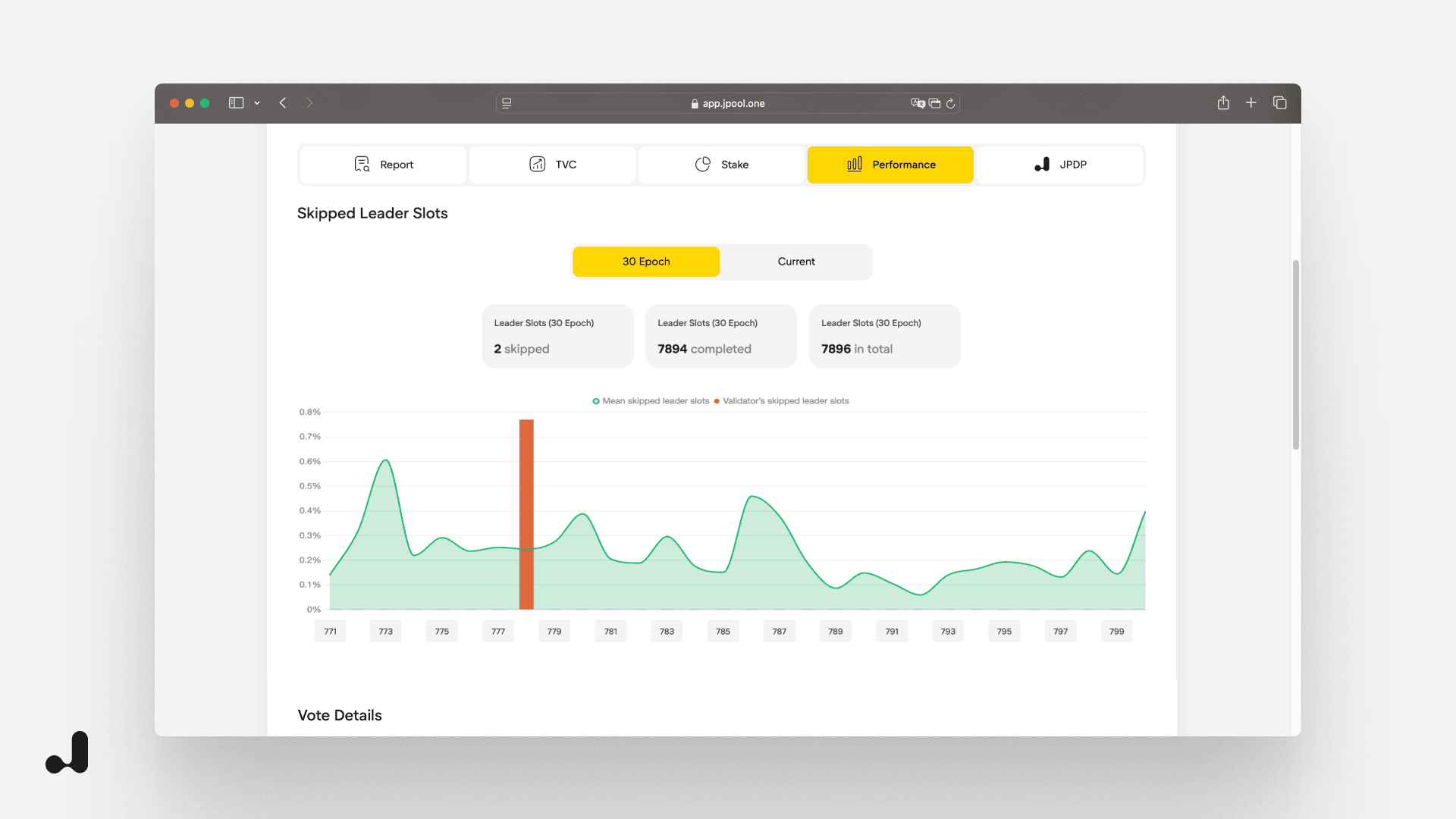
    • Skipped leader slots: A dual-mode chart compares your skipped-slot rate to the cluster average across 30 epochs or the current one, making outliers jump straight off the page.
    • Validator APY vs. cluster: Side-by-side bars track your epoch-by-epoch APY against the network average, revealing whether you’re adding—or eroding—delegator yield.
    • Income mix (30-epoch view): A stacked line-and-bar plot breaks down total earnings into commission, leader-slot rewards, Jito rewards, voting compensation, and fees, so you know exactly what’s moving the bottom line.
    • Timely Vote Credits trend: A combined bar/line graph shows your TVC count and rank per epoch, letting you cross-check voting performance, never leaving this single tab.
    • Commission history: A flat or fluctuating line tracks your commission rate over time, spotlighting any tweaks that could spook (or attract) delegators.

    💡 Why it matters: Delegators judge validators on uptime, yield, and consistency. With every core metric in one place, you can prove your performance, pinpoint weak spots, and showcase hard numbers that earn trust—and more stake.

    5. JPDP – Track Your Standing in the JPool Delegation Program

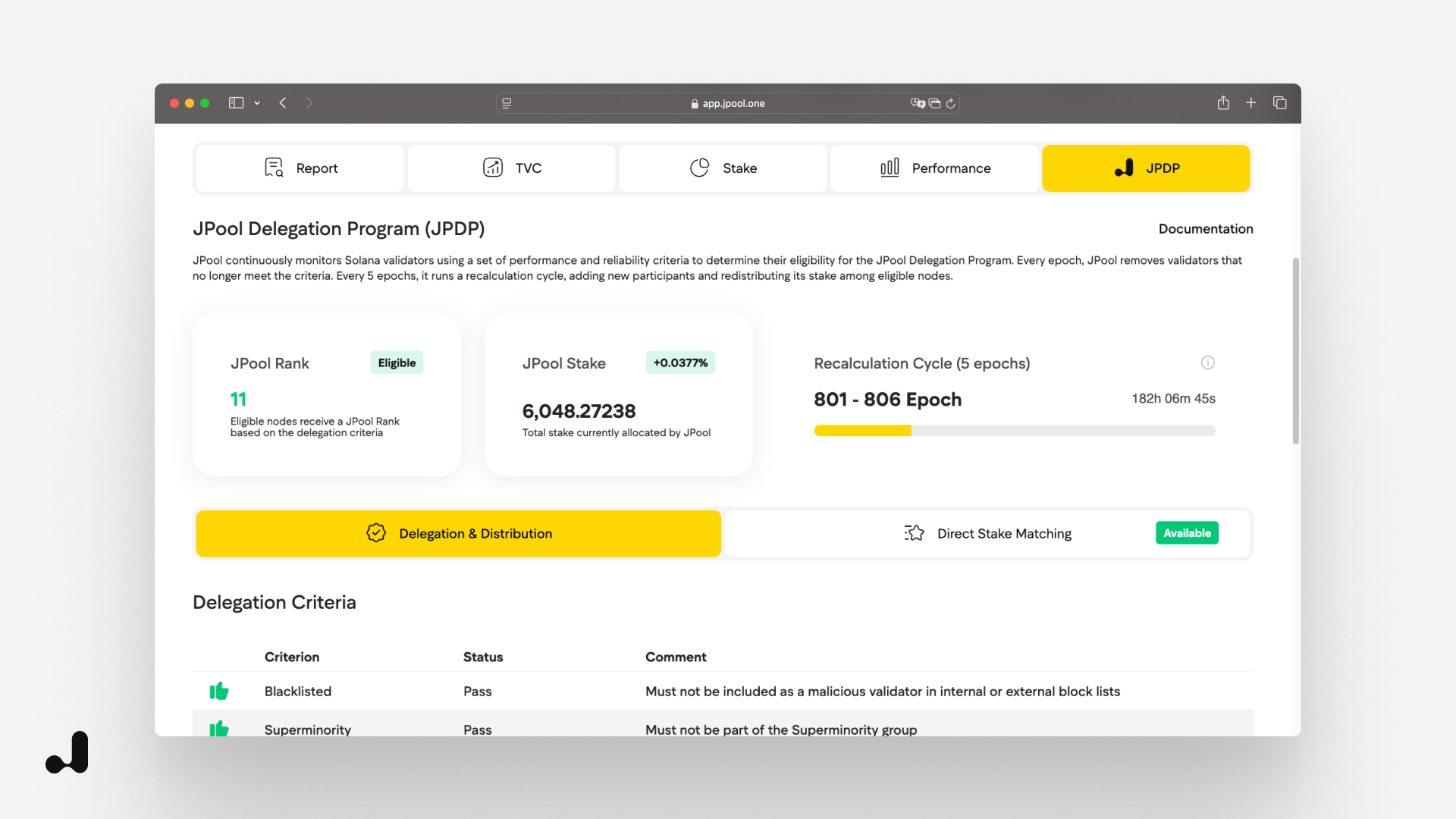
    The JPool Delegation Program (JPDP) tab shows exactly how—and why—JPool is allocating stake to your validator. Eligibility is recalculated every five epochs, so this view is your real-time scorecard for attracting, retaining, or boosting JPool delegations.

    • Eligibility snapshot: Large info cards display your current JPool Rank, the amount of JPool Stake already delegated, and a live countdown to the next five-epoch recalculation cycle.
    • Delegation criteria checklist: A pass/fail table walks through every requirement—from commission caps to Superminority status—so you can spot (and fix) any blockers before the next review.
    • Distribution breakdown: Forecast boxes estimate the stake you’ll receive next cycle and the delta versus your current amount, while a detailed table splits that stake into buckets such as Community Good, JPool Boost, Base Delegation, and more.
    • Direct Stake Matching: A dedicated pane lists wallets that have staked directly to your validator and shows the extra SOL JPool is matching—up to 20k SOL—to reward those delegations.

    💡 Why it matters: JPDP stake can substantially boost your validator’s earnings and visibility. This tab tells you, in plain language, what you’re getting now, what you could get next epoch, and what concrete actions keep you in the running.

    Validator Profit Calculator

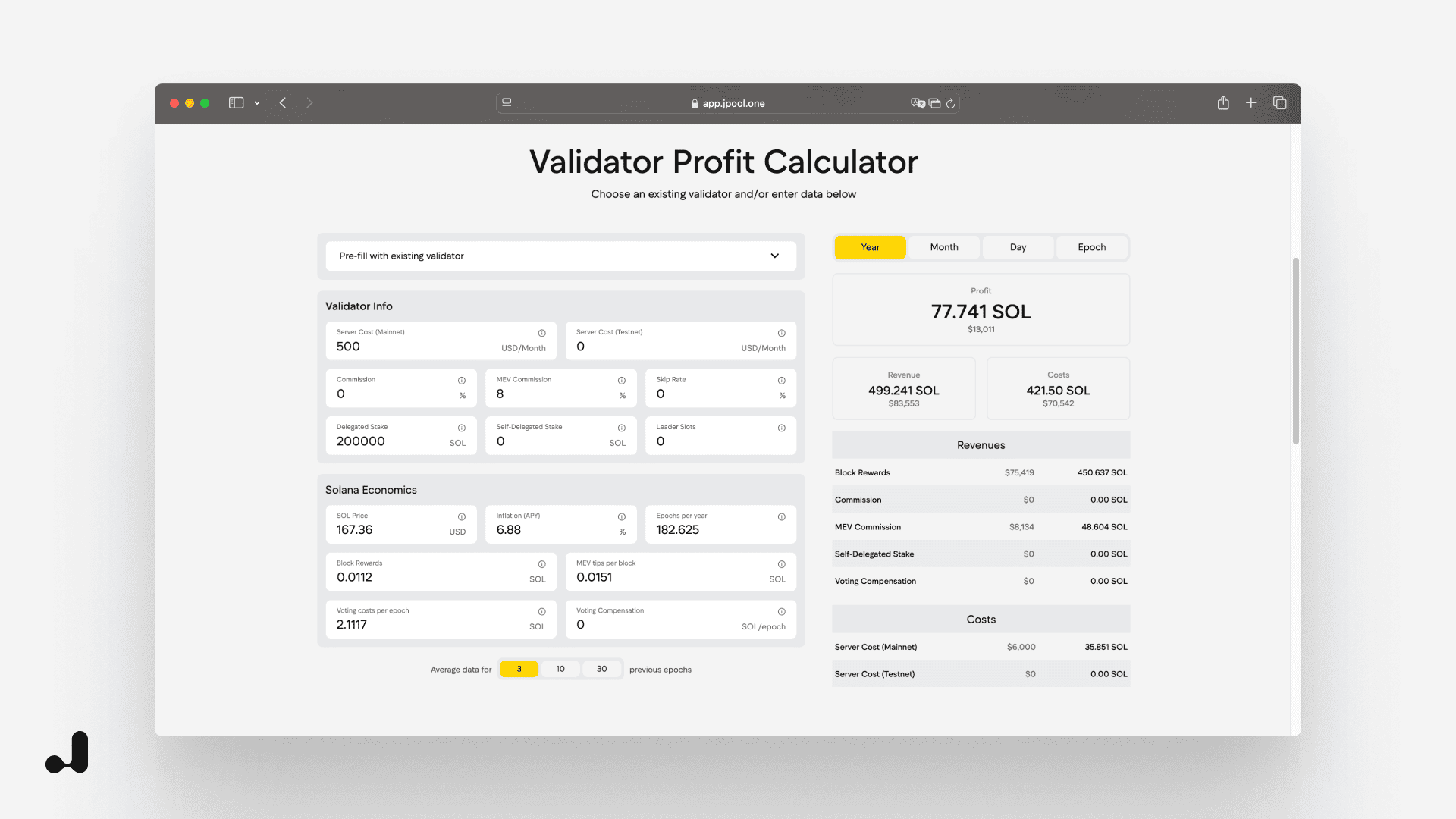
    With our Validator Profit Calculator, you can now easily estimate your expected returns when delegating to a specific validator. By adjusting the amount of SOL and viewing projected annual rewards, you get a clearer picture of potential profits—empowering you to compare validators not just on trust and performance, but also on projected yield.

    👉 Try it now: Validator Profit Calculator

    Explore. Compare. Stake Smarter.

    Whether you’re a passionate supporter of decentralization or a yield-driven investor, JPool’s upgraded interface gives you everything you need to make better staking decisions — from validator reliability to network diversity and beyond.

    🔗 Explore Direct Staking

    🔗 View All Validators