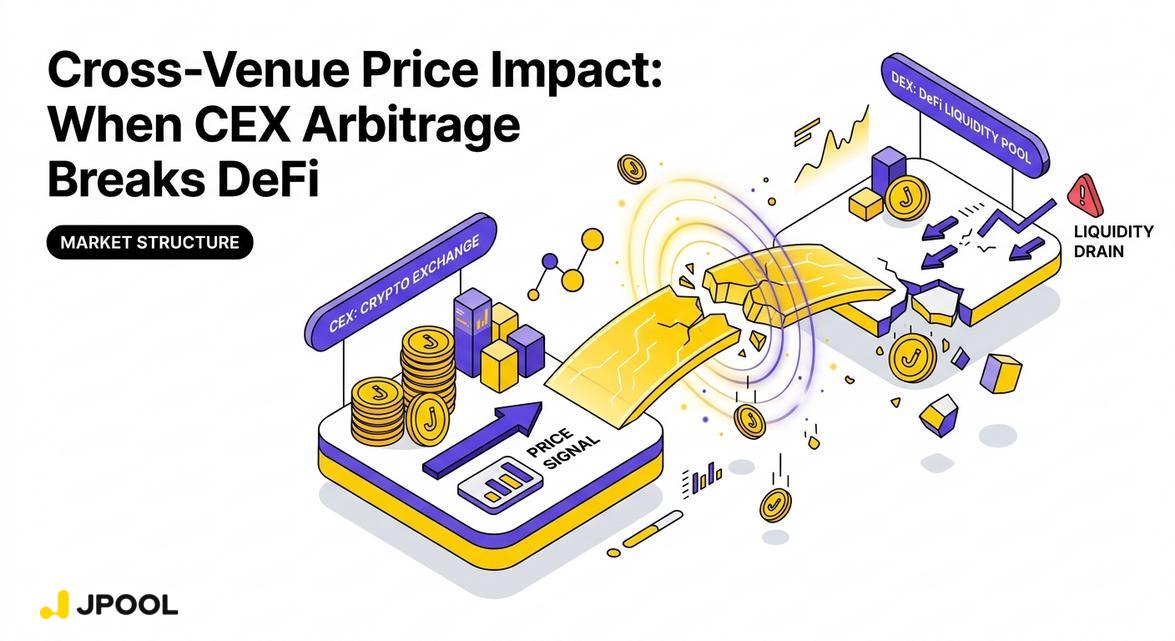
Solana’s sub-second finality is its greatest performance achievement. It is also the structural condition that makes cross-venue price impact uniquely dangerous on this network. When a large market order moves the SOL/USDT price on Binance, the arbitrage window that opens on Solana DEXs does not last minutes — it lasts slots. And within those slots, every DeFi protocol relying on an on-chain oracle is exposed to a deviation that the protocol’s design cannot anticipate.
Table of Contents
- The Propagation Path: From Binance Order Book to Solana DEX
- Single-Slot Oracle Deviation: The Attack Surface DeFi Ignores
- Why Cross-Venue Arbitrage Is Not a Market Efficiency Story
- The Staking Layer’s Exposure: APY Volatility as a Cross-Venue Signal
- The Bond as a Structural Buffer Against Oracle-Driven Yield Shocks
- What Cross-Venue Market Structure Means for Liquid Staking Selection
This is not a theoretical risk. It is a structural feature of how centralized and decentralized venues interact at the speed of Solana’s consensus.
The Propagation Path: From Binance Order Book to Solana DEX
Understanding cross-venue price impact on Solana requires mapping the exact propagation path of a price shock.
A large sell order on Binance moves the CEX mid-price. Within milliseconds, co-located arbitrage bots detect the spread between the new Binance price and the stale price on Solana DEXs — Jupiter aggregator routes, Orca concentrated liquidity pools, Raydium AMMs. These bots construct arbitrage transactions and submit them to Solana validators, targeting inclusion in the next available slot.
Here is where Solana’s architecture creates a specific vulnerability. Because Solana produces blocks approximately every 400 milliseconds, the window between a CEX price movement and its reflection in DEX liquidity is measured in slots, not seconds. During this window — which may span one to three slots depending on network congestion and validator scheduling — the on-chain price visible to DeFi protocols diverges from the true market price.
This divergence is not random noise. It is a directional, predictable deviation that sophisticated actors can exploit. The CEX-to-DEX arbitrage flow is not merely corrective — it is the mechanism through which the deviation is resolved. But in the interval before resolution, any protocol that reads the on-chain price as ground truth is operating on stale data.
Single-Slot Oracle Deviation: The Attack Surface DeFi Ignores

The phrase “oracle manipulation” typically evokes multi-block TWAP attacks. Single-slot oracle deviation is a distinct and less-discussed phenomenon.
A single-slot deviation does not require an attacker to manipulate oracle state across multiple blocks. It requires only that a sufficiently large CEX price movement occurs, that the on-chain oracle has not yet updated, and that a DeFi protocol executes a state-changing operation — a liquidation, a borrow limit check, a collateral valuation — within that deviation window.
The risk is asymmetric. Liquidation engines that trigger on stale low prices can force borrowers into liquidation at prices that do not reflect actual market conditions. Lending protocols that accept collateral valuations based on a momentarily elevated on-chain price can extend credit against collateral that is already worth less on every other venue. The protocol acts correctly according to its own logic — it reads the oracle, it executes the rule — but the oracle input is temporarily decoupled from reality.
What makes this particularly acute on Solana is the combination of three factors:
- Speed without synchronization. Solana’s slot time is fast enough that oracle update transactions and arbitrage transactions compete for the same block. Whether the oracle update lands before or after the arbitrage transaction is a function of fee priority and validator scheduling — not a guarantee.
- Concentrated liquidity depth. Solana DEX pools, particularly concentrated liquidity positions, can exhibit sharp price impact on large trades precisely because liquidity is positioned tightly around the current price. A single large arbitrage transaction moving the pool price creates a momentary on-chain price that diverges significantly from the CEX reference.
- Atomic composability. Solana’s parallel execution model allows complex multi-instruction transactions. An actor who identifies a single-slot deviation can construct a transaction that reads the stale oracle, executes a protocol interaction that benefits from the deviation, and settles — all within a single atomic operation before the oracle corrects.
Why Cross-Venue Arbitrage Is Not a Market Efficiency Story
The standard framing of CEX-DEX arbitrage is benign: arbitrageurs correct price discrepancies and improve market efficiency. This framing is accurate at the aggregate level and over sufficient time horizons. It obscures what happens at the slot level.
Cross-venue arbitrage on Solana is not a passive correction mechanism. It is an active extraction process. The arbitrageur captures the spread between the CEX price and the DEX price. The cost of that extraction is borne by the DEX liquidity providers — who sell at the stale price — and by any DeFi protocol user whose position is evaluated during the deviation window.
The extraction is not uniformly distributed across the validator set either. As covered in JPool’s analysis of MEV supply chain centralization, high-value arbitrage transactions are routed through MEV infrastructure to validators with the technical capacity to process them. This means that cross-venue arbitrage revenue concentrates among the same validators who already dominate MEV capture — compounding the stake concentration dynamics that liquid staking protocols must actively counteract.
The Staking Layer’s Exposure: APY Volatility as a Cross-Venue Signal
Cross-venue price impact does not stay contained within the DeFi protocols it directly affects. It propagates into staking economics through a less-obvious channel: validator APY volatility.
Validators who participate in MEV infrastructure capture cross-venue arbitrage revenue as part of their block rewards. When a large CEX price movement creates a rich arbitrage opportunity, MEV-participating validators capture elevated revenue in that epoch. Validators outside the MEV routing layer do not. The result is epoch-to-epoch APY variance that is partially driven by cross-venue market structure events — not by any change in the validator’s operational quality.
This creates a diagnostic problem for liquid staking protocols. A sharp APY drop in a given epoch may reflect genuine validator underperformance, or it may reflect the validator’s position in the MEV routing hierarchy relative to a period of elevated cross-venue arbitrage activity. Treating these as equivalent signals produces incorrect delegation decisions.
JPool’s delegation program addresses this through two mechanisms that are specifically calibrated for this type of volatility.
- The 30-epoch APY average for Performance ranking. JPool’s Performance tier ranks validators by APY-30 (30-epoch average) as the primary criterion, followed by credits ratio, APY-10, APY-3, current APY, and validator age as successive tiebreakers. A single epoch of elevated or depressed MEV revenue does not move a validator’s ranking meaningfully. The 30-epoch window smooths cross-venue arbitrage windfalls and droughts out of the performance signal, leaving a cleaner measure of sustained operational quality.
- The suspicious APY drop detection layer. JPool’s monitoring system flags validators who exhibit an APY drop of more than 20% relative to the previous epoch as suspicious — triggering a visible warning in the Validator Dashboard. A drop exceeding 50% in absolute terms triggers instant removal from the delegation program. This detection layer serves a dual function: it catches genuine validator failures, and it surfaces anomalous yield behavior that may indicate a validator’s MEV participation status has changed — a relevant signal in a market where cross-venue arbitrage revenue is a material component of total validator income.
Critically, validators with a bond health at 100% are exempt from the suspicious APY drop check. This exemption is not a loophole — it is a design choice that recognizes the bond as a credible commitment device. A validator who has posted sufficient collateral to cover APY shortfalls has already internalized the cost of underperformance. The bond system converts the abstract risk of cross-venue-driven APY volatility into a concrete, on-chain financial obligation.
The Bond as a Structural Buffer Against Oracle-Driven Yield Shocks

JPool’s bond system — a unified collateral mechanism serving both security and performance guarantees — is particularly relevant to cross-venue price impact risk in a way that is rarely articulated.
The bond’s performance function is straightforward: if a validator’s actual APY falls below JPool’s Target APY in a given epoch, the bond covers the shortfall for delegators. The Target APY itself is calculated as the mean APY of the top 30 validators (by 10-epoch average) among validators with non-JPool stake of 750,000 SOL or less — recalculated every epoch.
In the context of cross-venue arbitrage dynamics, this mechanism has a specific implication. If a period of elevated CEX-to-DEX arbitrage activity produces a temporary spike in MEV revenue for a subset of validators — pushing the Target APY upward — validators outside the MEV routing layer face a larger performance bond requirement for that period. The bond system does not eliminate this exposure, but it makes it financially explicit and collateralized. Delegators are guaranteed the target yield regardless of where their validator sits in the cross-venue arbitrage capture hierarchy.
The bond health tiers further structure this exposure. A validator whose bond health falls to the 80–99% range enters a grace period — a signal that performance pressure is building before it becomes a delegation cut. The 50–79% range triggers a 50% stake reduction. Below 50%, delegation is capped to bond capacity or the validator is flagged for removal. This graduated response means that cross-venue-driven APY pressure surfaces as a measurable, actionable signal in JPool’s monitoring infrastructure before it becomes a delegator yield event.
What Cross-Venue Market Structure Means for Liquid Staking Selection
For advanced DeFi users evaluating liquid staking options on Solana, cross-venue price impact introduces a selection criterion that is rarely discussed: how does the protocol’s delegation architecture respond to the MEV revenue volatility that cross-venue arbitrage creates?
A liquid staking pool that delegates primarily to MEV-dominant validators maximizes expected APY under normal cross-venue arbitrage conditions — but concentrates exposure to the validators most likely to exhibit sharp APY swings when cross-venue arbitrage conditions change. A pool that delegates across a broader, structurally diverse validator set accepts a modest expected APY reduction in exchange for a smoother, more predictable yield profile.
JPool’s architecture reflects the second approach. The Cascade allocation system — prioritizing Community Good validators, then Direct Stake validators, then Performance validators — distributes delegation across validators with materially different MEV participation profiles. The 5% per-validator pool stake cap ensures that no single MEV-dominant validator can concentrate the pool’s yield exposure. The 30-epoch APY averaging prevents short-term cross-venue arbitrage windfalls from distorting delegation decisions.
The result is a liquid staking pool whose yield profile is structurally less correlated with single-epoch cross-venue arbitrage events — not because it avoids MEV-participating validators entirely, but because its delegation architecture prevents any single cross-venue market structure event from dominating the pool’s aggregate yield.
For users whose JSOL holdings are deployed as collateral in lending protocols or liquidity positions — where yield stability directly affects position health — this structural property is not a secondary consideration. It is a primary risk parameter.
Explore JPool’s liquid staking infrastructure and validator delegation program at jpool.one.
Subscribe to our digest pages and stay updated:
Facebook Community · Instagram · Threads · Pinterest
Leave a Reply