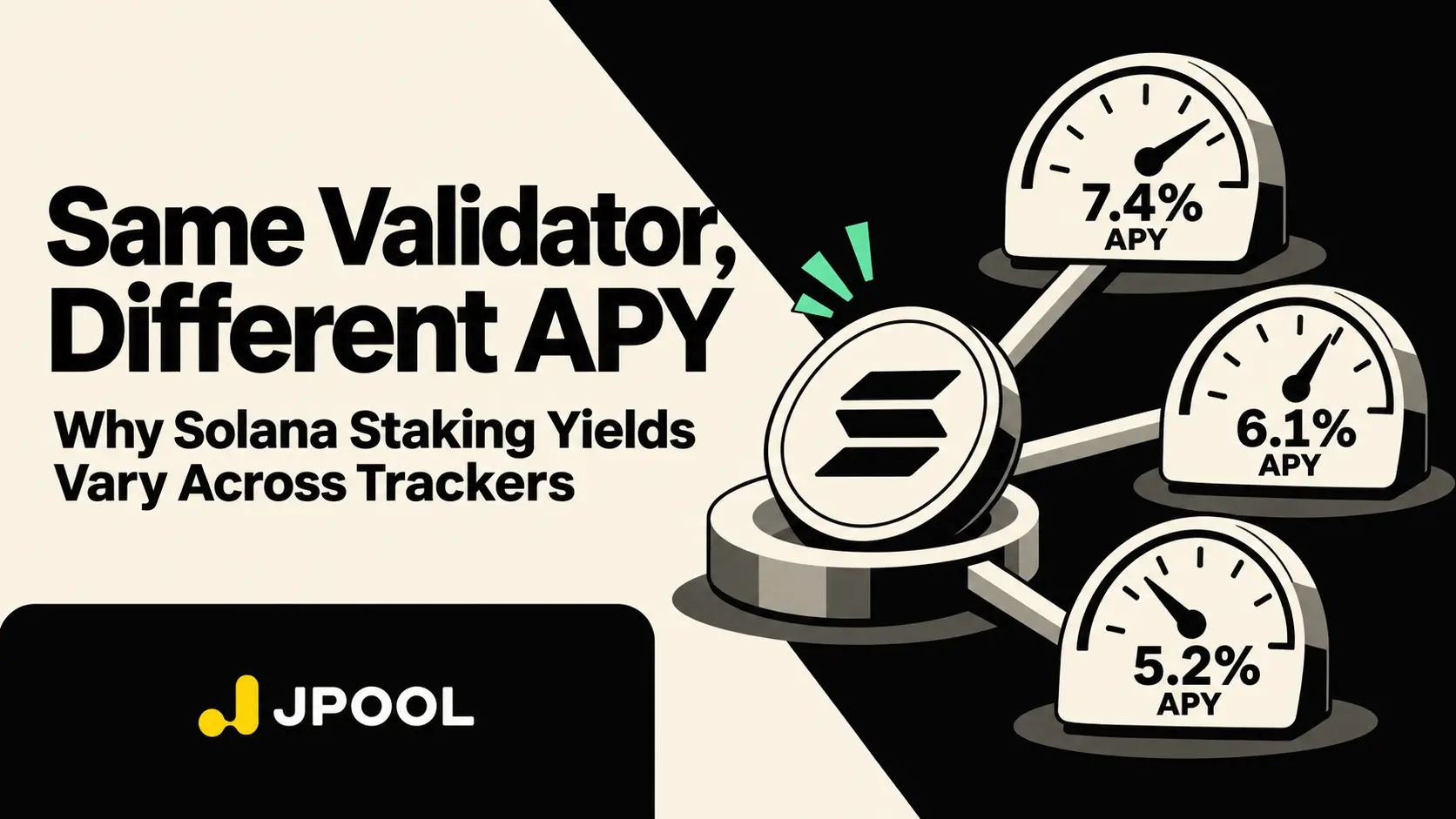
Pick a Solana validator today and you read its yield off a dashboard. Open a second dashboard for the same validator and the number changes. Open a third and it changes again. These are not stale caches or rounding differences. On one ordinary afternoon, the same validator read 3.2% on one tracker and 28.57% on another, a nearly nine-fold gap, and nothing on either page warned you the other existed.
Table of Contents
Open Three Trackers, Get Different Numbers
On October 27, 2026, with Solana mainnet midway through epoch 1069, the Cryptology validator showed four different yields across three trackers: 3.20% on Solana Compass, 3.96% on Stakewiz, and 25.57% and 28.57% on two Trillium views. The single closed epoch itself came to 2.34%, which is what that epoch’s reward actually paid. This is not an exotic validator chosen to make a point. A second established validator, Serhio911, moved the same way: 4.1% on Compass, 4.31% on Stakewiz, and 3.00% for the raw epoch.
Here is what it costs you. Compare two validators on Stakewiz and you see 3.96% against 4.31%, so you lean toward the second. For the single closed epoch itself the same two read 2.34% and 3.00%. You would still pick the same validator, but the yield you would plan around changes by more than a full percentage point depending only on which tab you opened.
For a treasury sizing a position, that is the difference between a sound projection and a fictional one. If you delegate as an individual, the stakes are plainer: you pick the validator with the best number you can see and leave your stake there, so the figure that made the decision is the one you count on. It is also the one least likely to hold, because the highest reading is often a lucky epoch rather than the better operator. No dashboard flags it in either case.
Nobody Is Measuring It Wrong
It would be natural to assume some of these sites are simply wrong. They are not. For epoch 1068, four independent trackers computed the same underlying per-epoch reward for Cryptology and agreed to within a rounding error, about five thousandths of a percentage point. The measurement is not in dispute.
The spread appears entirely in what each site does with that number before it is shown on-screen. Same reward, different display rules. Once you see that the number is agreed and only the presentation differs, the gap is a matter of display choices, not a measurement error. It also points to the fix: if every site adopted a shared methodology and turned a reward into a yield the same agreed way, the number would match wherever you looked.
Why the Numbers Diverge
No site can show you a single day’s reward and call it a yield. One epoch is too noisy to display raw, so every tracker has to smooth it into something stable. That smoothing is a set of judgment calls, and different sites make different calls, which is where the gap comes from.
The noise has a specific source, and the Alpenglow upgrade intensified it. A validator does two jobs, and its reward now splits between them. One half is earned by voting, which it does every epoch, so that part is steady and scales with its stake. The other half is paid only for the blocks it is chosen to produce as a leader, and which blocks it gets is a random, stake-weighted draw held before each epoch. Call it leader luck: a validator entitled to a share of blocks draws a number around that share, sometimes above, sometimes below. Because half the reward depends on that draw, a single day’s number is partly luck, not skill.
How much luck you see depends on the validator’s size. Think of coin flips: a single flip is all or nothing, but many flips land close to half. A large validator is entitled to many blocks every epoch, so its draws average out within that epoch and a single day reads close to the truth. A small one is entitled to only a handful, so each epoch is nearly all or nothing. A validator with a few hundred SOL staked draws no blocks at all in most epochs, then gets a whole batch of them in a single epoch. Its one-day yield swings from near zero to many times the average, none of it reflecting any change in how well it runs.
Every tracker starts from this same noisy number and processes it differently: how far back to look, how to blend those epochs, what to throw out, and which rewards to count. A tracker can lean on the single closed epoch alone. Compass averages five. Stakewiz takes a ten-epoch median. Trillium uses a recency-weighted blend and keeps a one-time migration payout that lands Cryptology at 25% and above. Four defensible choices, four different numbers, all pointing at the same validator.
Averaging More Epochs Doesn’t Fix It
The obvious fix is to average several epochs instead of leaning on any single one. It helps, but it cannot remove the problem, because an average of past yields is still built from the very thing luck distorts. The luck is not cancelled, only spread thinner.
A median is worse. It takes the recent epochs, sorts them by yield, and reports the middle value. For a small validator that draws blocks once every twenty epochs, most epochs are low, no-block epochs, so the middle value is a low epoch too. The median reports that floor and calls it the yield, understating a validator that is earning its full share on average. So for the small validators that need an honest number most, the median is the most misleading choice of all.
A Different Approach: Forecast, Don’t Average

JPool’s research proposes measuring yield a different way: forecast what a validator should earn, rather than averaging what it already paid. The method separates skill from luck.
It starts by measuring efficiency. In any epoch, a validator could have earned a certain maximum, set by the votes it was due to cast and the blocks it was drawn to produce. Efficiency is the share of that maximum it actually captured. Because the maximum is measured against the slots it drew, a lucky or unlucky draw cancels out, leaving a clean read on how well the validator operates.
It then projects that efficiency forward on the blocks the validator’s stake entitles it to, at current inflation and commission, rather than the blocks it happened to draw. Swapping entitled blocks for drawn ones is what takes luck out of the number.
Three Numbers Instead of One
A forecast shown alone would just be one more number to distrust. The proposal publishes three together. Expected APY is the luck-free forecast, the headline. Paid APY is what stakers actually received over the last 30 days, counting an epoch that paid nothing as a zero rather than quietly dropping it. Luck compares the two, showing how far actual payouts ran above or below the forecast, which makes the random draw visible instead of letting it distort the headline.
Tested against faithful rebuilds of the existing trackers, the forecast is about as accurate as the best of them for validators operating normally. That tie is no surprise: both are built from the same realized rewards. Its real advantage is catching validators whose pay has just stopped or started: one that quietly stopped, which a stale ten-epoch average still reports as earning a healthy 5%, or a newly active one the same average still shows as paying nothing.
This is an early, versioned proposal. Only twelve post-Alpenglow epochs exist to test it, and on normally operating validators alone the forecast is ahead in eight of them, so the result is encouraging rather than settled, and the research says so plainly.
What This Means When You Pick a Validator
Treat a single dashboard figure as one opinion, not the truth. Before you plan around a yield, check what the number actually is: last epoch’s result, a long average that may hide a validator that just stopped or started paying, or a forecast of what the validator should earn next. These are three different measures, and for a volatile validator they diverge greatly.
There is also a way to avoid the swings instead of planning around them. Staking through JPool spreads your stake across roughly 200 validators. One validator’s leader luck barely changes a pool that size, so your yield lands close to the expected rate every epoch, not on whatever blocks a single operator happened to draw.
A Shared Standard for Showing APY
One last point, aimed beyond individual delegators. Every tracker, wallet, and staking service that shows an APY makes these same display choices privately, which is the whole reason one indicator reads four ways on one afternoon. A delegator can only trust the number when the method behind it is shared and public, the same from one site to the next. JPool has put a proposal on the table and shown its work, every input recomputable from public RPC, meant to be argued with and improved on. If you measure or display Solana yield, or run staking of your own, help settle a common standard instead of shipping one more private number.
The full method, every formula, the backtest, and the on-chain inputs behind every number, live in JPool’s research article: A Standard for Solana Staking APY After Alpenglow. If you operate or allocate at any scale, it is worth the read before your next staking decision.
Leave a Reply