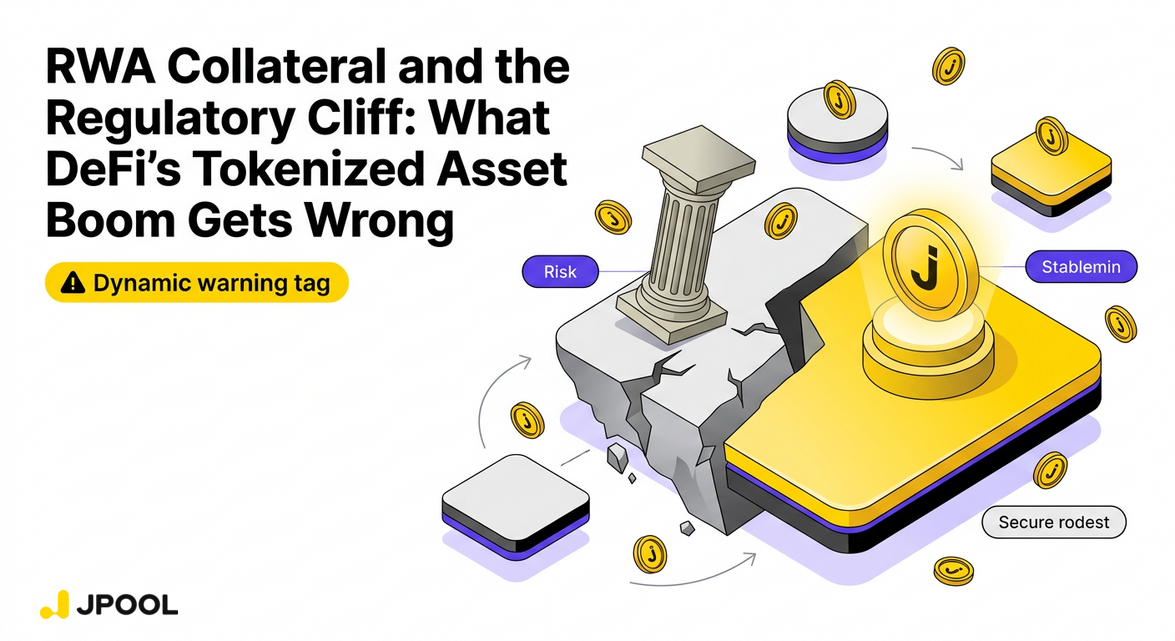
Tokenized real-world assets are being positioned as the maturation of DeFi — the moment when on-chain finance connects to the $100+ trillion world of traditional financial instruments. Tokenized T-bills, money market funds, and government bonds are flowing onto Solana, and DeFi protocols are accepting them as collateral. The narrative is compelling. The risk architecture underneath it is not.
Table of Contents
This article is not about whether RWAs will succeed. It is about a specific, underexplored failure mode that the current wave of tokenized asset adoption has embedded into DeFi’s collateral stack — and why that failure mode does not exist in native liquid staking assets like JSOL.
The Legal Wrapper That DeFi Forgot
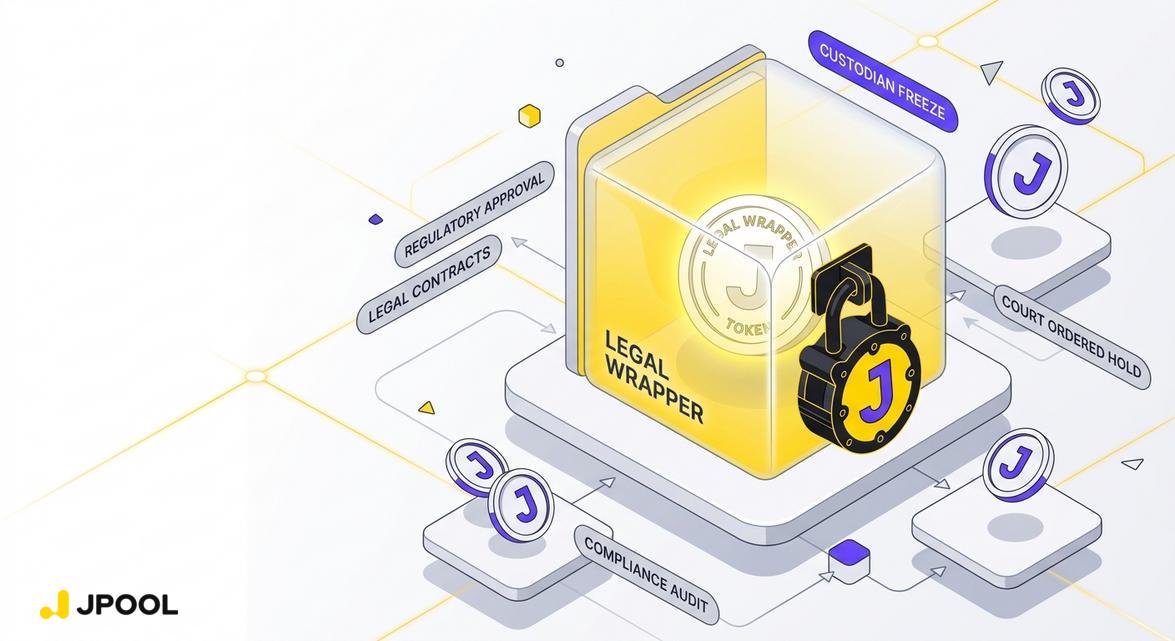
Every tokenized T-bill, money market share, or government bond on Solana has a legal wrapper. Behind the on-chain token is an off-chain entity: a special purpose vehicle, a fund administrator, a custodian, or a regulated issuer. The token is not the asset. The token is a claim on the asset — and that claim is only as good as the legal infrastructure that enforces it.
This distinction is not academic. It is the precise point where RWA collateral introduces a risk class that has no equivalent in native crypto assets. When you hold JSOL, you hold a cryptographically enforced claim on staked SOL managed by an immutable on-chain program. There is no off-chain counterparty whose insolvency, regulatory sanction, or jurisdictional conflict can sever that claim. When you hold a tokenized T-bill, you hold a claim that runs through at least one — and often several — off-chain legal entities whose continued operation is a prerequisite for your redemption rights.
DeFi protocols accepting RWA collateral are, whether they acknowledge it or not, accepting counterparty exposure to those off-chain entities. The smart contract does not know that the issuer has been sanctioned. The liquidation engine does not know that the custodian has frozen redemptions. The oracle does not know that the legal wrapper has been challenged in court.
Three Failure Modes the Collateral Stack Cannot See
Failure Mode 1: Issuer Regulatory Action
A tokenized T-bill issuer operating under a specific regulatory framework can be sanctioned, suspended, or ordered to halt operations by a regulator in any jurisdiction where it operates. When that happens, the on-chain token does not automatically reprice. It continues to trade at or near par until secondary market participants recognize the impairment — which may take hours or days. During that window, the token is being used as full-value collateral in lending protocols, LPs, and structured positions across DeFi. The collateral is impaired; the protocol does not know it yet.
This is not a theoretical scenario. The legal and regulatory framework governing tokenized assets is, as JPool’s own documentation notes, “far from settled and continuously evolving.” Existing laws, changes to the regulatory framework, and related measures by authorities “may affect the compliant issuance, domestic and international tradability and transferability or convertibility” of tokenized assets and “may potentially result in a full or partial loss of units or reduction of value.”
Failure Mode 2: Custodian Freeze
The underlying T-bills or bonds are held by a custodian. That custodian operates under its own regulatory obligations, which may include asset freezes in response to legal orders, AML/KYC compliance actions, or counterparty default. A custodian freeze does not break the on-chain token — it breaks the redemption path. The token continues to exist on-chain. Its claim on the underlying asset becomes temporarily or permanently unenforceable.
DeFi protocols holding this token as collateral now hold an asset with an uncertain redemption path. Liquidation mechanisms designed around the assumption of liquid, redeemable collateral encounter an asset that cannot be redeemed through normal channels.
Failure Mode 3: Legal Ineffectiveness of Tokenization
JPool’s documentation explicitly identifies this risk: “There is a risk that tokenization of the supposedly underlying rights and/or the transfer of such rights and obligations by transfer of a Token may not be legally effective and that, consequently, the Token does not constitute ownership and may result in a full or partial loss of rights or reduction of value.”
This is the RWA collateral regulatory risk in its most acute form. A court or regulatory authority in a relevant jurisdiction determines that the tokenization structure does not constitute a legally valid transfer of ownership. The on-chain token, regardless of its technical properties, does not represent what it claims to represent. Every DeFi protocol that accepted it as collateral is now holding a token with contested or nullified legal backing.
The Collateral Substitution Problem
DeFi protocols are not equipped to perform continuous legal due diligence on RWA collateral. Smart contracts accept collateral based on oracle prices, whitelists, and governance votes — not on real-time monitoring of issuer regulatory status, custodian operational health, or cross-jurisdictional legal enforceability.
This creates a structural blind spot. A tokenized T-bill and a native liquid staking token may sit side by side in a lending protocol’s collateral registry, assigned similar risk parameters, treated as equivalent in liquidation logic. They are not equivalent. One carries a continuous, invisible dependency on off-chain legal infrastructure that the protocol cannot monitor. The other — a native LST like JSOL — carries no such dependency.
JSOL’s claim on staked SOL is enforced by the Solana Stake Pool Program: an open-source, immutable on-chain program that has undergone 9 independent security audits by firms including Kudelski, Neodyme, Quantstamp, OtterSec, and Halborn.
- There is no off-chain counterparty.
- There is no custodian.
- There is no legal wrapper that a regulator can invalidate.
JPool’s documentation is explicit: “JPool never has access to user funds. All staking, unstaking, and rebalancing operations are executed by the on-chain program with no intermediary.”
The collateral substitution problem is not that RWAs are inherently bad collateral. It is that DeFi’s risk infrastructure was built for assets whose risk is primarily technical and market-based — not legal and jurisdictional. Native LSTs fit that infrastructure. Tokenized RWAs introduce a risk dimension the infrastructure was not designed to price.
JSOL’s Structural Immunity and the Bond Layer
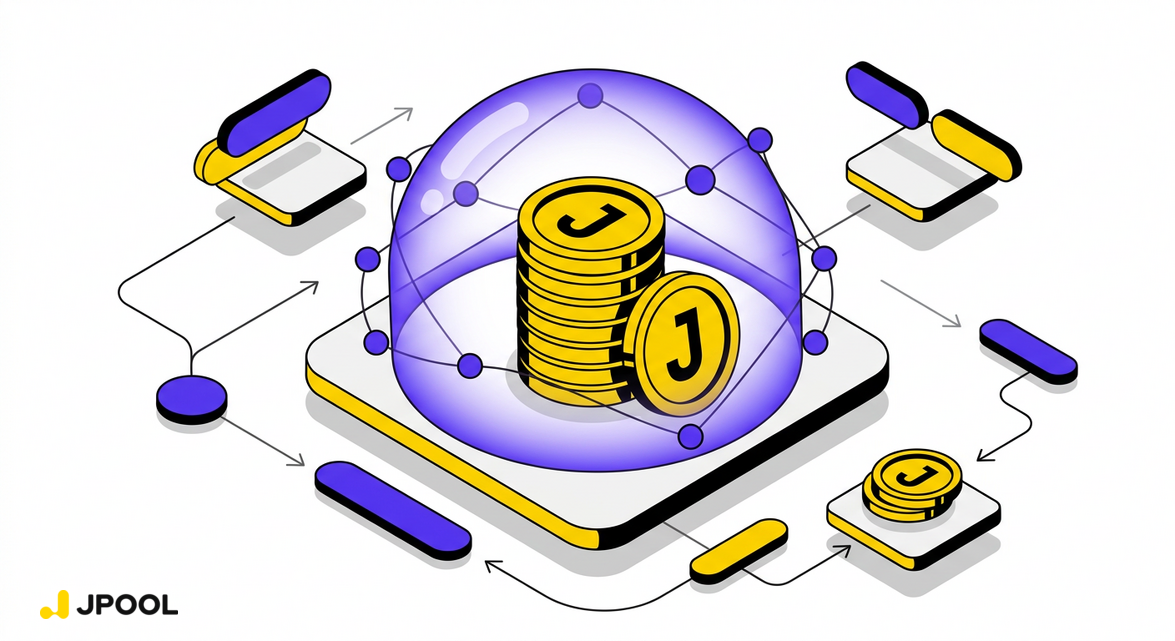
The contrast becomes sharper when examining what happens at the protocol level when collateral quality is questioned.
For RWA collateral, the failure cascade runs: regulatory action → oracle lag → protocol mispricing → bad debt. The protocol has no mechanism to detect legal impairment before it manifests as a price event.
For JSOL, the risk surface is fundamentally different. JSOL’s value is derived from staked SOL and the performance of validators in JPool’s delegation program. That performance is backed by an on-chain bond system: validators in the JPool Delegation Program are required to post a bond denominated in SOL, with a security component calculated at 0.5 SOL per 1,000 SOL of total validator JPool stake. This bond serves a dual function: it protects delegators against validator misbehavior or downtime, and it covers any deficit between a validator’s actual yield and JPool’s calculated Target APY.
The Target APY itself is recalculated every epoch, benchmarked against the mean APY of the top 30 validators meeting JPool’s eligibility criteria. If a validator’s performance falls short, the bond covers the shortfall directly. This is an on-chain, programmatic guarantee — not a legal representation made by an off-chain entity.
The governance layer reinforces this. JPool’s pool admin keys are protected by a Squads multisig with a 2-of-3 signing threshold, with authority keys stored on offline hardware wallets. No single operator can alter pool parameters, add or remove validators, or update fees unilaterally. The protocol’s integrity does not depend on trusting any single party — it depends on cryptographic thresholds enforced on-chain.
This architecture is structurally immune to the Solana RWA legal fragility scenario by design:
- There is no issuer to sanction.
- There is no custodian to freeze.
- There is no legal wrapper to challenge.
The claim JSOL represents — a proportional share of staked SOL plus accrued rewards — is enforced by code that no regulatory authority can modify.
The Risk Repricing That Hasn’t Happened Yet
DeFi’s current collateral risk models treat RWA tokens primarily as credit and market risk instruments. The legal and regulatory risk dimension — the counterparty exposure to off-chain legal infrastructure — is not systematically priced into collateral parameters, liquidation thresholds, or protocol reserve requirements.
This is the regulatory cliff: not a single dramatic event, but the accumulated exposure of DeFi protocols to a risk class they have not priced, monitoring systems they do not have, and failure modes that do not follow the on-chain patterns their liquidation engines were designed to handle. The DeFi tokenized T-bills risk is not priced into the yield spread. It is priced into nothing at all.
As MEV infrastructure and cross-venue arbitrage continue to mature on Solana — dynamics explored in depth in MEV Supply Chain Centralization: Jito, Validators, and Order Flow — the protocols best positioned to absorb systemic shocks will be those whose collateral base is structurally resilient, not just yield-optimized. Native liquid staking assets, built on audited on-chain programs with no off-chain legal dependencies, represent a different risk class than tokenized RWAs — and that difference will matter precisely when the regulatory cliff arrives.
The question for DeFi participants is not whether tokenized T-bills offer attractive yield. It is whether the protocols accepting them as collateral have priced the risk that their legal wrapper can fail silently, at speed, in ways that on-chain liquidation engines cannot detect in time.
Explore JPool’s liquid staking infrastructure and validator delegation program at jpool.one.
Subscribe to our digest pages and stay updated:
Facebook Community · Instagram · Threads · Pinterest
Leave a Reply