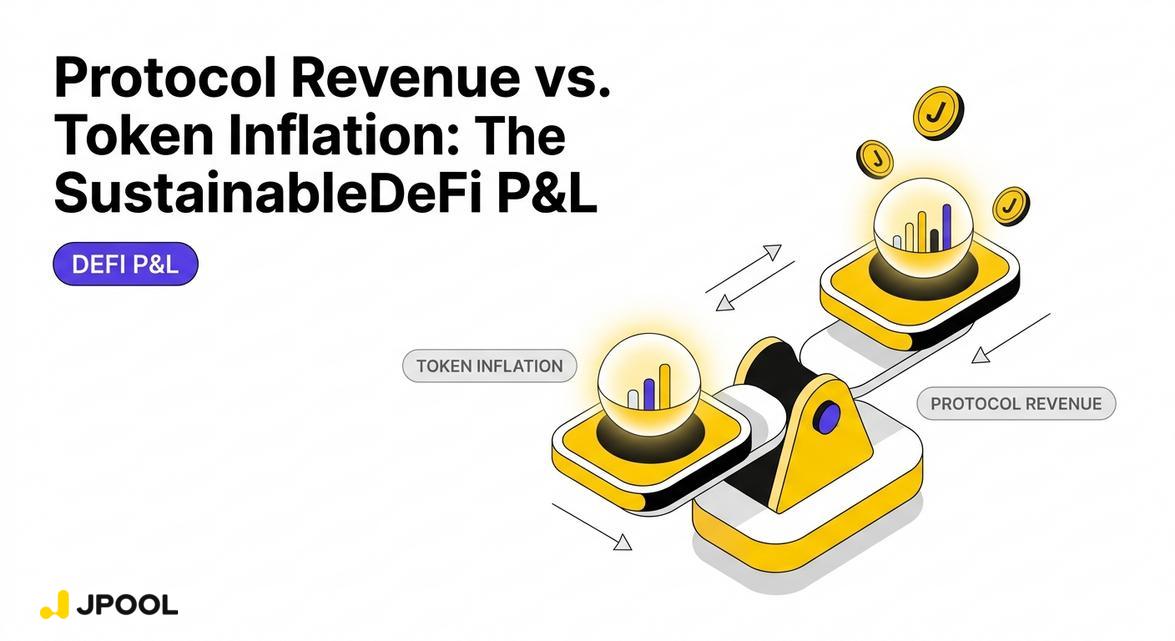
Most yield numbers in Solana DeFi are not what they appear to be. Behind the APY figures displayed on dashboards lies a structural question that almost no protocol makes easy to answer: how much of this yield is backed by real economic activity, and how much is simply the network printing new tokens?
Table of Contents
- Solana’s Inflation Schedule: The Hidden Denominator in Every Yield Calculation
- The Two-Ledger Problem: Separating Inflation Yield from Protocol Revenue
- How to Evaluate DeFi Protocol Revenue Quality on Solana
- JSOL Yield as a Sustainable Revenue Benchmark
- The Compression Trajectory: Why This Matters Now
This distinction — protocol revenue vs. token inflation — is the most important variable in evaluating sustainable DeFi P&L on Solana. Getting it wrong means chasing yields that are mathematically guaranteed to compress over time.
Solana’s Inflation Schedule: The Hidden Denominator in Every Yield Calculation
Solana operates a programmatic inflation schedule. According to Solana’s official inflation documentation, the network’s design parameters specify an initial inflation rate of 8% annually, a disinflation rate of -15% per year, and a long-term terminal inflation rate of 1.5%. This schedule is not a marketing choice — it is a protocol-level commitment to issuing new SOL tokens at a predetermined rate, regardless of network activity.
These newly issued tokens are distributed as staking rewards to validators and their delegators. This is the mechanism that makes staking yield possible at the base layer — and it is also the mechanism that creates the most common misreading of DeFi yield quality on Solana.
The critical insight: staking rewards sourced from inflation are not protocol revenue. They are a transfer from non-staking SOL holders to staking SOL holders. Every SOL issued as a staking reward dilutes the holdings of anyone not participating in staking. The yield is real in nominal terms. In real terms — measured against total SOL supply — it represents a redistribution, not a creation of new value.
This is the hidden denominator in every Solana yield calculation. A protocol advertising 7% APY must answer a prior question: 7% of what, and funded by what?
The Two-Ledger Problem: Separating Inflation Yield from Protocol Revenue
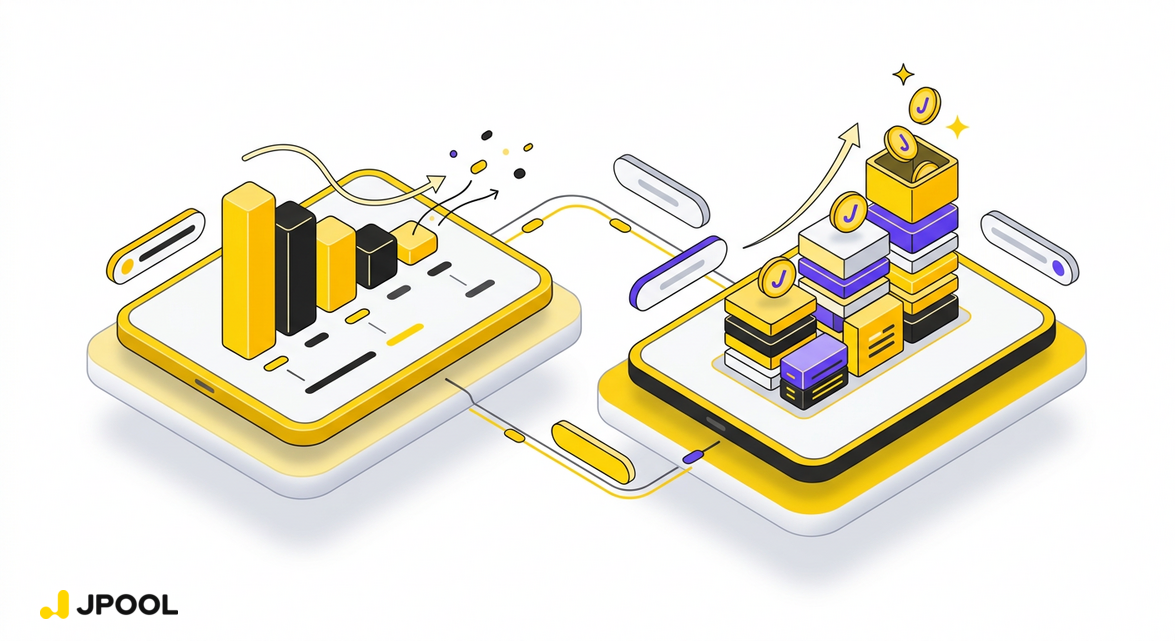
Evaluating sustainable DeFi P&L on Solana requires maintaining two separate mental ledgers simultaneously.
- Ledger 1: Inflation-Sourced Yield
This is yield that flows from the Solana inflation schedule. It is available to any staker, requires no protocol-specific activity, and will compress as the inflation rate declines toward its terminal rate. It is not a competitive advantage — it is a baseline that every staking participant receives. Protocols that present inflation-sourced staking yield as their primary value proposition are, in effect, presenting the network’s monetary policy as their product. - Ledger 2: Protocol Revenue
This is yield generated by actual economic activity: trading fees, liquidation fees, borrowing interest, MEV capture, and other on-chain value flows that exist because users are actively transacting. Protocol revenue is not dilutive — it is additive. It represents value created by network participants, not value redistributed from non-stakers to stakers.
The sustainable DeFi P&L question is simple: what percentage of a protocol’s yield comes from Ledger 2?
A protocol whose yield is 100% inflation-sourced has a P&L that will mechanically compress as Solana’s inflation rate declines. A protocol whose yield is primarily protocol-revenue-sourced has a P&L that can grow independently of the inflation schedule — because it grows with network usage.
How to Evaluate DeFi Protocol Revenue Quality on Solana
Applying this two-ledger framework to real protocols requires examining three specific signals.
- Signal 1: Fee Revenue Transparency
Does the protocol publish verifiable on-chain fee revenue? Protocols with genuine protocol revenue can point to specific fee accounts, liquidation event logs, or swap volume data. Protocols whose yield is primarily inflation-sourced often cannot — because there is no fee revenue to show. The absence of transparent fee reporting is itself a signal about revenue quality. - Signal 2: Yield Behavior During Low-Inflation Periods
As Solana’s inflation rate declines on its programmatic schedule, inflation-sourced yields compress. Protocols with genuine protocol revenue maintain or grow their yields during these periods because their income is tied to network activity, not token issuance. Monitoring yield behavior across inflation-rate changes is one of the cleanest tests of revenue quality available. - Signal 3: The Spread Between Nominal APY and Real APY
Solana’s own documentation introduces the concept of adjusted staking yield — the change in fractional token supply ownership of staked tokens due to inflation issuance. Nominal APY includes inflation-sourced rewards. Real APY — adjusted for the dilutive effect of new token issuance on non-staking holders — is lower. For a protocol to generate positive real yield for the broader SOL ecosystem, its revenue must exceed the dilution it imposes. Protocols that cannot articulate this spread are presenting an incomplete P&L.
JSOL Yield as a Sustainable Revenue Benchmark
Within this framework, liquid staking yield from JPool occupies a specific and defensible position in the Solana DeFi P&L hierarchy.
JSOL’s yield is sourced from two components that map directly onto the two-ledger model. The inflation-sourced component is the baseline staking reward available to all SOL delegators. The protocol-revenue component includes MEV capture — incremental yield generated by validator activity during periods of elevated network transaction volume — and the performance optimization delivered by JPool’s dynamic, multi-factor delegation strategy.
What distinguishes JSOL’s yield quality is not the headline number but the floor guarantee mechanism. JPool operates a unified bond system comprising two components: a security bond (calculated at 0.5 SOL per 1,000 SOL of total validator JPool stake, protecting delegators against validator misbehavior or downtime) and a dynamically calculated performance bond that specifically covers any deficit between a validator’s actual APY and the network Target APY. Together, these ensure that the Target APY is delivered even when individual validator performance falls short.
The Target APY itself is recalculated every epoch, benchmarked against the mean APY of the top 30 validators drawn from a filtered universe of mid-size Solana validators — excluding superminority nodes, blacklisted validators, and validators with a credits ratio below 95%. As JPool’s documentation states directly: “For delegators: You always earn the target APY. The bond covers any shortfall.”
This means JSOL’s yield is not a marketing estimate. It is a programmatically enforced benchmark backed by on-chain collateral. When evaluating DeFi protocol revenue quality, this structure provides a concrete reference point: a yield floor that is both transparent and verifiable on-chain.
For DeFi participants building positions on Solana, JSOL functions as a yield-quality anchor — a benchmark against which to measure whether a protocol’s advertised APY represents genuine protocol revenue or inflation-sourced redistribution dressed up as yield.
The same due diligence lens applies to collateral quality in DeFi positions. As explored in RWA Collateral and the Regulatory Cliff: What DeFi’s Tokenized Asset Boom Gets Wrong, the gap between nominal yield and structural durability is not unique to staking — it runs through the entire DeFi collateral stack.
The Compression Trajectory: Why This Matters Now
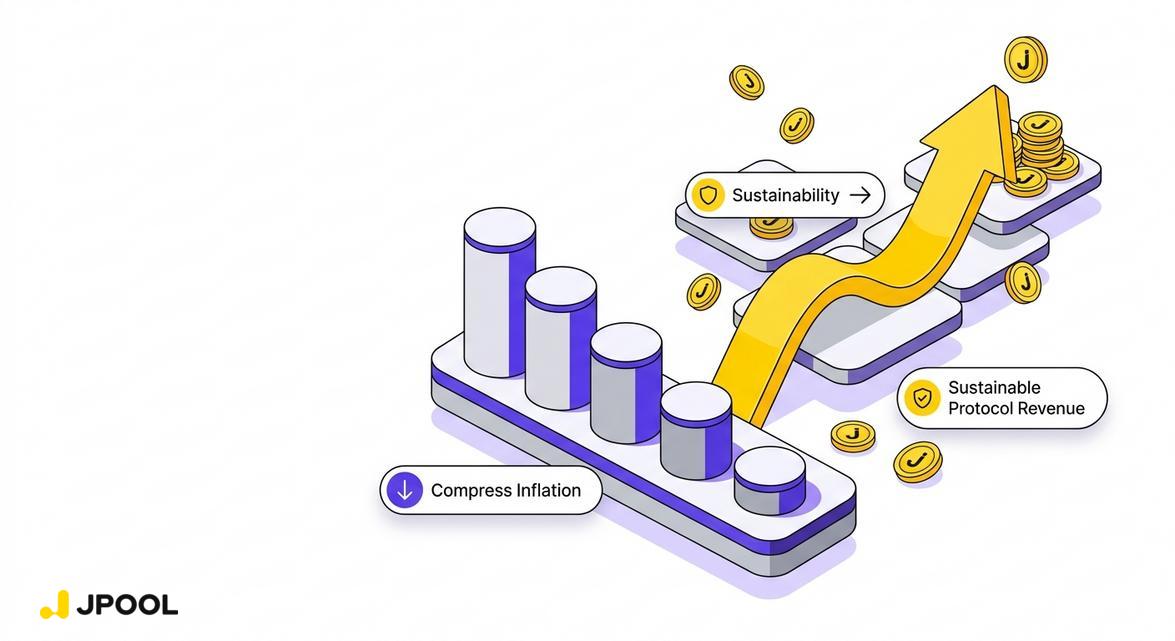
Solana’s inflation rate is on a programmatic downward trajectory. As it moves toward its long-term terminal rate, the inflation-sourced component of every Solana staking yield will compress. This is not a risk — it is a scheduled event, visible in the protocol parameters today.
The protocols that will sustain competitive yields through this compression are those with genuine protocol revenue: fee income, MEV capture, and on-chain economic activity that grows with network usage rather than shrinking with the inflation schedule.
For DeFi participants evaluating sustainable protocol revenue in Solana DeFi, the compression trajectory transforms the two-ledger question from an academic exercise into a practical portfolio decision. Yield sourced from inflation is a depreciating asset. Yield sourced from protocol revenue is a growing one — provided the protocol’s underlying economic activity continues to expand.
The sustainable DeFi P&L is not the one with the highest current APY. It is the one whose revenue structure will still be generating real yield when the inflation schedule reaches its terminal rate.
Explore JPool’s liquid staking infrastructure and validator delegation program at jpool.one.
Subscribe to our digest pages and stay updated:
Facebook Community · Instagram · Threads · Pinterest
Leave a Reply