Open your wallet, check JSOL against SOL, and the number is not 1.00. It sits higher, and it climbs a little almost every day. That number is not arbitrary, and it is not a quote pulled from any exchange. It is one division of on-chain balances, and reading it correctly tells you exactly what your staked position is worth.
Table of Contents
It’s Not a Peg, and It’s Not a Market Price
Two mental models mislead people here, and both are wrong. The first treats JSOL like a stablecoin that should have a fixed value and worries when it does not. The second treats the rate like an oracle price that markets push around. Neither applies.
JSOL is a receipt for staked SOL that is earning. Its value against SOL is not defended by a mechanism and not set by a trading venue. It is the plain result of dividing what the pool holds by how many receipts are outstanding. Once you see it as that ratio, the behavior stops being mysterious: it rises because the numerator grows while the denominator remains still.
One Formula: Pool SOL Divided by JSOL Supply
Take the total SOL the pool controls across all its validators. Divide it by the total JSOL in circulation. That quotient is the SOL each JSOL can redeem.
Suppose the pool holds 1,000,000 SOL backing 800,000 JSOL. Each JSOL is worth 1.25 SOL. There is no model, no discretion, and no price feed in that number. It is an accounting fact read straight from on-chain balances. JPool’s backend refreshes those two figures from the chain every 30 seconds, so the rate you see is never more than half a minute behind the ledger.
Why It Climbs Every Epoch
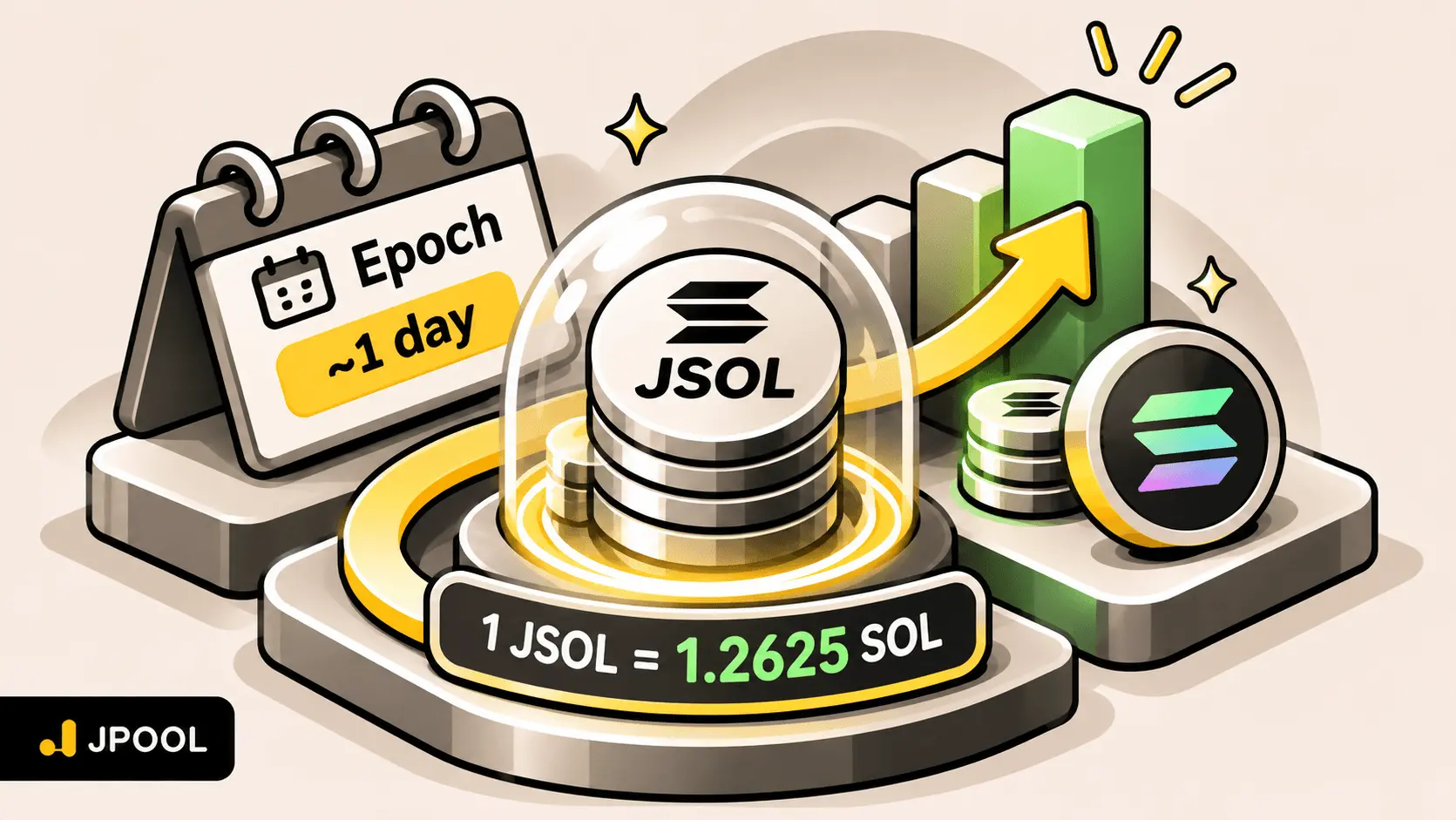
Staking rewards are what move the number. At each epoch boundary, roughly once a day on Solana today, the network credits staking rewards into the pool’s stake accounts. The pool’s total SOL goes up. The JSOL supply barely moves when rewards land, because the rewards themselves mint no new tokens.
Return to the example. If that 1,000,000 SOL earns and becomes 1,010,000 SOL over an epoch, and the 800,000 JSOL supply is untouched, each JSOL is now worth 1.2625 SOL. You still hold the same number of tokens. Each one simply redeems for more SOL than it did before. You do not get more tokens, you get stronger ones.
Depositing and Withdrawing Don’t Dilute You
A large deposit does not dilute the JSOL you already hold, because minting happens at the live rate.
When you deposit, the pool mints JSOL in proportion to the SOL you add, using the same ratio that defines the rate. Stake 1.25 SOL at a 1.25 rate and you are credited 1 JSOL, before a small deposit fee (covered below) trims what reaches your wallet. The numerator and denominator move together, so the rate is unchanged by the deposit. Withdrawals work in reverse: your JSOL is burned at that moment’s rate, and the pool releases the matching SOL. If you choose delayed unstaking, your JSOL is still burned right away at the current rate. Only the SOL delivery is held back until the epoch ends. Deposits and exits are rate-neutral for everyone else in the pool.
What the Fees Actually Touch
Only one fee touches the rate: the epoch fee, JPool’s own commission on each epoch’s staking rewards. It is the single lever on how fast the rate climbs. A higher epoch fee leaves holders a smaller share of each epoch’s rewards, so the rate rises a little slower.
The deposit, withdrawal, and referral fees are different. They are charged on the SOL moving in or out at the moment of a transaction, not on the standing balance. They do not change the per-unit value of the JSOL already in circulation. So when you reason about the rate’s trajectory, the epoch fee is the lever. The transaction fees affect your entry and exit, not the slope of the line.
Can the Rate Go Down?
Because the rate is a ratio of pool SOL to supply, nothing in the code forces it to only rise. There is no floor and no guarantee of monotonic growth written into the contract. If the pool’s total SOL ever fell relative to supply, the rate would fall with it.
In practice, that is hard to trigger. Solana has no slashing today, so a validator does not forfeit staked principal for poor performance. A weak or offline validator simply earns less, which slows the rate’s climb rather than reversing it. The real tail risk sits in the code that holds the funds: the Stake Pool Program. It has passed nine independent security audits, which reduce but do not eliminate smart-contract risk, and JPool holds no key that can move your SOL. Spreading stake across many validators keeps any single operator from moving the rate much. Treat the steady climb as what a well-run pool produces, not as a guaranteed line.
The Rate and the Market Quote Are Two Different Numbers
By now the exchange rate has a clear meaning: it is what the pool owes you, the SOL your JSOL redeems for. There is a second number that can disagree with it. On a DEX, JSOL trades at whatever a buyer will pay right now, and that quote is not the same thing as the redeemable rate. Most of the time the two sit close together.
They can separate under stress. When many holders want out at once and the pool’s instant reserve is finite, sellers who refuse to wait accept a discount on a DEX, and the market quote dips below the rate. That gap is a liquidity and timing cost, not a drop in what your JSOL is fundamentally worth. The redeemable value is unchanged.
Redemption is what pulls the quote back. Because anyone can return JSOL to the pool at the rate, instant up to the reserve or delayed for the full amount, JSOL trading below the rate is a profit waiting to be taken: buy the discounted token, redeem it at the rate, keep the difference. That arbitrage closes the gap as conditions normalize. So when you value or exit a position, treat the exchange rate as fair value and the market quote as the price of leaving in a hurry.
Leave a Reply