A validator holding your stake has gone offline. If you staked to it natively, you have to fix it yourself: notice the problem, move your stake, and lose yield until you do. If you staked through JPool and hold JSOL, there is nothing for you to do. JPool spreads your stake across many validators and drops any that stop working, so one validator going offline barely changes what you earn.
Table of Contents
The 2 a.m. Alert
The alert says a validator you are staked with has stopped voting. Two questions come straight to mind. Are you losing yield right now? And do you need to move your stake before the epoch ends?
Start with the part that settles most of the worry. Downtime costs you rewards, not your principal. Solana does not take your stake away when a validator goes offline, so your SOL itself is not at risk. That leaves a smaller question: how much yield do you lose, and for how long?
If You Had Staked It Yourself
To see why pooling matters, picture staking all your SOL to that one validator yourself, natively. Since Alpenglow, a validator earns your rewards by doing two jobs: it votes on blocks every epoch, and it produces the blocks it is picked to lead. Both pay, and they pay about the same amount. A validator that is offline does neither, so while it is down, the reward it would pass to you stops. Its commission rate does not change. What changes is the reward that commission comes out of.
If all your stake sat on that one validator, you take the full hit. And nothing fixes it for you. You have to spot the problem, turn off the stake, wait a cooldown epoch for it to free up, then stake it again, losing part of an epoch to the move. The outage just exposes how concentrated you already were. That is part of why two validators with the same advertised APY can pay you differently.
What Actually Happened to Your Stake
Now the real case, the one you chose by staking through JPool and holding JSOL. Your SOL is not staked to just one validator. JPool spreads the pooled SOL across many validators and sets a hard limit: no single validator can hold more than 5% of the pool. That limit is checked and fixed on every rebalance.
The spread also makes the chain itself safer. Solana stalls if validators holding more than a third of all stake go down at once, so the health measure that matters is the smallest number of validators it would take to reach that third. That number is Solana’s Nakamoto coefficient. The more thinly stake is spread, and the smaller any one validator’s slice, the more validators it would take, and the higher that number climbs.
So the validator that went dark never held all of your stake. At most it held 5%, and usually closer to the 0.8% an average seat holds. JPool also picks these validators on expected performance, not luck, which is a separate reason your overall yield is steadier than any one operator’s. Your share of the outage is a fraction of what you would carry on your own.
Measuring the Dip
Here are the numbers. A Solana epoch is about 432,000 slots, which runs roughly a day. JPool lets a validator fall behind for up to 90,000 of those slots, about five hours, or a fifth of an epoch, before it steps in (more on that next). So the longest a single outage can run before JPool acts is about 21% of one epoch. The hit to your overall reward is that outage length times the validator’s share of the pool.
| Validator’s share of pool | Dark ~10% of an epoch (a brief outage) | Dark ~21% of an epoch (a full grace window) |
|---|---|---|
| 0.8% (an average seat) | 0.08% of the epoch’s reward | 0.17% |
| 2% | 0.20% | 0.42% |
| 5% (the hard cap) | 0.50% | 1.04% |
Look at the bottom-right corner, the worst case the system allows. A 5% validator down for the full grace window costs about 1% of one epoch’s reward. An epoch is about a day, so that is roughly 1% of a single day’s staking reward. Stretched across a full year of rewards, one such event is a few thousandths of a percent of your annual yield, far less than a basis point of APY. And that assumes it happens once in a year. The normal case, a small validator down for a short while, rounds to nothing.
The Part You Slept Through
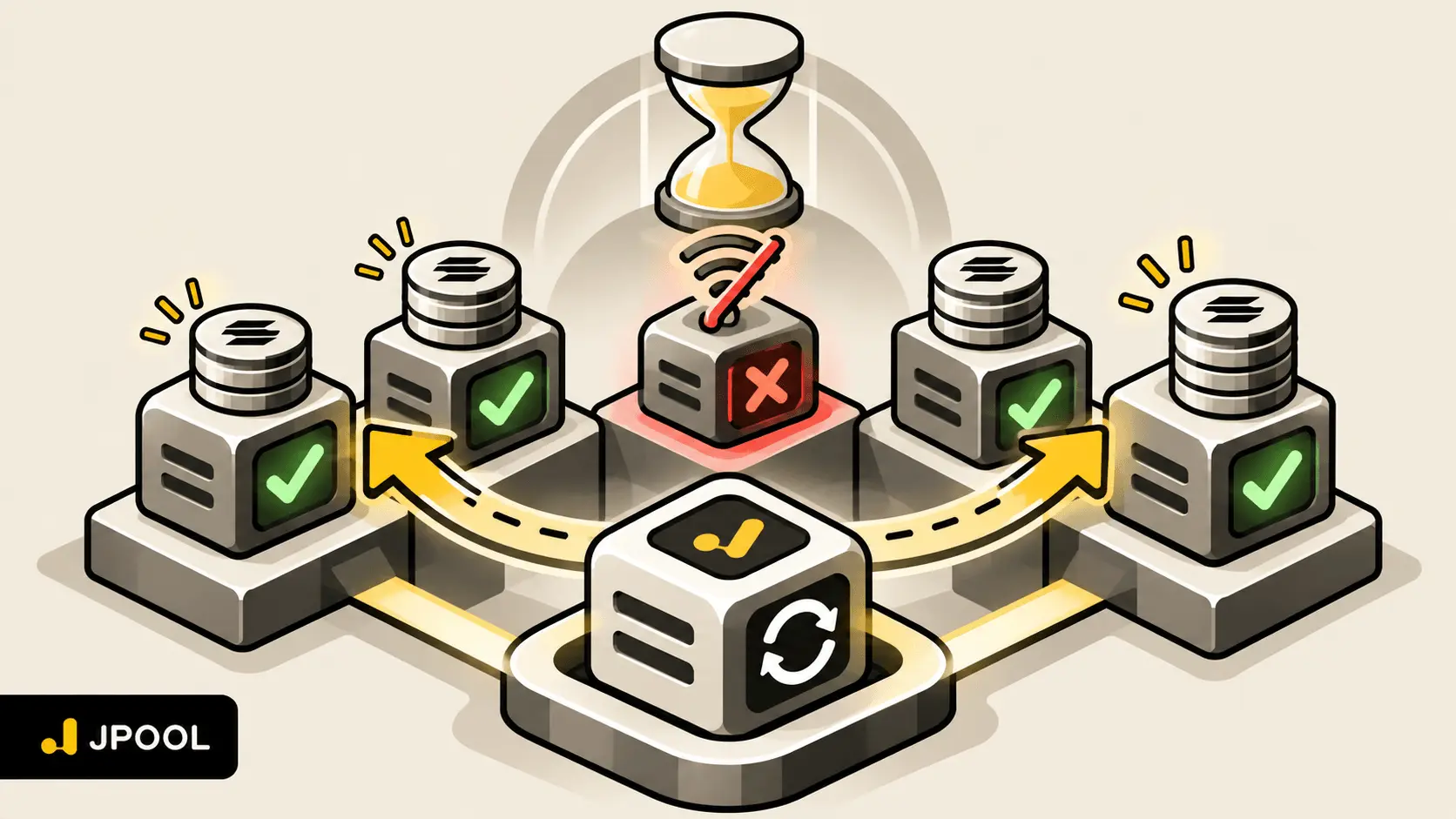
Spreading the stake caps the size of the hit. Removing bad validators caps how long it lasts. JPool checks the chain on every cycle and measures how far behind each validator’s last vote is. When a validator stays silent past the grace window, JPool marks it for removal, sets its target stake to zero, and pulls the stake out fast, ahead of the normal per-epoch limit that paces routine rebalancing. Your stake moves to validators that are voting.
So the numbers in the table are not a cost you keep paying. They are the most one outage can take from you. The loss stops growing the moment JPool pulls the stake off the dead validator, and the grace window is the longest it can run before that happens. After that your stake is back on validators that are earning, so the hit is capped at that one window and does not repeat.
Removal is not instant. JPool waits out the grace window first, which is what stops a quick restart from costing a good validator its seat in JPool’s Delegation Program. But none of it is on you. You do not have to watch the clock, open a terminal, or decide anything. A validator that stays down is dropped at the next rebalance once the grace runs out, whether or not you ever saw the alert.
When It Could Still Reach You
Removal is all or nothing. JPool does not trim a validator’s stake a little when it slips a little. It either keeps the validator or drops it. So a validator that is slow but not fully silent can cost you a bit until a separate, slower uptime check catches it. The grace window is also fixed at about five hours (90,000 slots), not adjusted to conditions. That is on purpose. It stops a five-minute restart from costing a good validator its seat, but it also means a real outage runs the full grace before removal.
Alpenglow adds another catch: a validator has to keep meeting certain conditions each epoch to earn at all, and one that lets a condition lapse can lose a reward it had already earned. JPool picks validators that clear those conditions reliably, which is work you would otherwise do yourself. And remember, this protects you from downtime, not from slashing. Solana does not slash for downtime today. If that changes, so does the risk being managed.
So, Do You Have to Do Anything?
Back to the 2 a.m. question. No, you do not need to move anything. The validator held a small share of your stake, the yield it cost you is a rounding error on your yearly return, and the pool is already moving stake away from it without any input from you.
That is the trade you get from a managed pool instead of a single operator. It is the opposite of the delegate-and-forget problem. You are not quietly ignoring one validator you picked. The pool watches every validator for you and acts when one fails. For an allocator sizing Solana exposure, validator downtime is a risk that is spread out, measured, and handled, not one that keeps you up at night.
Leave a Reply