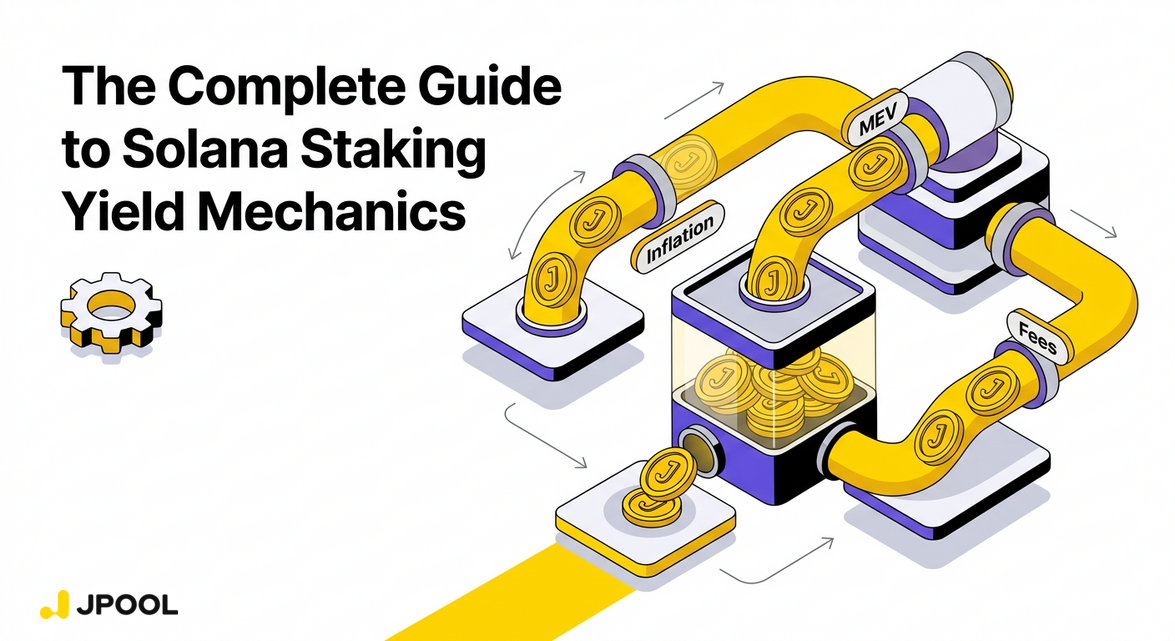
Understanding where Solana staking yield actually comes from is essential for making informed delegation decisions in 2026. Unlike traditional narratives that focus solely on inflation-based APY, the reality of Solana validator economics involves multiple revenue streams—including network transaction fees and validator performance dynamics—that directly impact your staking returns.
Table of Contents
- Where Does Solana Staking Yield Come From?
- How Validator Performance Impacts Your APY
- The Role of Smart Delegation in Optimizing Yield
- MEV and Priority Fees: The Variable Yield Component
- How JSOL Captures and Compounds Staking Yield
- Validator Revenue Transparency: Beyond Headline APY
- Direct Staking with Amplified Returns
- Leveraged Staking: Amplifying Yield Through Network Economics
- Evaluating Staking Platforms: A Framework for 2026
- Conclusion: Moving Beyond Inflation-Only Narratives
This guide breaks down the transparent, network-cash-flow model behind Solana staking yield and explains how platforms like JPool optimize these mechanics to deliver competitive returns.
Where Does Solana Staking Yield Come From?
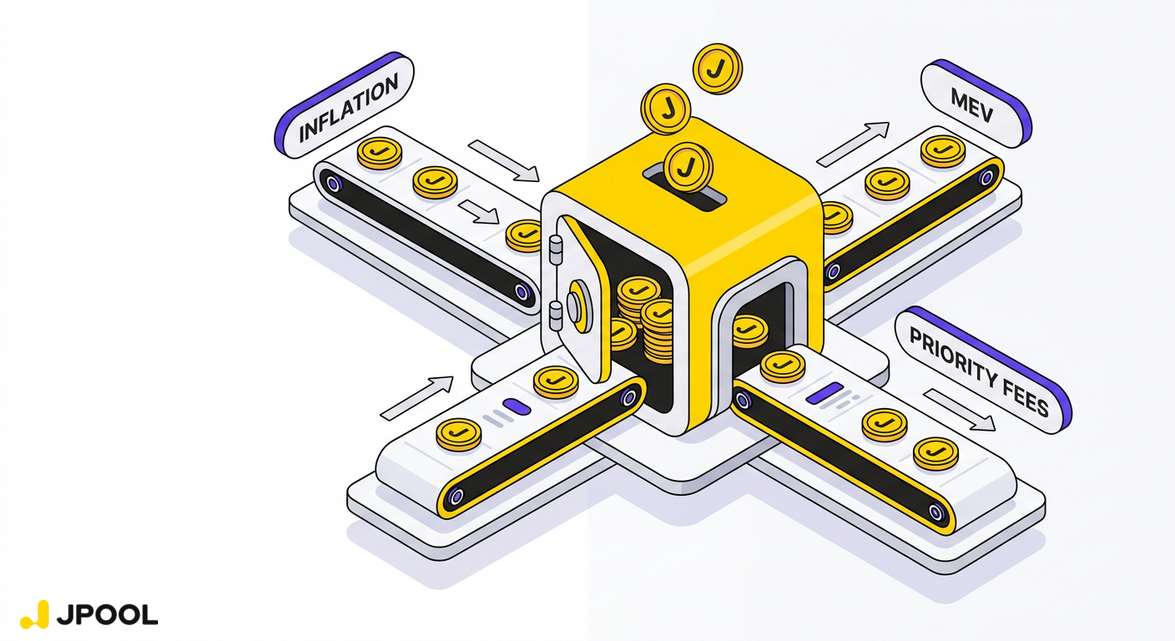
Solana staking rewards are generated through a combination of protocol-level inflation and network activity. When you stake SOL, you delegate your tokens to validators who process transactions and secure the network. In return, validators earn rewards that are distributed to delegators after deducting validator commissions.
The core components of validator revenue include:
- Inflation Rewards: Protocol emissions distributed to validators based on their stake weight and vote participation.
- Priority Fees: Transaction fees paid by users to prioritize their transactions during periods of network congestion.
- MEV (Maximal Extractable Value): Additional revenue opportunities that can provide incremental yield during periods of elevated network activity.
JPool’s delegation criteria strictly cap commissions at 10% to protect user yield, ensuring that validators in the JPool Delegation Program maximize the portion of rewards flowing to stakers.
How Validator Performance Impacts Your APY
Not all validators deliver the same returns. Validator performance directly determines the APY you earn, which is why JPool requires validators to maintain top-tier performance metrics.
JPool’s Performance Standards:
- Validators must rank in the top 400 by APY over the previous 10 epochs and achieve a resulting JPool Rank above Top 200 to qualify for the JPool Delegation Program.
- To remain in the program, validators must maintain a JPool Rank above the top 350.
- Commission on inflation and MEV rewards must remain under 10%.
These rigorous standards ensure that delegated stake flows only to high-performing validators who consistently deliver competitive yields.
The Security Bond Mechanism
JPool has implemented a unique accountability system for validator performance. If a validator’s APY falls below the requirement, operators can deposit SOL as a security bond to cover the shortfall. At the end of each epoch, JPool compares the validator’s APY with the APY of the validator in 10th place in the Top-10 list (validators ranked by APY over the last 10 epochs).
If a validator underperforms, the bond is used to compensate delegators for the yield gap. This mechanism protects staker returns even when individual validators experience temporary performance issues.
The Role of Smart Delegation in Optimizing Yield

Manual validator selection requires constant monitoring and technical expertise. JPool’s Smart Delegation Strategy automates this process by continuously evaluating validators across multiple performance dimensions and reallocating stake to optimize returns.
How JPool’s Smart Delegation Strategy Works:
JPool utilizes a dynamic, multi-factor delegation strategy that optimizes for performance, decentralization, and ecosystem growth. The strategy evaluates validators using a comprehensive scoring system that weighs:
- Current APY, 3-epoch average APY, and 10-epoch average APY (weighted at 0.33 each).
- Infrastructure diversity to minimize risk by penalizing excessive stake concentration.
- Validators.app score (weighted at 1.0) for independent performance validation.
- Smart Validator Toolkit (SVT) adoption (weighted at 4.0), rewarding validators using JPool’s free management tools.
Every five epochs, JPool recalculates validator rankings, adds newly eligible validators, and redistributes stake across all active participants. Every epoch, validators that no longer meet the criteria are removed, ensuring continuous optimization.
MEV and Priority Fees: The Variable Yield Component
While inflation rewards provide a baseline APY, network activity generates additional revenue through priority fees and MEV opportunities. These components are variable and depend on network congestion and transaction demand.
Priority Fees Explained:
During periods of high network activity, users pay priority fees to ensure their transactions are processed quickly. Validators earn these fees in addition to inflation rewards, creating yield variability based on real-time network conditions.
MEV Considerations:
MEV can provide incremental yield during periods of elevated network activity. However, MEV revenue is opportunistic and market-condition dependent—not a guaranteed structural premium. JPool’s delegation criteria ensure that validators handling MEV opportunities maintain the same 10% commission cap, protecting delegator returns.
How JSOL Captures and Compounds Staking Yield
When you stake SOL through JPool, you receive JSOL—a liquid staking token that represents your claim on a growing pool of staked SOL plus accrued rewards.
JSOL Yield Mechanics:
- Exchange Rate Growth: JSOL accrues rewards automatically as the JSOL↔SOL exchange rate increases each epoch.
- Auto-Compounding: Your number of JSOL tokens stays constant; each JSOL simply becomes redeemable for more SOL over time.
- No Manual Claiming: Rewards compound continuously without requiring any action on your part.
The rate of exchange rate growth approximates JPool’s net APY after validator performance and protocol fees. APY varies with network conditions and validator performance and is not guaranteed.
Validator Revenue Transparency: Beyond Headline APY
Understanding the full economics of validator operations provides context for evaluating staking platforms. JPool offers a Validator Profit Calculator that breaks down validator economics across multiple time horizons, showing how revenues and costs translate into profit.
Key Validator Economic Factors:
- Inflation rewards based on stake weight and vote participation.
- Commission rates that determine the split between validators and delegators.
- Operational costs including infrastructure, bandwidth, and vote transaction fees.
- Performance consistency measured across current, 3-epoch, and 10-epoch averages.
JPool’s requirement that validators publish their name and logo creates additional accountability, enabling delegators to track performance and make informed decisions.
Direct Staking with Amplified Returns
For users who want to support specific validators while maximizing returns, JPool offers Direct Staking with a unique matching program.
Direct Stake Matching:
For every SOL staked directly to a validator in the JPool Delegation Program, JPool supplies an equal 1-for-1 delegation, based on available liquidity and capped at 20,000 SOL per validator. This matching applies to both standard direct stakes and leveraged positions.
If the validator also participates in the Solana Foundation Delegation Program, the Foundation provides a second boost, potentially multiplying the effective stake significantly.
Leveraged Staking: Amplifying Yield Through Network Economics
JPool’s Leveraged Staking option allows users to amplify their direct stake by borrowing additional SOL from lending platforms. This strategy increases the effective stake amount, boosting APY while introducing additional risk considerations.
How Leverage Amplifies Yield:
When you stake with leverage, JPool borrows extra SOL from a lending platform and adds it to your stake. Since rewards are calculated on the larger combined balance, your APY rises. The additional yield comes from earning rewards on the amplified stake at JPool’s APY while paying the borrow APR on the outstanding debt.
The positive difference between staking APY and borrow APR is reflected in the Leverage APY. This mechanism allows users to capture more of the network’s cash flow without adding new capital, though it requires active monitoring of loan-to-value ratios and health factors.
Evaluating Staking Platforms: A Framework for 2026
When evaluating liquid staking platforms, focus on transparent, verifiable metrics rather than marketing-driven headline rates:
- Validator Selection Criteria: Does the platform enforce rigorous performance standards?
- Commission Caps: Are validator commissions capped to protect delegator yield?
- Performance Accountability: Are there mechanisms to compensate delegators when validators underperform?
- Infrastructure Diversity: Does the delegation strategy minimize concentration risk?
- Yield Transparency: Can you verify where APY comes from and how it’s calculated?
How to Evaluate the Best Solana Liquid Staking Token in 2026: A Security & Yield Framework provides an institutional-style framework for assessing architecture, diversification, transparency, and DeFi utility across Solana LST options.
Conclusion: Moving Beyond Inflation-Only Narratives
Solana staking yield in 2026 is driven by a combination of inflation rewards, priority fees, validator performance, and network activity. Platforms that optimize across all these dimensions—through smart delegation, rigorous validator selection, and performance accountability mechanisms—deliver more consistent and competitive returns.
JPool’s approach combines automated validator monitoring, strict performance criteria (top 400 APY requirement with a resulting Top 200 JPool Rank, 10% commission cap, 750,000 SOL maximum stake), and unique features like security bonds and direct stake matching to maximize delegator yield while supporting network decentralization.
Understanding these mechanics allows you to make informed staking decisions based on transparent, verifiable network economics rather than headline APY figures alone.
Leave a Reply