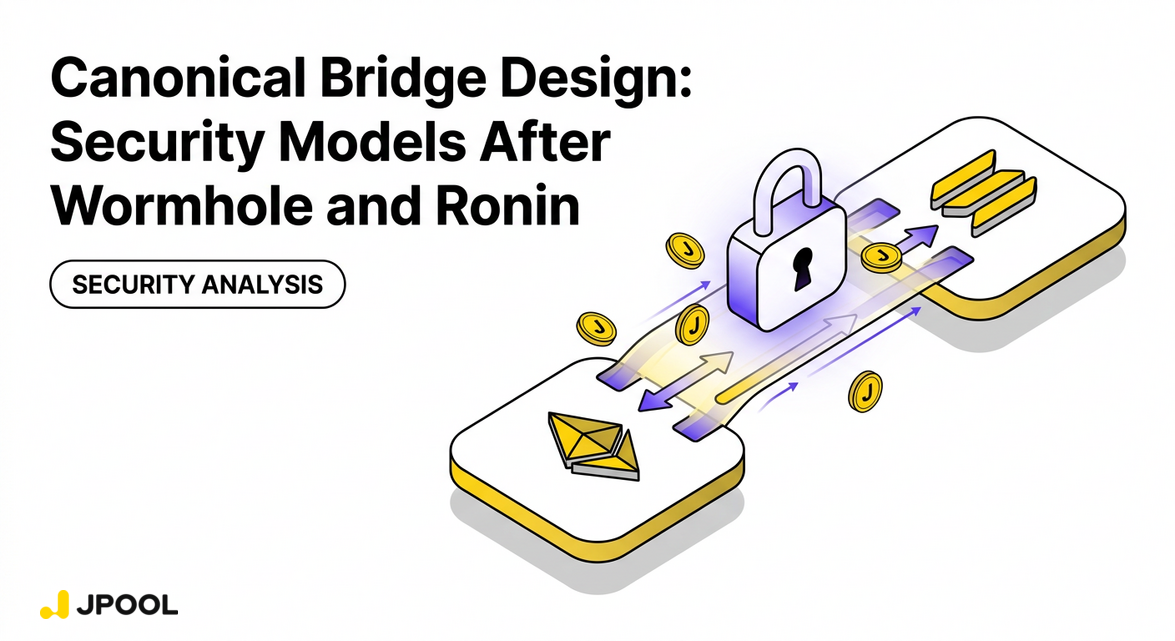
The two largest bridge exploits in DeFi history — Wormhole ($320M, February 2022) and Ronin ($625M, March 2022) — were not random failures. They were predictable outcomes of specific architectural decisions. Understanding why requires going deeper than the post-mortems: it requires examining the verification models that canonical bridges rely on, the trust assumptions those models embed, and the structural responses that have emerged since.
Table of Contents
- The Verification Problem Every Bridge Must Solve
- Wormhole’s Guardian Network: Where the Trust Was Buried
- Ronin’s Validator Set: Concentration as an Attack Vector
- The Architectural Taxonomy: Four Models, Four Trust Profiles
- Post-Exploit Design Responses: What Actually Changed
- Solana Bridge Architecture and the Native Staking Alternative
This is not a recap of what happened. It is an analysis of how canonical bridge design creates — and can eliminate — exploitable trust surfaces.
The Verification Problem Every Bridge Must Solve
Every canonical bridge faces the same fundamental challenge: how does Chain B know that something actually happened on Chain A?
Blockchains cannot natively read each other’s state. A bridge must introduce a mechanism to carry that information across — and every mechanism introduces a trust assumption. The security model of any bridge is, at its core, a description of who or what is trusted to attest that a cross-chain event occurred, and what happens if that trusted party is compromised, colluded with, or simply wrong.
There are four primary verification models in canonical bridge design:
- External validator / guardian sets — A defined group of off-chain parties sign attestations of cross-chain events.
- Light client verification — Chain B runs a cryptographic verification of Chain A’s consensus directly, without trusting intermediaries.
- Optimistic verification — Events are assumed valid unless challenged within a dispute window.
- ZK proof verification — Cryptographic proofs of state transitions are verified on-chain without trusted intermediaries.
Each model distributes trust differently. The Wormhole and Ronin exploits are case studies in what happens when the trust distribution in models 1 and 2 is misconfigured.
Wormhole’s Guardian Network: Where the Trust Was Buried
Wormhole uses an external validator model it calls a “Guardian Network” — a set of 19 guardian nodes that observe events on supported chains and produce signed attestations (VAAs: Verified Action Approvals). A supermajority of 13 of 19 guardians must sign a VAA for it to be accepted as valid by the receiving chain’s contract.
The February 2022 exploit did not compromise the guardian network. It bypassed it entirely.
The attack exploited a vulnerability in Wormhole’s Solana-side contract: a deprecated verify_signatures instruction that had not been properly disabled. The attacker used this instruction to spoof a valid guardian signature set — creating a fraudulent VAA that the contract accepted as legitimately signed by the guardian supermajority. The bridge minted 120,000 wETH on Solana against no corresponding deposit on Ethereum.
The architectural lesson: The guardian network’s 13-of-19 threshold was the security model’s stated trust assumption. But the actual attack surface was the contract code that validated guardian signatures — not the guardians themselves. The trust assumption was correctly designed at the consensus layer and catastrophically misconfigured at the implementation layer.
This distinction matters for DeFi cross-chain security models broadly: a well-designed verification threshold provides zero protection if the code that enforces that threshold contains an exploitable path that bypasses verification entirely. The security model and the implementation of that security model are two separate failure surfaces.
Ronin’s Validator Set: Concentration as an Attack Vector
Ronin used a different variant of the external validator model: a 9-node validator set requiring 5-of-9 signatures to authorize bridge transactions. This threshold was explicitly chosen as a usability optimization — fewer validators meant faster transaction finality.
The March 2022 exploit was not a smart contract bug. It was a social engineering and key compromise operation. The attacker obtained control of 5 of the 9 validator private keys: 4 from Sky Mavis directly, and 1 from the Axie DAO — a validator node whose signing authority had been temporarily delegated to Sky Mavis months earlier and never revoked.
The architectural lesson: A 5-of-9 threshold with 4 keys concentrated in a single organization is not a 5-of-9 security model. It is a 1-of-2 security model in practice — compromise Sky Mavis, obtain 4 keys; find one more. The stated threshold and the effective threshold diverged because the validator set’s operational concentration was never reflected in the formal security model.
This is the canonical bridge design failure mode that concentration analysis is designed to prevent: a threshold that appears distributed on paper but is operationally centralized in practice. The Ronin exploit demonstrated that validator set size is a necessary but insufficient condition for security — the independence of key holders matters as much as their number.
The Architectural Taxonomy: Four Models, Four Trust Profiles
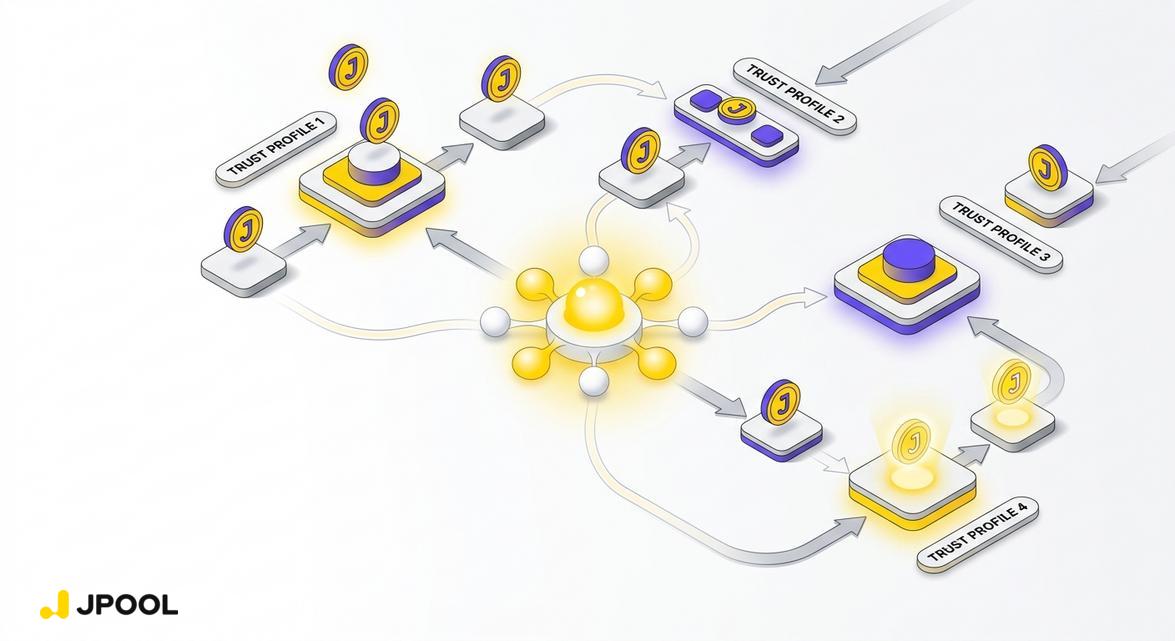
The post-Wormhole, post-Ronin design landscape has clarified the trust tradeoffs across verification models:
External Validator / Guardian Sets
- Trust assumption: Honest supermajority of a defined validator set
- Attack surface: Key compromise, collusion, implementation bugs in signature verification
- Mitigation: Larger validator sets, operational key distribution, formal verification of signature validation code
- Example failure: Ronin (key concentration), Wormhole (signature verification bypass)
Light Client Verification
- Trust assumption: The cryptographic security of the source chain’s consensus mechanism
- Attack surface: Consensus-level attacks on the source chain; implementation complexity
- Mitigation: Inherits source chain security; no trusted intermediary
- Tradeoff: High computational cost; not all chains support efficient light client verification
Optimistic Verification
- Trust assumption: At least one honest watcher will submit a fraud proof within the dispute window
- Attack surface: Watcher liveness failures; dispute window manipulation
- Mitigation: Economic incentives for watchers; sufficiently long dispute windows
- Tradeoff: Latency — assets are locked during the dispute window
ZK Proof Verification
- Trust assumption: Cryptographic soundness of the proof system
- Attack surface: Proof system implementation bugs; trusted setup ceremonies (in some constructions)
- Mitigation: Formal verification; recursive proof aggregation; trustless setup constructions
- Tradeoff: Proof generation cost; prover centralization risk during early deployment
No model eliminates trust entirely. Each model relocates trust to a different layer — from a validator set, to a consensus mechanism, to a watcher network, to a cryptographic proof system. The security question is not “which model is trustless?” but “which trust assumption is hardest to violate at scale?”
Post-Exploit Design Responses: What Actually Changed
The Wormhole and Ronin exploits triggered two categories of architectural response:
1. Guardian Set Expansion and Operational Hardening
Wormhole expanded its guardian set and introduced stricter operational security requirements for guardian key management. The core model — external validator attestation — remained unchanged, but the implementation layer received formal verification attention. The lesson absorbed: the security model’s stated threshold must be enforced by code that has been formally verified to implement that threshold correctly.
2. Movement Toward Light Client and ZK Verification
The exploits accelerated investment in verification models that do not rely on trusted intermediaries. Light client bridges — which verify source chain consensus directly on the destination chain — eliminate the guardian/validator attack surface by construction. ZK bridges extend this by generating cryptographic proofs of state transitions that can be verified on-chain without running a full light client. Both approaches trade implementation complexity and computational cost for a fundamentally different trust profile: one anchored in cryptographic assumptions rather than operator honesty.
The architectural trajectory is clear: the industry is moving away from external validator models toward cryptographic verification models, driven directly by the demonstrated attack surfaces of the Wormhole and Ronin designs.
Solana Bridge Architecture and the Native Staking Alternative
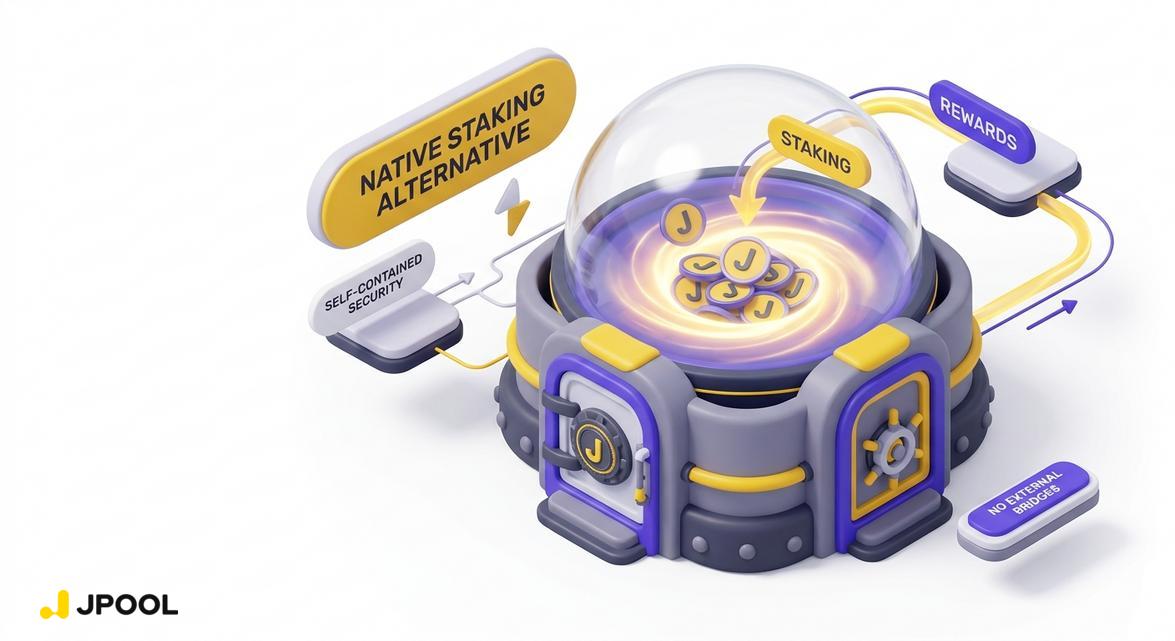
Solana’s bridge architecture reflects this trajectory. Wormhole — the primary cross-chain bridge for Solana — has undergone significant post-exploit hardening, and the Solana ecosystem has seen increased interest in ZK-based verification approaches as the computational costs of proof generation decline.
But the deeper architectural insight for Solana DeFi participants is this: the cross-chain trust problem is a problem you can avoid entirely.
Every bridge — regardless of its verification model — introduces a trust surface that native Solana assets do not carry. JSOL, as a native Solana liquid staking token, exists entirely within Solana’s consensus boundary. Its security model is the Solana Stake Pool Program: an open-source, immutable on-chain program that has undergone 9 independent security audits by firms including Kudelski, Neodyme, Quantstamp, OtterSec, and Halborn. There is no guardian network to compromise. There is no validator key set to concentrate. There is no cross-chain attestation that can be spoofed.
The governance layer reinforces this directly. JPool’s pool admin keys are protected by a Squads multisig with a 2-of-3 signing threshold, with authority keys stored on offline hardware wallets — a direct architectural parallel to the key concentration failure mode that Ronin demonstrated. No single operator can alter pool parameters, add or remove validators, or update fees unilaterally.
This is not a claim that Solana is immune to all risk — technology risks, including security weaknesses in underlying code and consensus mechanism vulnerabilities, apply to all distributed ledger assets. It is a claim about which trust assumptions a user accepts when they hold JSOL versus a bridged asset: the former depends on Solana’s consensus and an audited on-chain program; the latter depends on all of that plus the security model of a bridge whose trust assumptions, as Wormhole and Ronin demonstrated, can fail at the implementation layer in ways the stated model does not predict.
For DeFi participants building on Solana, the hidden fragility of off-chain dependency structures — explored in depth in RWA Collateral and the Regulatory Cliff: What DeFi’s Tokenized Asset Boom Gets Wrong — has a direct parallel in bridge architecture: the stated security model and the actual attack surface are not the same thing. Understanding the gap between them is the prerequisite for building durable cross-chain DeFi positions.
Explore JPool’s liquid staking infrastructure and validator delegation program at jpool.one.
Subscribe to our digest pages and stay updated:
Facebook Community · Instagram · Threads · Pinterest
Leave a Reply