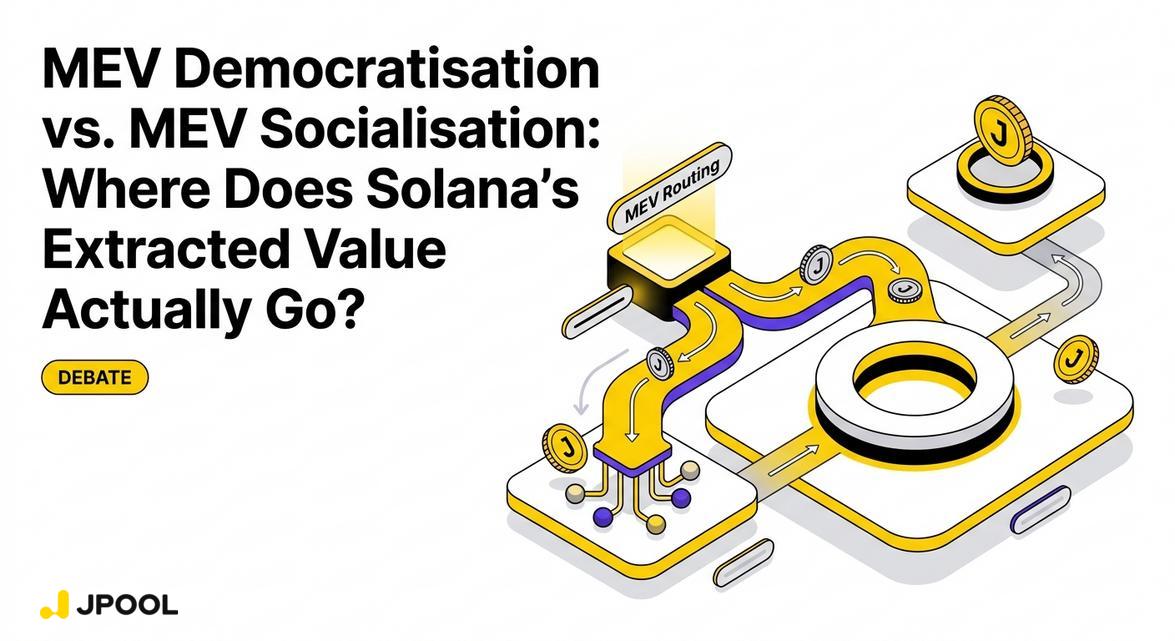
For most of Solana’s MEV history, the question of where MEV revenue lands was settled by default: validators and searchers captured it, stakers received whatever trickled through commission structures, and the protocol itself took nothing. That default is no longer stable. In 2026, a live governance debate is reshaping who has a legitimate claim on MEV revenue — and the outcome will structurally alter liquid staking yields for years.
Table of Contents
- The Conceptual Fork: Two Visions for MEV Revenue
- How Ethereum’s PBS Settled (and Didn’t Settle) This Debate
- Solana’s MEV Revenue Landscape: No PBS, No Settled Model
- The Yield Arithmetic: Why the Destination of MEV Revenue Matters for Liquid Stakers
- The Governance Horizon: What a MEV Socialisation Decision Would Mean
- The Structural Position of Liquid Staking in This Debate
Understanding this shift requires separating two concepts that are frequently conflated: MEV democratisation and MEV socialisation. They sound similar. They point in opposite directions.
The Conceptual Fork: Two Visions for MEV Revenue
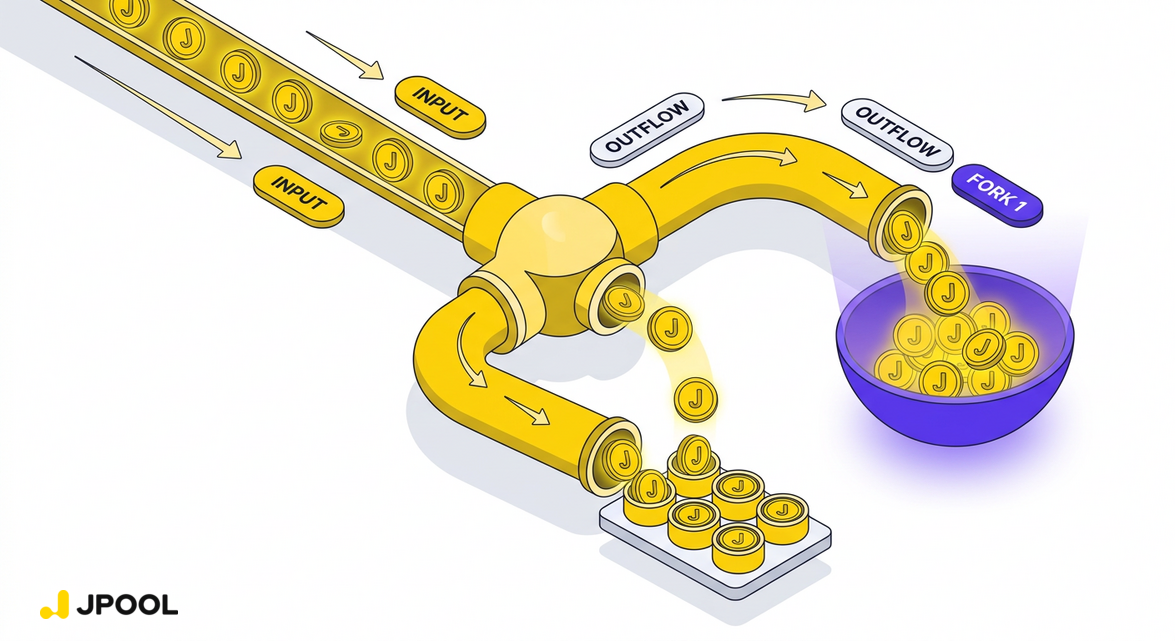
MEV democratisation holds that MEV revenue should flow downward — from validators and searchers toward the delegators and stakers who provide the economic security that makes MEV extraction possible. The logic is straightforward: without stake, there are no validators; without validators, there is no block production; without block production, there is no MEV. Stakers are the silent upstream input to every MEV transaction, yet they historically receive the residual after validators and searchers have taken their share.
MEV socialisation, by contrast, holds that MEV revenue should flow outward — to the protocol itself, either as a burn mechanism reducing SOL supply, as a treasury funding public goods, or as a redistribution to all token holders regardless of staking status. The socialisation argument treats MEV as a form of economic rent extracted from ordinary users (who bear the cost of sandwich attacks, priority fee inflation, and execution degradation) and argues that this rent should be returned to the network broadly rather than captured by a narrow set of infrastructure participants.
These are not merely philosophical positions. They map onto concrete protocol design choices with measurable yield consequences for liquid staking participants.
How Ethereum’s PBS Settled (and Didn’t Settle) This Debate
Ethereum’s Proposer-Builder Separation (PBS) is the most mature attempt to institutionalise MEV governance at the protocol level. Under PBS, block builders — specialised entities that construct maximally profitable blocks — submit bids to block proposers (validators). The proposer selects the highest bid and receives the MEV payment. Builders compete for inclusion; proposers capture the auction surplus.
This architecture is a form of MEV democratisation in a narrow sense: it routes MEV revenue to validators (proposers) who then pass a portion to their delegators via commission structures. But it does not socialise MEV — the protocol itself captures nothing. The burn mechanism introduced by EIP-1559 applies to base fees, not MEV. MEV revenue in Ethereum flows entirely within the validator-delegator economic chain.
The consequence for Ethereum stakers is that MEV has become a meaningful and relatively predictable component of staking yield — but only for stakers delegated to validators that participate in MEV auction infrastructure. Validators that opt out receive only the base block reward. The yield gap between MEV-participating and non-participating validators has become a persistent structural feature of Ethereum staking economics.
Solana’s situation is structurally different — and the divergence is widening.
Solana’s MEV Revenue Landscape: No PBS, No Settled Model
Solana does not have a native PBS equivalent. Block production is not separated from block construction at the protocol level. The MEV infrastructure that exists is a voluntary, off-protocol layer: validators choose whether to run MEV-compatible clients; searchers choose whether to route transaction bundles through third-party MEV relay systems. As covered in our analysis of MEV supply chain centralization, this voluntary architecture creates structural participation asymmetries across the validator set.
The absence of a settled protocol-level MEV model means Solana is in an earlier and more contested phase of MEV governance. Several competing visions are active simultaneously:
- Vision 1 — Validator-Captured MEV (Status Quo): MEV revenue flows to validators running MEV-compatible clients, who retain it minus whatever their commission structure passes to delegators. Stakers benefit only indirectly, through the APY uplift that MEV-participating validators can offer. The protocol captures nothing.
- Vision 2 — Staker-Directed MEV Democratisation: Emerging proposals argue that MEV revenue should be more explicitly passed through to stakers — not as a commission residual, but as a structured, auditable component of staking yield. Under this model, validators would be required to report MEV revenue separately and pass it through at a defined rate. Liquid staking protocols that enforce commission caps on MEV rewards (as JPool does, requiring ≤10% commission on both inflation and MEV rewards) are early implementations of this logic at the delegation layer rather than the protocol layer.
- Vision 3 — Protocol-Level MEV Socialisation: The most structurally disruptive proposals call for MEV revenue to be captured at the protocol level — either burned (reducing SOL supply, benefiting all holders) or redirected to a network treasury. This model would fundamentally alter the economics of liquid staking: if MEV revenue is extracted before it reaches validators, the yield uplift that MEV-participating validators currently offer would compress or disappear entirely.
The Yield Arithmetic: Why the Destination of MEV Revenue Matters for Liquid Stakers

The practical stakes of this debate are visible in the yield arithmetic of liquid staking.
Under the current Solana model, a liquid staking pool’s APY is a function of: base inflation rewards, validator performance (credits ratio, uptime), commission rates, and MEV capture. MEV is the variable that has grown most significantly as a share of total validator revenue in recent epochs. A pool that delegates exclusively to MEV-non-participating validators is structurally disadvantaged on yield relative to one that delegates to MEV-participating validators — not because of any failure in validator operation, but because of MEV revenue routing.
This creates a tension for liquid staking protocols that prioritise decentralisation over pure yield maximisation. Smaller, independent validators — precisely the operators that decentralisation-focused delegation strategies aim to support — are less likely to have the infrastructure to participate fully in MEV extraction. If MEV revenue continues to grow as a share of total staking economics, the yield gap between MEV-heavy and MEV-light validators will widen, creating pressure on delegation strategies to concentrate toward MEV-dominant operators.
JPool’s bond system addresses part of this tension directly. The Target APY benchmark — calculated as the mean APY of the top 30 validators with non-JPool stake ≤ 750,000 SOL, recalculated every epoch — sets a performance floor that validators must meet or have their bond cover. This means that even if a validator’s MEV capture is lower than the benchmark, delegators are not penalised: the shortfall is covered by the validator’s posted bond. The bond system effectively decouples delegator yield from individual validator MEV participation, distributing the MEV yield benefit across the pool without requiring every validator to be a MEV maximiser.
The Governance Horizon: What a MEV Socialisation Decision Would Mean
If Solana’s governance process moves toward protocol-level MEV socialisation — capturing MEV at the base layer rather than at the validator layer — the implications for liquid staking are significant and underappreciated.
- Scenario A — MEV Burn: If MEV revenue is burned at the protocol level, total SOL supply decreases faster, benefiting all SOL holders through deflation. But staking APY from MEV would compress. Liquid staking tokens like JSOL, which accrue value through the JSOL↔SOL exchange rate growth, would see that growth rate slow on the MEV component. The net effect on JSOL holders depends on whether the deflationary benefit to SOL price outweighs the yield compression — a calculation that is not straightforward and depends heavily on individual holding horizon and position size.
- Scenario B — MEV Treasury: If MEV revenue is redirected to a protocol treasury funding public goods, the yield compression effect is similar to the burn scenario, but without the deflationary offset. Stakers would be subsidising ecosystem development through foregone yield — a transfer that may be collectively beneficial but is individually dilutive for yield-seeking stakers.
- Scenario C — Structured Pass-Through (Democratisation): If governance moves toward requiring explicit MEV pass-through to stakers — essentially formalising what commission caps on MEV rewards already attempt to do at the delegation layer — liquid staking protocols that have already built MEV commission enforcement into their delegation criteria would be structurally ahead. JPool’s existing requirement that validators maintain ≤10% commission on MEV rewards positions the pool to adapt to a formalised pass-through regime without architectural changes.
The Structural Position of Liquid Staking in This Debate
Liquid staking protocols occupy a unique position in the MEV revenue debate: they sit between the protocol layer (where socialisation proposals would operate) and the individual staker (who bears the yield consequences). This intermediary position creates both exposure and leverage.
The exposure is straightforward: any protocol-level change to MEV revenue routing directly affects the yield that liquid staking pools can deliver to their token holders. A pool’s APY is not insulated from MEV governance decisions.
The leverage is less obvious but more important. Liquid staking protocols that enforce MEV commission standards across their validator sets are already functioning as private-order MEV governance mechanisms. By requiring that validators in the JPool Delegation Program maintain ≤10% commission on MEV rewards — with instant removal for violations — JPool is operationalising a democratisation principle at the delegation layer, regardless of what happens at the protocol layer.
This means that the MEV democratisation vs. socialisation debate is not purely a governance abstraction for liquid staking participants. It is a live design question that the delegation architecture of their chosen protocol is already answering — in one direction or another — with every epoch.
Stake SOL and earn JSOL at jpool.one. Explore JPool’s validator delegation program and MEV commission enforcement criteria in the JPool Delegation Program documentation.
Subscribe to our digest pages and stay updated:
Facebook Community · Instagram · Threads · Pinterest
Leave a Reply