Every discussion of Solana decentralization eventually arrives at validators — how many there are, how stake is distributed, whether any single operator controls too much. That conversation is necessary. It is also incomplete.
Table of Contents
- The RPC Layer: Solana’s Invisible Chokepoint
- How Geo-Blocking Propagates Through the Staking Stack
- The Three Failure Scenarios No One Prepares For
- JPool’s Architecture and the Frontend-Independent Access Path
- Building a Geo-Resilient Staking Stack
- The Chokepoint That Decentralization Metrics Don’t Capture
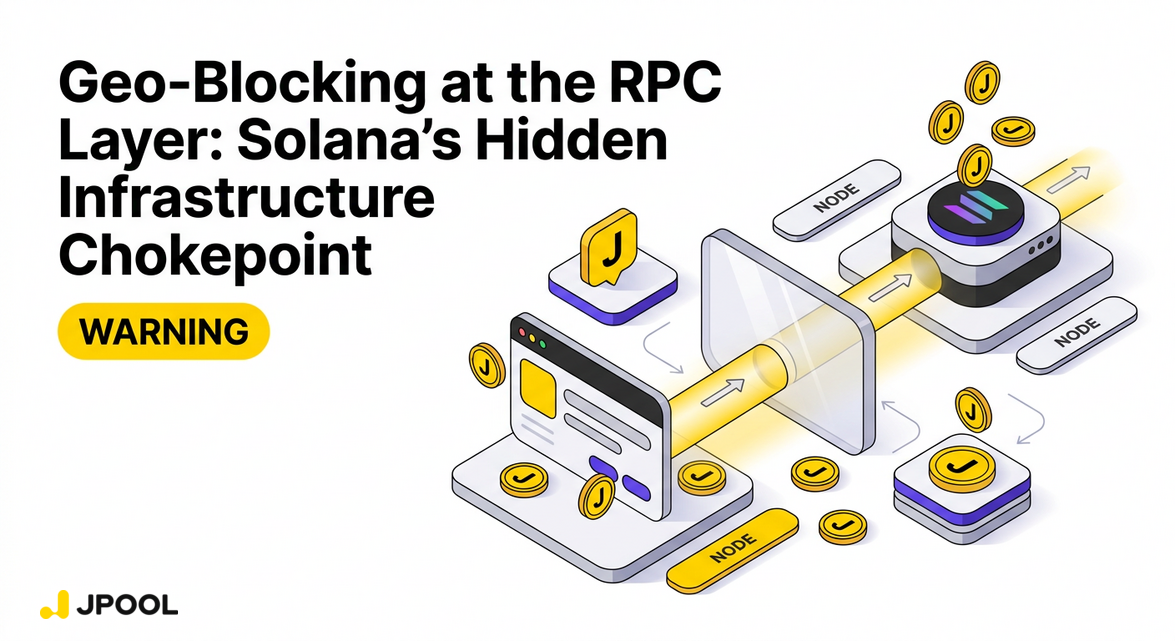
There is a layer that sits between every user and every validator, one that most stakers never think about until it stops working: the Remote Procedure Call (RPC) layer. This is the infrastructure that translates a user’s wallet action — staking, unstaking, swapping — into a transaction that reaches the Solana network. And it is increasingly subject to a risk that the decentralization conversation almost never addresses: geo-blocking.
The RPC Layer: Solana’s Invisible Chokepoint
When you click “Stake” in a Solana wallet or DeFi application, your request does not go directly to the blockchain. It travels through an RPC endpoint — a server that accepts your request, queries the Solana network state, and submits your signed transaction to the network. Without a functioning RPC connection, your wallet cannot read balances, simulate transactions, or broadcast anything to the chain.
This creates a structural dependency that is easy to overlook. The Solana network itself may be fully operational, validators may be processing blocks without interruption, and your JSOL may be accruing rewards — but if your RPC provider has geo-blocked your region, you have no practical path to interact with your assets through a standard interface.
The concentration risk here is real. A small number of RPC providers handle the majority of Solana application traffic. When any one of them implements geo-restrictions — whether in response to regulatory pressure, sanctions compliance obligations, or commercial decisions — the impact is not limited to a single application. It propagates across every wallet, DEX, lending protocol, and staking interface that routes through that provider.
How Geo-Blocking Propagates Through the Staking Stack
Geo-blocking at the RPC layer does not announce itself. From a user’s perspective, the experience is typically one of three things: a transaction that silently fails, a wallet that cannot load balances, or an application that returns a generic error with no explanation.
The propagation path runs as follows:
RPC provider implements geo-restriction → Application frontend cannot reach its configured endpoint → User wallet cannot simulate or submit transactions → Staking, unstaking, and DeFi interactions become inaccessible
What makes this particularly acute for liquid staking is the time-sensitivity of certain operations. A user attempting to manage a leveraged staking position, respond to a liquidation threshold, or execute a delayed unstake within a specific epoch window cannot simply wait for the geo-restriction to be lifted. The window closes regardless of whether the RPC layer is accessible.
The JPool Terms of Service explicitly identifies the access risk: the platform “makes no representations or warranties that access to the Services, our website, platform, or any materials will be continuous, uninterrupted, timely, error-free.” This is not a legal formality — it is an accurate description of a real infrastructure dependency that users in affected regions may encounter.
The Three Failure Scenarios No One Prepares For
Scenario 1: The Compliant Geo-Block
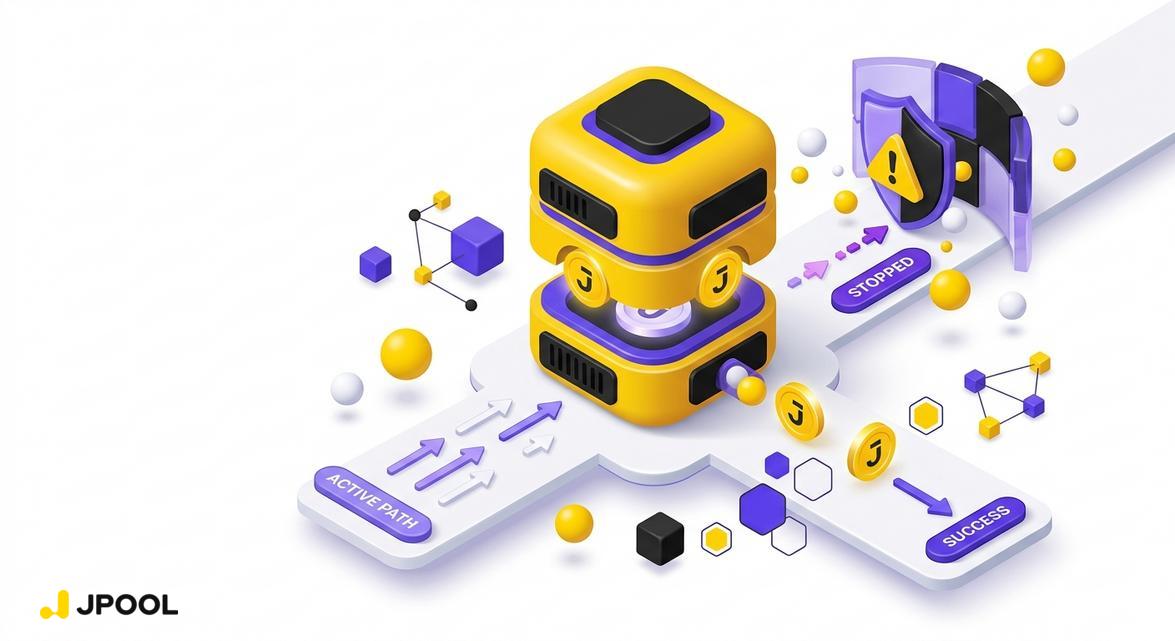
An RPC provider operating under specific regulatory frameworks receives guidance requiring it to restrict access from sanctioned or newly restricted jurisdictions. The provider complies. Users in those regions — including users with no connection to the sanctioned activity — lose access to every application that routes through that provider. Their assets remain on-chain, untouched. Their ability to manage those assets through standard interfaces disappears.
This scenario is not hypothetical. JPool’s own Terms of Service lists specific jurisdictions subject to access restrictions under international sanctions frameworks, including OFAC and EU restrictions. The list is explicitly noted as subject to periodic updates. A user in a jurisdiction that moves onto a sanctions list may find their access path through standard RPC infrastructure severed with little warning.
Scenario 2: The Commercial Geo-Block
RPC providers are commercial entities. They make decisions about which markets to serve based on regulatory cost, revenue potential, and compliance overhead. A provider may exit a market not because of sanctions but because the compliance cost of serving that market exceeds the commercial return. The result for users is identical to a regulatory geo-block: the endpoint becomes unreachable, and the applications depending on it become non-functional.
Scenario 3: The DDoS-Triggered Geo-Restriction
RPC infrastructure is a high-value target. A sustained DDoS attack against a major provider may trigger automated or manual geo-restrictions as a mitigation measure — blocking traffic from regions identified as attack sources. Legitimate users in those regions become collateral damage in an infrastructure defense response. JPool’s own web infrastructure uses Cloudflare for DDoS and WAF protection at the frontend layer, which illustrates that this threat class is real and actively defended against. But frontend-level protection does not extend to third-party RPC providers that applications depend on.
JPool’s Architecture and the Frontend-Independent Access Path
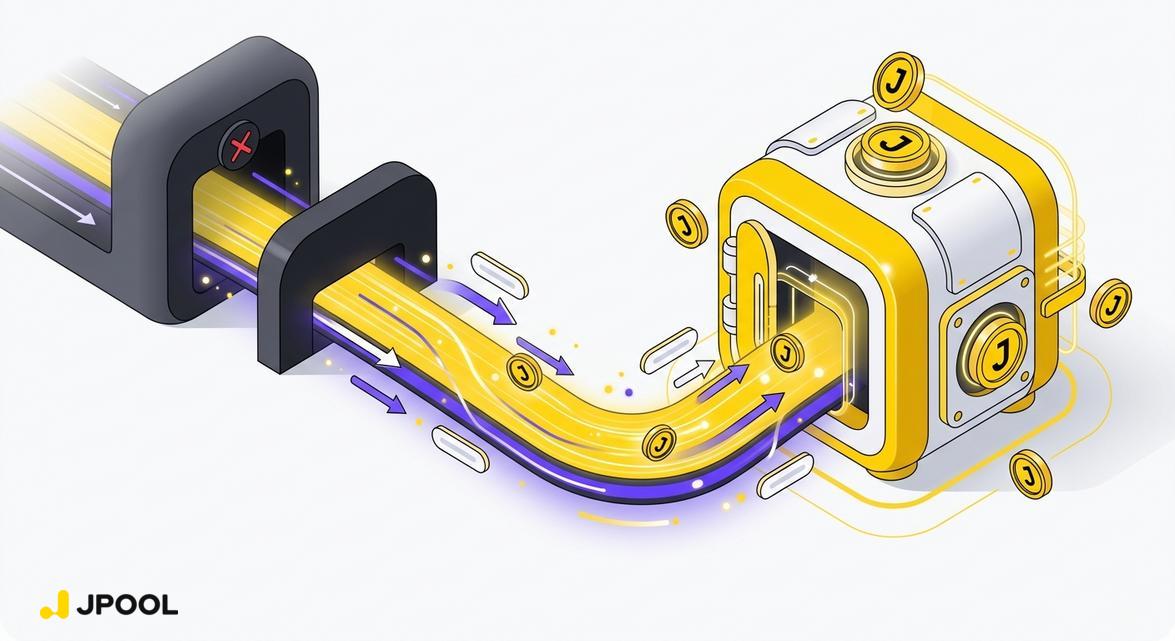
This is where JPool’s non-custodial architecture becomes directly relevant to the geo-blocking problem — not as a marketing point, but as a functional property with operational consequences.
JPool’s security documentation states explicitly: “Frontend-independent. Users can interact with the pool directly via the CLI even if the JPool website is unavailable.”
This is a meaningful architectural distinction. Because JPool runs on the Solana Stake Pool Program — an open-source, immutable on-chain program — the protocol itself cannot be geo-blocked. What can be geo-blocked is the web frontend and the RPC endpoints it uses. But the underlying program remains accessible to anyone who can reach any Solana RPC endpoint, including self-hosted nodes or alternative providers.
The CLI reference provides a direct programmatic interface to the stake pool. A user who cannot access the jpool.one frontend due to geo-restrictions at the application or RPC layer can, in principle, interact with the same on-chain program through a different access path. The staking contract does not know or care which interface submitted the transaction.
This matters for a specific category of user: those managing positions that require time-sensitive action. The ability to fall back to a CLI-based interaction path — or to route through an alternative RPC provider — is not a theoretical escape hatch. It is the operational difference between being able to manage a staking position and being locked out of it during a critical window.
The non-custodial architecture reinforces this. JPool never has access to user funds. All staking, unstaking, and rebalancing operations are executed by the on-chain program with no intermediary. This means there is no operator-level action required to process a user’s transaction — the program executes autonomously when a valid transaction reaches it, regardless of which interface or RPC path was used to submit it.
Building a Geo-Resilient Staking Stack
Understanding the geo-blocking risk is the first step. Acting on it requires a concrete infrastructure posture. The following framework applies to any Solana staker who operates in or may be affected by regions with variable RPC access:
- 1. Audit your RPC dependency. Most wallets and applications use a default RPC endpoint configured by the application developer. Identify which provider your primary interface uses. Understand whether that provider has a history of geo-restrictions or operates under regulatory frameworks that could trigger them.
- 2. Configure a fallback RPC endpoint. Most Solana wallets allow users to configure a custom RPC endpoint. Maintaining a configured fallback — particularly one from a provider with a different regulatory footprint — reduces single-provider dependency. Solana’s public RPC endpoints provide a baseline fallback, though they carry rate limits and reliability constraints under high load.
- 3. Know your CLI access path. For users with meaningful staking positions, familiarity with the JPool CLI reference is not optional infrastructure knowledge — it is a contingency capability. The CLI allows direct interaction with the stake pool program independent of the web frontend. JPool’s documentation provides a full CLI reference for stake pool and bond management operations.
- 4. Understand your position’s time sensitivity. Not all staking positions carry equal urgency. A straightforward liquid staking position that auto-compounds each epoch requires no active management and is largely insensitive to short-term RPC access disruptions. A leveraged staking position with active LTV monitoring — as discussed in depth in JPool’s analysis of hidden DeFi risk assumptions and collateral durability — carries time-sensitive management requirements where RPC access continuity becomes operationally critical.
- 5. Separate infrastructure risk from protocol risk. The Solana network and JPool’s on-chain program are not the source of geo-blocking risk. The risk lives in the access layer: RPC providers, application frontends, and the commercial and regulatory decisions of the entities that operate them. Keeping this distinction clear prevents misattributing an infrastructure access failure to a protocol failure.
The Chokepoint That Decentralization Metrics Don’t Capture
Nakamoto Coefficient calculations, validator stake distribution analyses, and superminority tracking all measure decentralization at the consensus layer. None of them capture the concentration risk that exists at the RPC access layer.
A network can have hundreds of geographically distributed validators processing blocks without interruption while a significant fraction of its user base is simultaneously unable to submit transactions — because the RPC infrastructure those users depend on has implemented geo-restrictions. The consensus layer is decentralized. The access layer is not.
This is the crypto infrastructure chokepoint that the standard decentralization conversation misses. For Solana stakers, the practical implication is straightforward: the resilience of your staking position is not determined solely by the protocol you use. It is determined by the full stack of infrastructure dependencies between you and that protocol — and geo-blocking at the RPC layer is the dependency most likely to fail silently, at the worst possible moment, with the least warning.
JPool’s frontend-independent architecture and CLI access path represent one structural response to this problem. They do not eliminate RPC dependency — no application can — but they provide an alternative access route that operates independently of the web frontend and its configured RPC provider. In a geo-blocking scenario, that alternative route is the difference between having access to your position and not.
Explore JPool’s liquid staking infrastructure and validator delegation program at jpool.one.
Subscribe to our digest pages and stay updated:
Facebook Community · Instagram · Threads · Pinterest
Leave a Reply