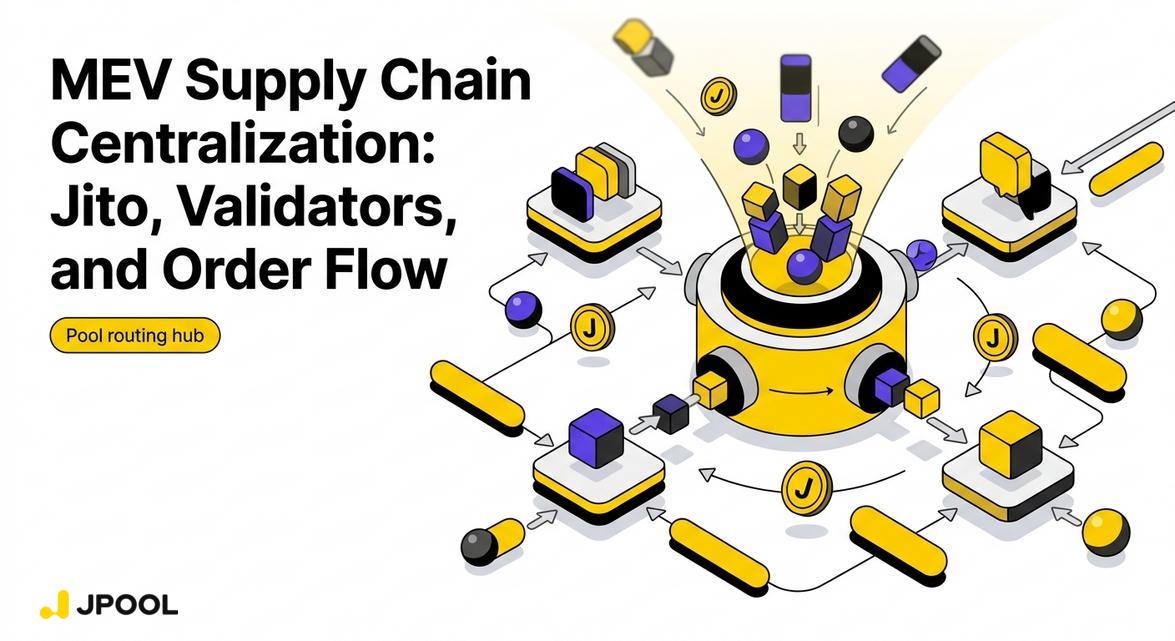
Solana’s MEV landscape is not a free market. It is a supply chain — and like any supply chain, it has chokepoints. Understanding where those chokepoints sit, and how they interact with validator power distribution, is essential context for evaluating liquid staking safety on Solana in 2026.
Table of Contents
- The MEV Supply Chain: A Two-Tier Validator Economy
- Order Flow on Solana: The Routing Layer Nobody Visualizes
- The MEV Commission Gate: How JPool Enforces a Hard Ceiling
- The Cascade: How Slot Architecture Structurally Resists MEV-Driven Concentration
- The 5% Cap: The Hard Ceiling That MEV Cannot Override
The MEV Supply Chain: A Two-Tier Validator Economy
Maximal Extractable Value on Solana does not distribute evenly across the validator set. It concentrates — structurally, not accidentally.
The mechanism is straightforward. Jito’s block engine introduced a separate transaction pipeline: searchers submit bundles of transactions to Jito’s relayer infrastructure, which routes them to validators running the Jito-Solana client. Validators who run this client gain access to a stream of MEV-optimized bundles that validators running the standard client do not see. The result is a bifurcated validator economy: operators with the infrastructure, technical capacity, and connectivity to run Jito-compatible nodes capture a materially larger share of per-epoch revenue than those who cannot or do not.
This is not a criticism of Jito’s design. It is a description of what happens when a high-performance MEV infrastructure layer is introduced into a network where validator economics are already stratified by stake size. Larger validators with more resources adopt MEV infrastructure faster and more completely. Their revenue advantage compounds into higher APY, which attracts more stake, which increases their block production share, which increases their MEV capture. The feedback loop is self-reinforcing.
For Solana’s decentralization, the implication is direct: MEV supply chain participation is not uniformly accessible, and the validators who benefit most from it are already the most staked. Order flow concentration and stake concentration reinforce each other.
Order Flow on Solana: The Routing Layer Nobody Visualizes
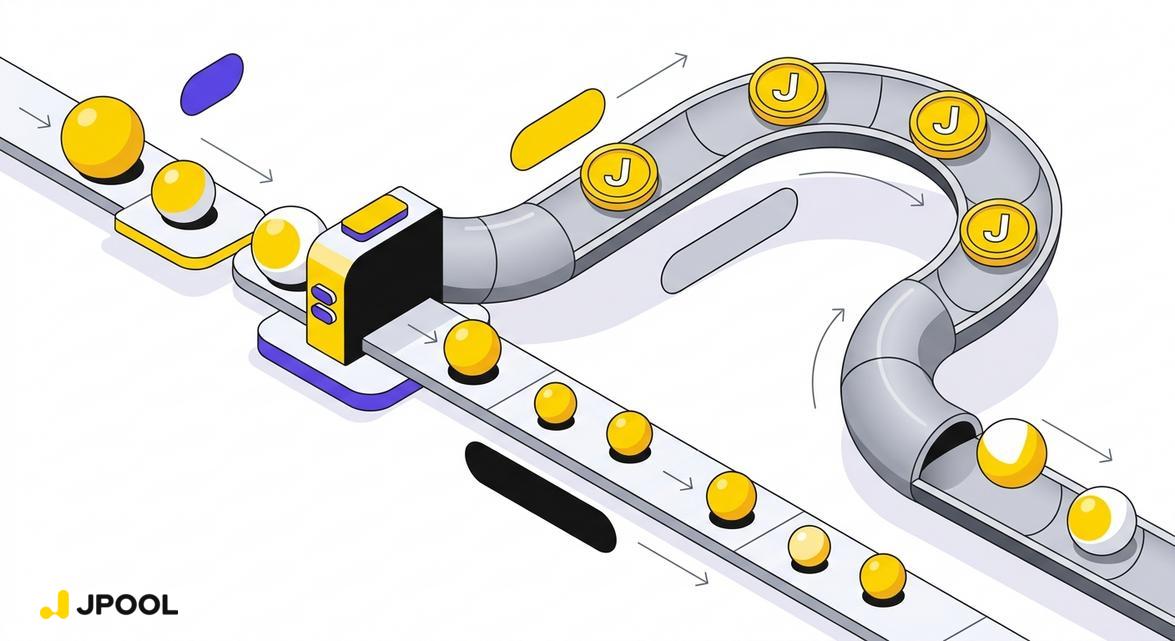
The phrase “order flow on Solana” is often used loosely. Precisely, it refers to the path that a transaction takes from origination — a user’s wallet, a DeFi protocol, a trading bot — to inclusion in a block. On a network without MEV infrastructure, this path is relatively flat: transactions enter the mempool and validators include them roughly in fee-priority order.
Jito’s architecture changes this geometry. High-value transaction bundles — arbitrage sequences, liquidation captures, sandwich constructions — are routed through Jito’s relayer to validators running the Jito client. This means that the most economically valuable order flow on Solana does not reach all validators equally. It reaches the validators who are plugged into the MEV routing infrastructure.
The consequence for network topology is significant. A validator that is not part of the MEV routing layer sees a systematically lower-value transaction stream. Over many epochs, this translates into lower APY relative to MEV-participating validators — not because of any failure in their node operation, but because of their position in the order flow supply chain.
This dynamic creates a structural pressure on the validator set: operators who want to remain competitive on yield are incentivized to adopt MEV infrastructure, which further concentrates the order flow routing layer around a smaller set of technically sophisticated, well-resourced operators.
The MEV Commission Gate: How JPool Enforces a Hard Ceiling
One of the least-discussed aspects of how liquid staking protocols interact with MEV centralization is the commission enforcement layer. JPool’s delegation program requires that every validator in the program maintain a commission of 10% or less on both inflation rewards and MEV rewards. Exceeding this threshold on either dimension triggers instant removal from the program.
This matters in the MEV context for a specific reason. As MEV revenue has grown as a share of total validator income, the commission rate on MEV rewards has become an increasingly material variable for delegator yield. A validator that charges a standard 5% inflation commission but takes a 20% MEV commission is effectively extracting a much larger share of total staking economics than the headline commission rate suggests.
JPool’s unified commission cap — applied explicitly to MEV rewards, not just inflation — closes this extraction vector. Validators in the JPool delegation program cannot use MEV commission as a hidden margin lever. The 10% ceiling applies to the full revenue stack.
This enforcement is not passive. JPool’s documentation specifies that commission exceeding 10% triggers instant removal from the delegation program — not a warning, not a grace period. The same instant removal applies to validators who:
- Enter the superminority.
- Are added to any blacklist (including the Jito Foundation’s).
- Have non-JPool stake exceeding 750,000 SOL.
The blacklist dimension is particularly relevant to MEV centralization: the Jito Foundation maintains its own blacklist of validators engaged in harmful MEV practices. JPool’s delegation criteria treat inclusion on this list as an automatic disqualification. The MEV supply chain’s own governance layer is thus directly integrated into JPool’s validator eligibility framework.
The Cascade: How Slot Architecture Structurally Resists MEV-Driven Concentration
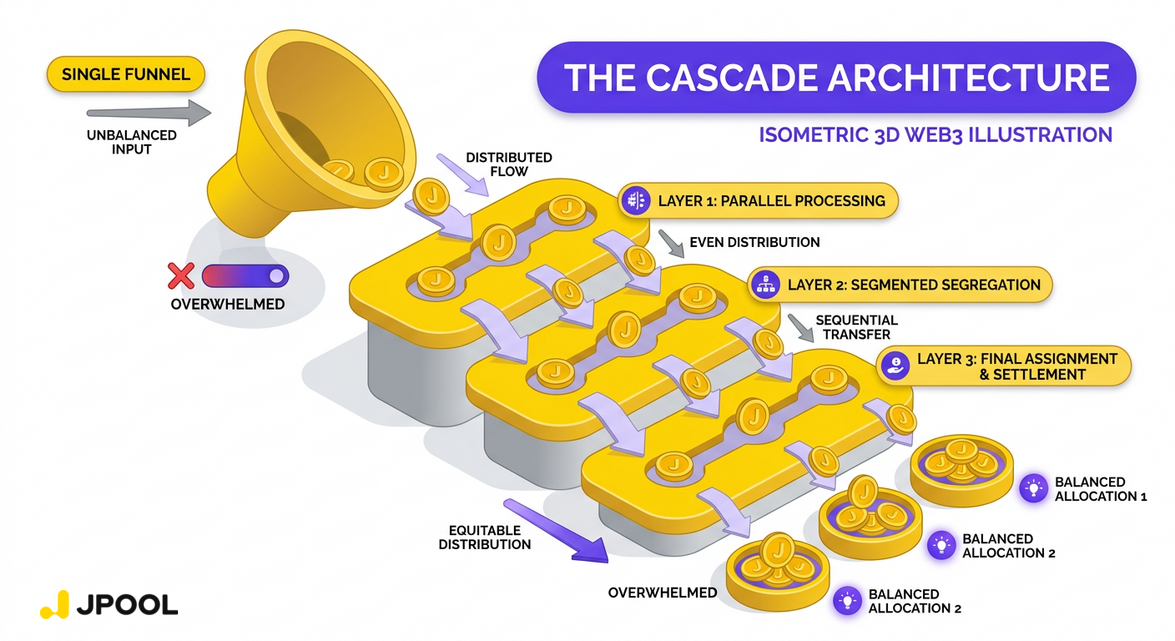
The deeper structural response to MEV centralization in JPool’s design is not the commission cap — it is the slot allocation architecture itself.
JPool’s delegation program allocates validator slots through a cascading priority system with three tiers: Community Good validators (ecosystem builders), Direct Stake validators (operators who attract external delegators), and Performance validators (top APY operators). The allocation logic is explicitly designed to prevent any single performance dimension — including MEV-driven APY — from dominating the entire validator set.
Consider what would happen without this architecture. A pure APY-maximizing delegation strategy would systematically funnel stake toward validators with the highest MEV capture — precisely the large, well-resourced operators already at the top of the MEV supply chain. The result would be a liquid staking pool that amplifies MEV-driven stake concentration rather than counteracting it.
JPool’s Cascade prevents this outcome through structural design by prioritizing three tiers:
- Community Good validators: Operators building open-source tools, DeFi infrastructure, and community resources receive priority allocation regardless of their MEV participation level.
- Direct Stake validators: These receive matching proportional to the external stake they attract, not to their MEV yield.
- Performance validators: These compete on a 30-epoch average APY metric that smooths out short-term MEV windfalls and rewards consistent, sustained operation.
The result is a delegation framework where MEV-driven APY spikes do not automatically translate into larger pool allocations. A validator that captures an outsized MEV event in a single epoch does not leapfrog Community Good or Direct Stake validators in the priority queue. The Cascade’s architecture absorbs MEV volatility rather than amplifying it into stake concentration.
JPool also scales its validator set linearly with TVL: one validator slot per 10,000 SOL. This means that as the pool grows, it distributes stake across a proportionally larger validator set rather than concentrating growth among existing participants. The decentralization benefit scales with adoption.
The 5% Cap: The Hard Ceiling That MEV Cannot Override
Even within the Performance tier — where APY is the primary ranking criterion — JPool enforces a hard constraint that MEV concentration cannot override: no single validator receives more than 5% of pool stake as pool delegation.
This cap operates independently of how strong a validator’s MEV capture is. A validator that consistently ranks first in APY across every epoch cannot receive more than 5% of the pool’s total delegation. When a validator exceeds this cap, non-matching excess is redistributed to below-cap validators proportionally to their direct stake. DS Matching excess is held as an unallocated reserve to preserve proportionality.
The practical effect is that JPool’s pool delegation cannot become a vehicle for MEV-driven stake concentration even if the broader Solana validator market moves in that direction. The 5% ceiling is a structural constraint, not a policy preference that can be overridden by market dynamics.
This is the layer of liquid staking infrastructure that the MEV centralization discussion on Solana rarely reaches. The conversation typically focuses on whether MEV is good or bad for stakers, or on the yield uplift that MEV-participating validators provide. What it does not typically address is how the delegation architecture of a liquid staking pool either amplifies or counteracts the stake concentration dynamics that MEV infrastructure creates.
As the Solana DeFi stack continues to converge, the structural properties of liquid staking delegation — how slots are allocated, how caps are enforced, how commission is monitored — become DeFi risk parameters, not just yield parameters. A liquid staking pool that delegates primarily to MEV-dominant validators is not simply optimizing yield. It is concentrating voting power and block production capacity in a way that has downstream implications for every protocol built on the network.
JPool’s delegation architecture represents a systematic approach to ensuring that liquid staking stake does not become a passive accelerant for MEV-driven centralization on Solana. Key components include:
- The Cascade allocation architecture
- The 5% maximum stake cap
- The MEV commission gate
- Jito blacklist integration
- A TVL-scaled validator set
Explore JPool’s liquid staking infrastructure and validator delegation program at jpool.one.
Subscribe to our digest pages and stay updated:
Facebook Community · Instagram · Threads · Pinterest
Leave a Reply