Liquid staking tokens are now load-bearing infrastructure inside Solana DeFi. They sit inside lending markets as collateral, inside liquidity pools as paired assets, and inside leveraged positions as the yield-generating engine. That composability is the feature. But it is also the risk nobody has mapped clearly: when the same asset class simultaneously serves as collateral across multiple protocols, a stress event at any layer does not stay contained. It travels.
Table of Contents
This article traces the failure pathways — not to discourage participation, but because understanding where contagion enters the system is the only way to evaluate whether the structural firewalls are actually adequate.
The Anatomy of a Collateral Dependency Chain
When a user deposits SOL into a liquid staking pool and receives a liquid staking token (LST) in return, they receive an asset that accrues staking yield while remaining transferable. That transferability is what enables composability — and composability is what creates dependency chains.
A dependency chain forms when the same LST is simultaneously:
- Pledged as collateral on a lending platform to borrow SOL.
- Deployed in a liquidity pool where it is paired with another asset.
- Held by a protocol treasury that uses it as a yield-bearing reserve.
Each of these positions is individually rational. Collectively, they create a network of claims on the same underlying asset — claims that all become active simultaneously under stress.
The critical insight is that collateral dependency is not linear — it is multiplicative. A single LST token can support multiple positions across multiple protocols. When the value or liquidity of that token comes under pressure, every position it underlies faces stress at the same time. This is the structural definition of Solana DeFi systemic risk: not the failure of one protocol, but the simultaneous activation of correlated claims across a shared collateral base.
Where the Failure Sequence Actually Starts
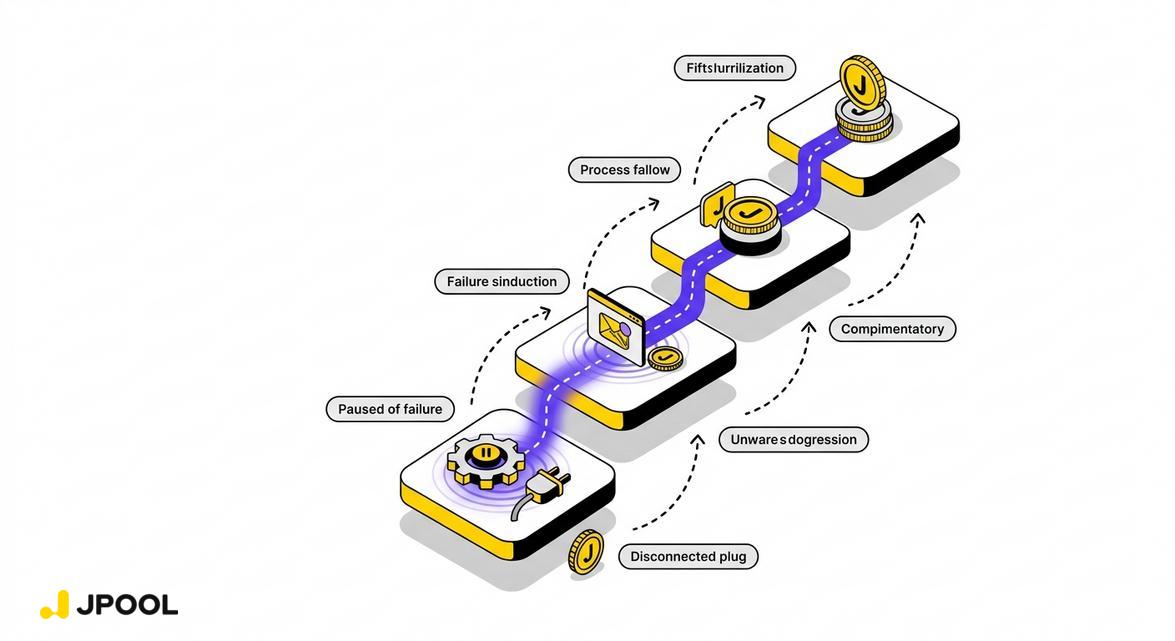
Systemic risk in a liquid staking ecosystem does not originate at the DeFi layer. It originates at the validator layer — and propagates upward.
- Layer 1 — Validator underperformance or exit. A validator in the stake pool begins missing blocks, experiences extended downtime, or exits abruptly. This affects the yield accruing to the pool — not the principal stake.
- Layer 2 — Exchange rate pressure. If underperformance is severe or widespread across multiple validators, the LST’s exchange rate appreciation decelerates. For users holding the LST as collateral on a lending platform, the collateral value grows more slowly than the debt accruing against it. The Health Factor begins to compress.
- Layer 3 — Liquidation pressure activates. As JPool’s documentation states, liquidation becomes a threat specifically when borrow interest remains higher than staking rewards for an extended period — in that scenario, debt grows faster than JSOL collateral compounds, LTV rises, and the Health Factor falls toward the liquidation threshold. If multiple users reach this threshold simultaneously, the lending platform begins liquidating LST collateral positions.
- Layer 4 — Liquidity pool imbalance. Liquidated LST positions are sold into the market. If significant volume hits liquidity pools simultaneously, the LST/SOL ratio in those pools shifts, creating price impact. This can trigger further collateral value deterioration for positions that have not yet been liquidated — a feedback loop.
- Layer 5 — Redemption queue pressure. Users who want to exit entirely attempt to redeem their LST for SOL. Instant redemption availability depends on pool liquidity. A simultaneous redemption surge can exhaust the instant-redemption reserve, forcing users into delayed unstaking — precisely when they most want immediate access.
This five-layer sequence is the anatomy of liquid staking systemic risk on Solana. Each layer is individually manageable. The risk is in the simultaneity.
The Third-Party Protocol Layer: A Risk Nobody Prices In
There is a risk category that sits orthogonally to the validator-to-DeFi contagion chain — and it receives almost no attention in most liquid staking discussions.
JPool’s documentation is explicit: beyond liquidation risk, there are a number of other risks associated with using a third-party lending platform, and users are directed to each lending platform’s own risk documentation for the complete picture.
This matters because JSOL operates under Solana Labs’ audited Stake Pool Program — a program that has undergone multiple security audits and under which JPool has no direct access to user funds. But the moment JSOL is deposited as collateral into a third-party lending protocol, it enters a different smart contract environment with its own risk surface: smart contract vulnerabilities, oracle price feed dependencies, governance parameter changes, and utilization-driven borrow rate spikes.
The practical implication: a user’s JSOL position can be technically sound at the staking layer while simultaneously being exposed to third-party protocol risk at the DeFi layer. These are not the same risk. They require separate evaluation. JPool’s architecture isolates the staking layer — but it cannot extend that isolation into external protocols.
JPool’s own risk documentation also acknowledges the broader technology risk dimension: there is a risk that developers or other third parties may introduce weaknesses or errors into the underlying code or technology of a token, which may be exploited in various types of attacks. This applies to any protocol in the composability stack — not just the staking layer.
Structural Firewalls: What Actually Interrupts Contagion

Understanding the failure sequence is only useful if there are identifiable points where contagion can be interrupted. Several structural features in JPool’s architecture function as firewalls — not guarantees, but friction that slows or contains propagation.
- The validator bond system. JPool requires validators in its delegation program to post a bond at a rate of 0.5 SOL per 1,000 SOL of total JPool stake. This bond serves a dual purpose: it protects delegators against validator misbehavior or extended downtime, and it covers any shortfall between a validator’s actual yield and JPool’s Target APY — a benchmark recalculated every epoch based on the mean APY of the top 30 qualifying validators on the network. The documented guarantee is direct: delegators always earn the target APY; the bond covers any shortfall. This mechanism interrupts the validator-to-exchange-rate propagation pathway at Layer 1 — yield shortfalls are absorbed by the bond before they reach the LST’s exchange rate.
- The pool reserve floor. JPool maintains a minimum reserve of 0.5% of TVL (at least 5,000 SOL) to ensure instant withdrawals are always possible, with a 1% target (at least 10,000 SOL). This reserve is the structural answer to Layer 5 redemption pressure — it provides a liquidity buffer that absorbs a baseline level of simultaneous redemption demand without forcing users into delayed unstaking.
- The non-custodial architecture. Because JPool operates via Solana Labs’ audited Stake Pool Program, the protocol has no direct access to user funds. A failure at the DeFi layer — a lending protocol exploit, for example — cannot reach back through the staking layer to affect the underlying stake accounts. The contagion boundary is architecturally enforced.
- The DeFi-lock visibility signal. JPool’s interface surfaces a specific indicator: the “unstakable amount” — how many JSOL can currently be exchanged back for SOL. If this amount is lower than the user’s total stake, it means part of their JSOL tokens are locked in DeFi protocols. This signal exists precisely because DeFi-locked JSOL cannot be redeemed until the external position is closed. Surfacing this information proactively is a contagion management tool — it prevents users from discovering their liquidity constraint only at the moment they most need liquidity.
The Concentration Risk That Amplifies Everything
There is one systemic risk factor that operates above the protocol level and amplifies every other risk in the chain: stake concentration at the validator layer.
JPool’s own risk documentation acknowledges this directly: the risk of a successful attack is elevated in digital assets based on DLT architecture with a high degree of concentration of unit ownership or network functions with a small number of parties. Applied to Solana’s liquid staking ecosystem, this means that if LST stake becomes concentrated among a small number of validators — and those validators experience correlated failures — the exchange rate impact propagates across the entire LST ecosystem simultaneously.
This is why JPool enforces a strict 750,000 SOL stake cap per validator: not as a performance optimization, but as a systemic risk containment measure. Distributing stake across a broad, diverse validator set reduces the correlation of failure events. A single validator’s downtime affects a small fraction of the pool’s total stake rather than a dominant share. The contagion radius shrinks in proportion to the distribution breadth.
The connection between decentralization policy and systemic risk management is not incidental. It is the core architectural logic.
The question “what happens when everything becomes collateral?” has a precise answer in the context of Solana DeFi: correlated claims activate simultaneously, liquidity constraints surface at the worst possible moment, and the failure sequence propagates from the validator layer upward through every protocol that holds the LST. The structural firewalls — bond coverage, reserve floors, non-custodial architecture, and stake distribution limits — are the mechanisms that determine how far that propagation travels.
For a deeper look at how capital-efficient DeFi loops with liquid staked SOL are constructed — and the position mechanics that determine how close to the edge a leveraged position sits — see Designing Capital-Efficient DeFi Loops with Liquid Staked SOL.
Start building on secure liquid staking infrastructure at jpool.one.
Subscribe to our digest pages and stay updated:
Leave a Reply